
Dollar-cost averaging means investing equal amounts at regular intervals. It buys more units when prices are low and fewer when prices are high. That can make a plan easier to follow, but a lower average purchase price does not guarantee a profit.
This distinction matters particularly when markets fall. “I bought more cheaply” describes your purchases. “My investment is profitable” describes the relationship between the current value and the money you invested. These are different statements.
A falling-market example
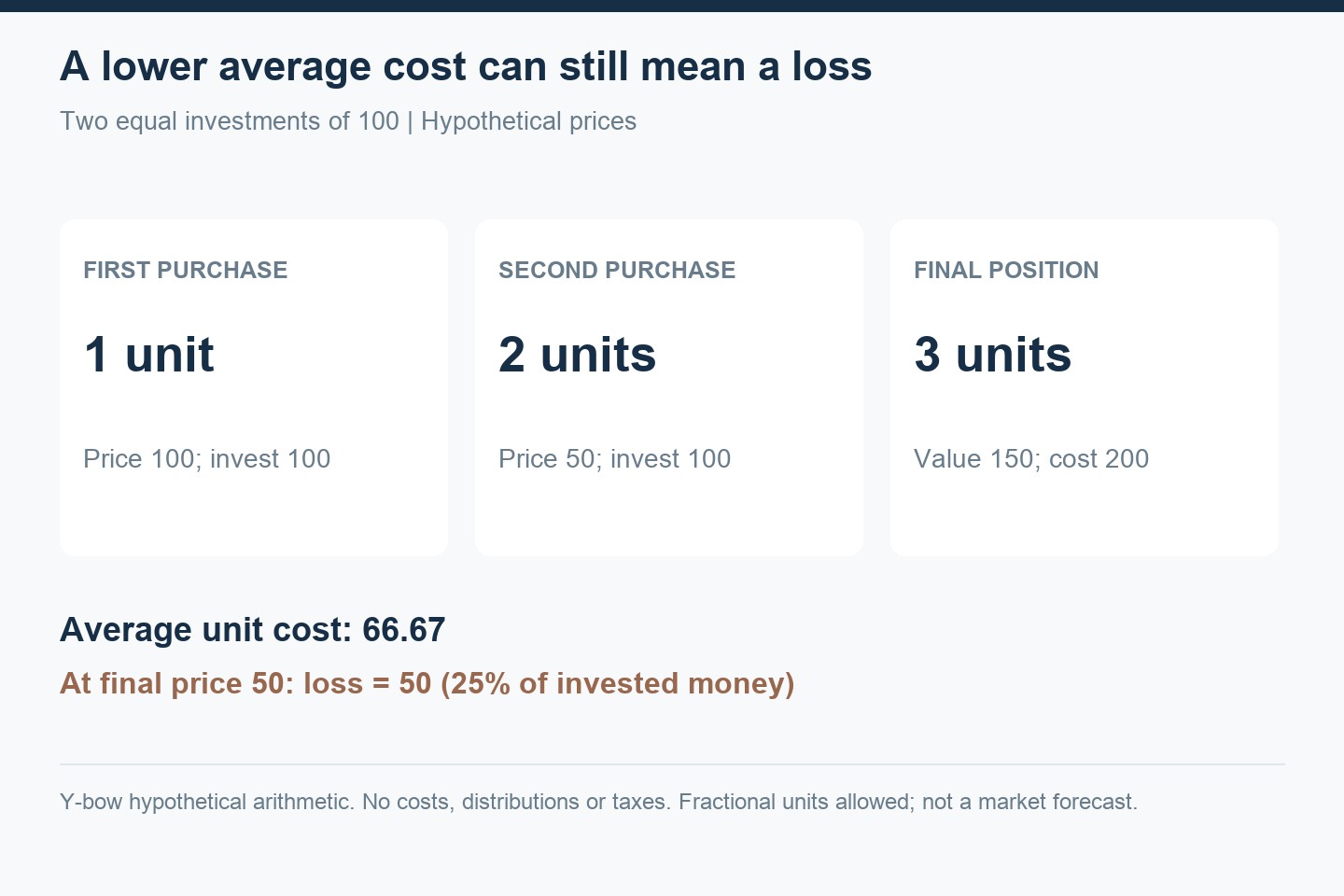
Imagine a fund whose unit price is 100 at the first purchase and 50 at the second. Invest 100 each time. The first purchase buys one unit; the second buys two. You own three units for a total cost of 200, so your average cost is 66.67 per unit.
At a market price of 50, those three units are worth 150. You have a 50 loss, or 25% of the money invested. Buying twice as many units at the lower price improved your average cost, but did not prevent a loss.
What makes the average cost look attractive?
The simple average of the two market prices is 75. Your average purchase cost is lower, at 66.67, because more units were bought at 50. Equal-money investing produces a unit-weighted cost, not the simple average of quoted prices.
This explains a mathematical benefit of the method without proving an investment benefit. A security can keep falling, fail, or recover too slowly to meet your needs. The method changes how you enter a position; it does not improve the underlying asset’s economics.
Salary investing and staging existing cash are different decisions
If you invest part of each paycheck as it arrives, you cannot invest future pay today. A regular contribution plan matches your cash flow. Comparing it with a lump sum that you never possessed is not a meaningful choice.
If you already have all the money, staging purchases holds part of it outside the investment temporarily. That can reduce the effect of an immediate fall but creates an opportunity cost if the market rises. FINRA’s explanation distinguishes these considerations; Investor.gov defines the regular-investment method.
The same plan can help or hurt in different paths
Assume 200 is available at the start. If the price goes from 100 to 50, investing all 200 immediately ends with a value of 100. The two 100 purchases end at 150. Staging helped in this particular path.
If the price goes from 100 to 150 instead, the immediate purchase ends at 300. The staged purchases buy one unit and two-thirds of a unit, worth 250 at the end. Staging lagged. Both examples ignore any interest earned by waiting cash and the time between purchases; neither estimates the probability of either outcome.
Choose a rule you can sustain
For many investors, the behavioral value is consistency. A written schedule can reduce repeated attempts to guess the perfect entry point. Nevertheless, regularly buying an unsuitable investment is still an unsuitable plan. Emergency reserves, diversification, investment horizon and costs should be decided first.
Our interpretation is that dollar-cost averaging is a cash-flow and behavior tool. Its value is clearer when described that way than when marketed as protection against any bear market. It also does not neutralize the daily-reset risks of leveraged ETFs such as TQQQ.
To compare performance properly, read our CAGR guide: the annualized return of a single starting investment is not the same calculation as the return on a series of contributions.
Educational examples only; no personalized investment advice. Source checks and calculations: October 11, 2026. Japanese counterpart.
Comments