

Growth and value are useful descriptions, but neither is a permanent winner. A fast-growing business can disappoint its shareholders if the purchase price assumes even faster growth. A statistically cheap stock can remain cheap because its business prospects are weak.
The practical task is to separate business performance from the price paid for that performance. You do not have to become a stock picker to understand this distinction; it also matters when assessing a style fund or a concentrated technology index.
What the terms describe
The SEC’s stock overview describes growth stocks in terms of faster earnings growth and value stocks in terms of lower valuation ratios. These categories can overlap. Different index providers use different variables and weighting rules, so two products carrying the same style label can hold different portfolios.
A low price-to-earnings ratio is not proof of undervaluation. Earnings may be temporarily high, debt may be substantial, or future profits may decline. A high ratio is not proof that a company is bad; it makes the assumed future more consequential.
The earnings–multiple relationship
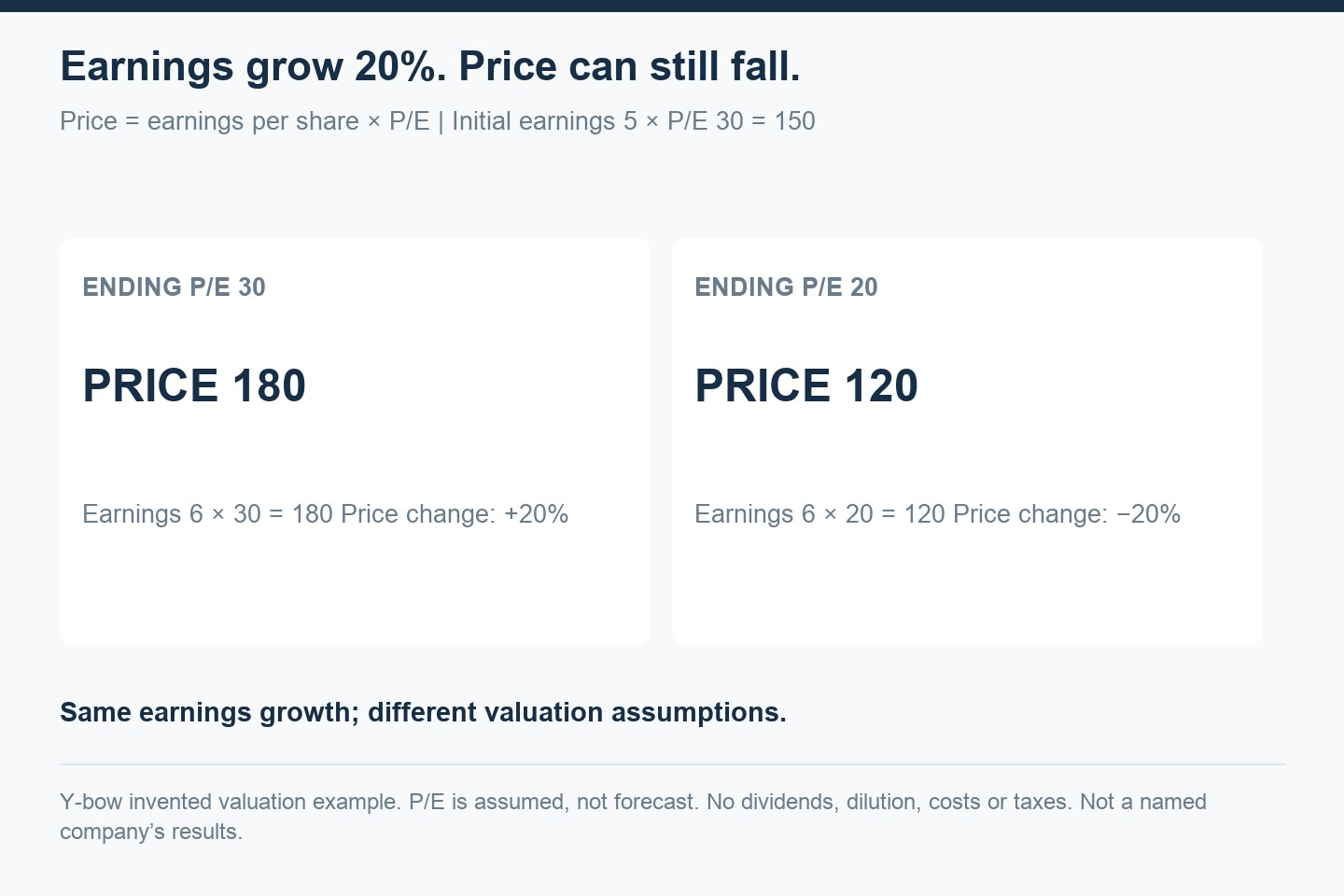
Ignoring distributions and other changes, price equals earnings per share multiplied by the P/E ratio. Suppose earnings begin at 5 and P/E is 30, so price is 150. Earnings grow 20% to 6, but P/E falls to 20. The new price is 120: a 20% price loss despite earnings growth.
If the P/E stays at 30, the price instead reaches 180, a 20% gain. With identical earnings growth, the change in the valuation multiple makes a large difference. These are invented inputs, not a company forecast.
The identity clarifies a risk that a growth narrative can hide. Investors purchase a claim at today’s price, not just a share of tomorrow’s impressive revenue headline. Dilution, financing costs and the conversion of sales into profits complicate the real calculation further.
A cheaper stock can still be risky
Suppose earnings of 5 at P/E 10 imply a price of 50. If earnings fall to 3 and the ratio remains 10, price falls to 30. The original low ratio did not prevent a 40% price decline. This is the basic danger behind a value trap.
Conversely, a company with durable earnings and modest expectations can generate a good investment outcome without spectacular growth. The label alone cannot decide which case you are buying.
Interest rates and concentration
Valuations depend partly on how future cash flows are discounted and what alternatives investors can buy. A change in interest rates can affect that process, but its impact is not identical across all companies. Debt, profitability and the timing of expected cash flows matter.
A growth fund may concentrate exposure to a few sectors or large companies. A value fund can have its own sector and economic sensitivities. Check holdings and overlap rather than assuming two style labels automatically create a balanced portfolio.
Avoid a permanent-winner conclusion
Choosing a style because it recently won is a form of historical extrapolation. Assess the benchmark, period, costs and risks behind a performance chart. A broad fund may include both styles, while combining specialized funds requires understanding what weights the combination produces.
See our ETF overlap guide and the semiconductor supercycle analysis for related distinctions between a compelling business story and an investment outcome. This article explains valuation arithmetic, not a recommendation for a particular style.
Adapted for the English edition; sources checked October 11, 2026. Original calculations and diagrams by Y-bow. Japanese counterpart.







Comments