
The Kardashev scale classifies hypothetical civilizations by the scale of energy they can use. It is an imaginative scientific framework, not a catalogue of civilizations astronomers have actually detected. The distinction prevents an appealing idea from becoming a claim without evidence.
We can use the framework to ask what technology might leave observable traces. We cannot use it alone to conclude that aliens exist, that a particular star hosts a megastructure, or that humanity will reach a new level on a fixed date.
Where the idea came from
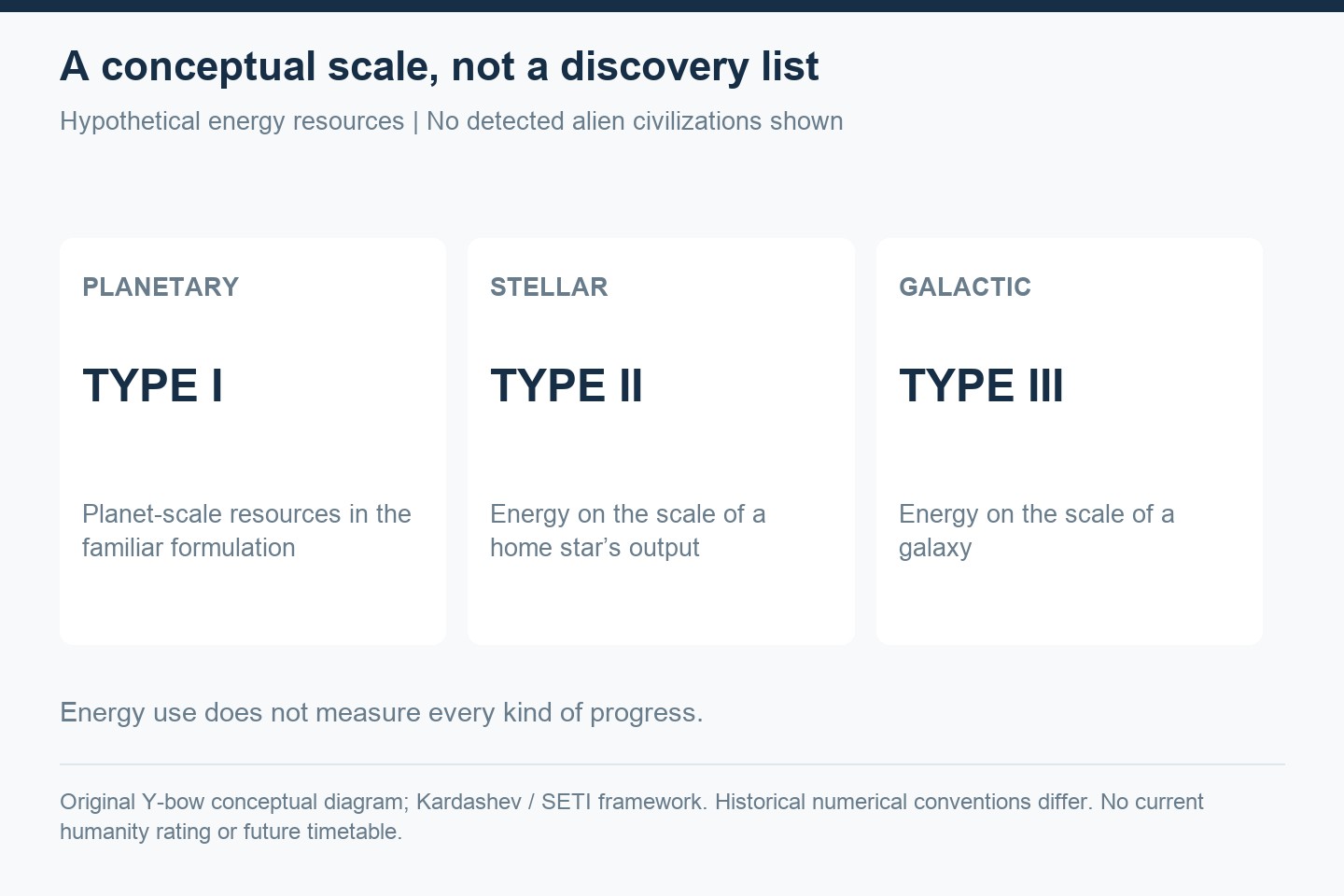
Nikolai Kardashev’s 1964 paper considered communication by extraterrestrial civilizations. The SETI Institute’s account describes the familiar progression from planetary-scale resources to a star’s output and then a galaxy’s energy.
Later popular formulations and extensions differ from the original numerical conventions. If an article gives humanity a decimal rating, ask which definition and power estimate it uses. That rating is not an astronomical measurement of our intelligence or moral development.
Think in scales, not trophies
Planetary, stellar and galactic energy are enormously different orders of magnitude. Our original diagram presents the conceptual steps without assigning a current numerical score to humanity or inventing a deadline for advancement.
Power is a rate of energy use. It is measured in watts; energy accumulated over time is measured in joules or related units. Confusing power with total energy can make a civilization comparison meaningless even before its assumptions are considered.
What might be observable?
NASA’s technosignature overview discusses possible traces such as narrow-band signals, lasers, artificial atmospheric chemicals and large energy-collecting structures. These are search ideas. A candidate signal must be checked against natural processes, instrumental effects and human interference.
A large structure collecting starlight might also reradiate energy as waste heat. That motivates observations, but excess infrared radiation has natural explanations too. A suggestive measurement is the start of a test, not the end of an argument.
Bigger energy use is not every kind of progress
A society could improve efficiency and reduce waste while using less power for the same task. It could also consume enormous energy without achieving wellbeing or sustainability. The scale captures one dimension of a hypothetical civilization, not a complete measure of its quality.
Information processing, communication, engineering reach and the ability to survive are different dimensions. Treating one energy ranking as a universal ladder imports values the physics does not establish.
No detection, no precise schedule
NASA’s UAP FAQ states that it has not found credible evidence of extraterrestrial life. Unexplained observations do not automatically become alien technology. A lack of confirmed detection also does not establish that technological life is impossible elsewhere.
Forecasts of when humanity might become a particular type depend on assumed growth, future technology and constraints. Extrapolating an exponential curve for centuries is a scenario, not a reliable timetable.
The useful question
Instead of asking which imagined civilization is “above” us, ask what observation could distinguish an artificial process from a natural one. That turns a speculative ranking into a testable research question.
For related limits of inference, read why a habitable-zone orbit is not proof of a second Earth and what we know about the invisible universe. Scientific curiosity works best when its possibilities remain separate from its evidence.
Adapted for the English edition; sources checked October 11, 2026. Original calculations and diagrams by Y-bow. Japanese counterpart.







Comments