
Owning three ETFs does not necessarily give you three independent sources of diversification. A global stock fund, a US total-market fund and an S&P 500 fund can hold many of the same companies. The useful question is what your combined portfolio owns.
VT, VTI and VOO are popular US-listed examples. They make the overlap issue easy to see, but the same reasoning applies to equivalent funds elsewhere. Product availability and tax treatment are local matters; the portfolio mathematics travels across borders.
Three funds, three different mandates
Vanguard Total World Stock ETF (VT) tracks a global all-cap index. Vanguard Total Stock Market ETF (VTI) targets the US equity market. Vanguard S&P 500 ETF (VOO) targets the S&P 500. Global, national and large-company exposure are different investment mandates, even when they share substantial holdings.
The VT fact sheet dated June 30, 2026 reports 61.9% allocated to the United States. The VTI fact sheet describes its US market exposure. The 61.9% figure is a dated snapshot, not a permanent property of global investing.
Adding a US fund is an active geographical tilt
Suppose a portfolio holds 50% VT and 50% VTI. Using VT’s stated US allocation and simplifying VTI to 100% US exposure, the portfolio’s US weight is 0.5 × 61.9% + 0.5 × 100% = 80.95%. You have changed the geographical allocation from 61.9% to about 81%.
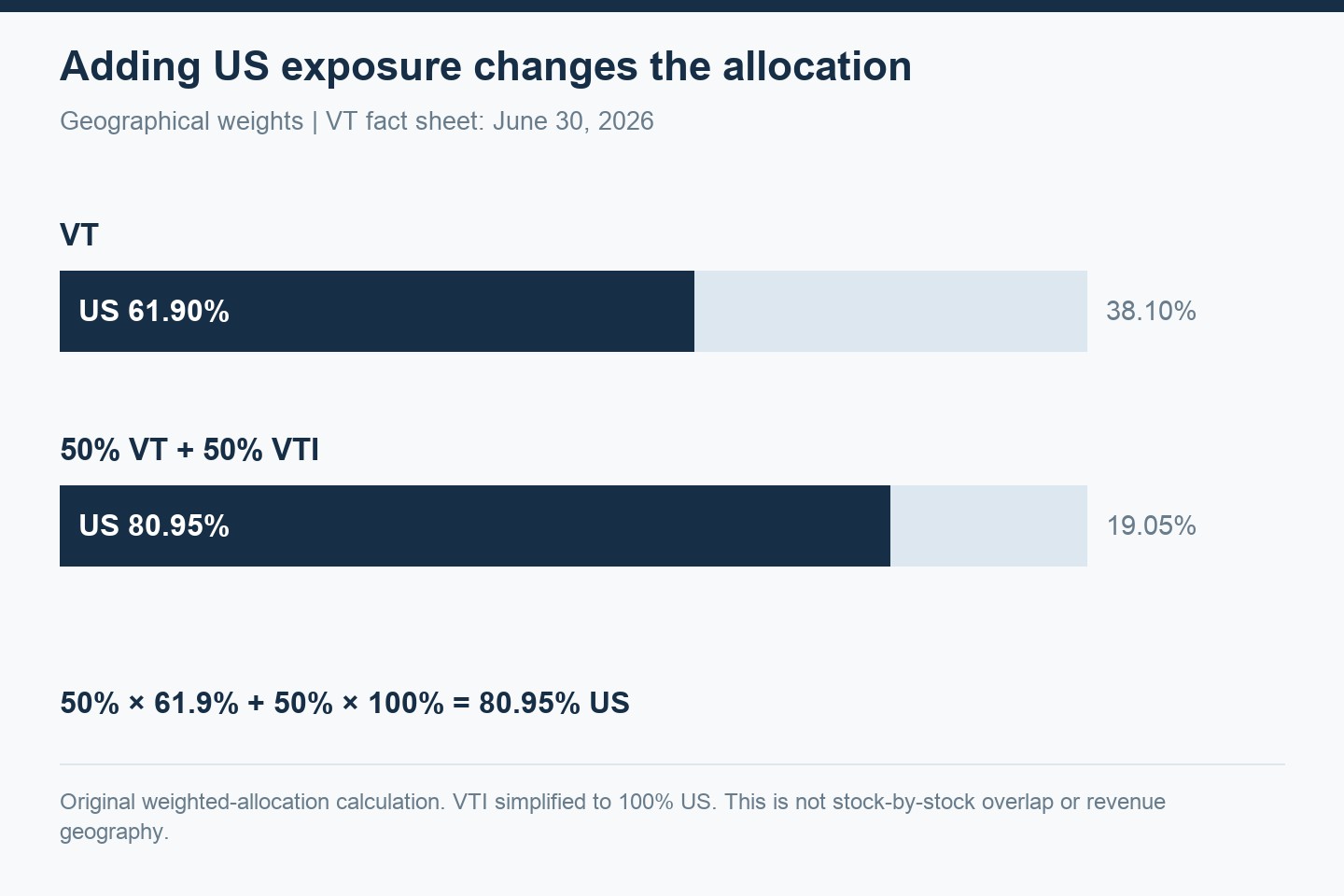
This is not inherently a mistake. A deliberate US tilt may fit an investor’s objective. The mistake is believing that adding VTI automatically spreads risk into companies or countries that VT does not already own. The tilt should be chosen explicitly, then evaluated as a tilt.
Geographical exposure is not holdings overlap
The chart above answers a country-allocation question. It does not calculate the exact shared stock holdings of two funds. For that, use holdings from the same date, reconcile securities and share classes, and compare portfolio weights.
A simple weighted overlap measure is the sum of the smaller weight for each shared security. If fund A holds Company X at 8% and fund B holds it at 12%, that company contributes 8 percentage points to this measure. Counting shared names treats a tiny position and a dominant position as equal, which can disguise concentration.
Even weighted overlap is only one lens. Funds holding different companies can remain exposed to the same economic driver, interest-rate sensitivity or technology spending cycle. Conversely, a multinational company’s listing country says little about where all its sales are earned.
More tickers can make a portfolio harder to understand
Consider adding VOO on top of VT and VTI. Large US companies already represented in the other funds receive additional weight. This may increase large-cap concentration while making the account appear more diversified because it contains another ticker.
Our preferred sequence is to choose an intended allocation first: global market exposure, a specified US tilt, or another explicit structure. Then choose the fewest suitable funds that implement it. Fees, fund domicile, currency, replication method and local taxation still matter, but they should not obscure the combined exposure.
A practical review
Write down your weights, calculate the combined country allocation, identify the largest combined company positions, and check whether the result matches your intention. Repeat with current holdings rather than assuming the old percentages remain valid. Rebalancing changes weights; it does not guarantee a better return.
A portfolio can be simple and concentrated, or complex and concentrated. Simplicity is useful because it makes the concentration easier to see. Compare this with TQQQ’s concentrated leveraged exposure and our discussion of market valuation indicators.
Educational analysis, not a recommendation of these ETFs. Sources checked October 11, 2026. Japanese counterpart.


Comments
List of comments (1)
[…] See our ETF overlap guide and the semiconductor supercycle analysis for related distinctions between a compelling business story and an investment outcome. This article explains valuation arithmetic, not a recommendation for a particular style. […]