
An investor who became wealthy has an interesting story. That story is not a complete dataset. People who lost money, closed accounts or stopped posting may be less visible. If you learn only from the remaining winners, the picture can become systematically optimistic.
Survivorship bias also affects formal investment research. Funds can close or merge. Companies can disappear from an index. A historical comparison built only from the names that remain today may answer a different question from the one you intended.
A sample that changes its own answer
Imagine four equally weighted funds with one-year returns of +20%, +10%, −20% and −40%. Their simple average return is −7.5%. If the two losing funds disappear and your database reports only the survivors, the average becomes +15%.
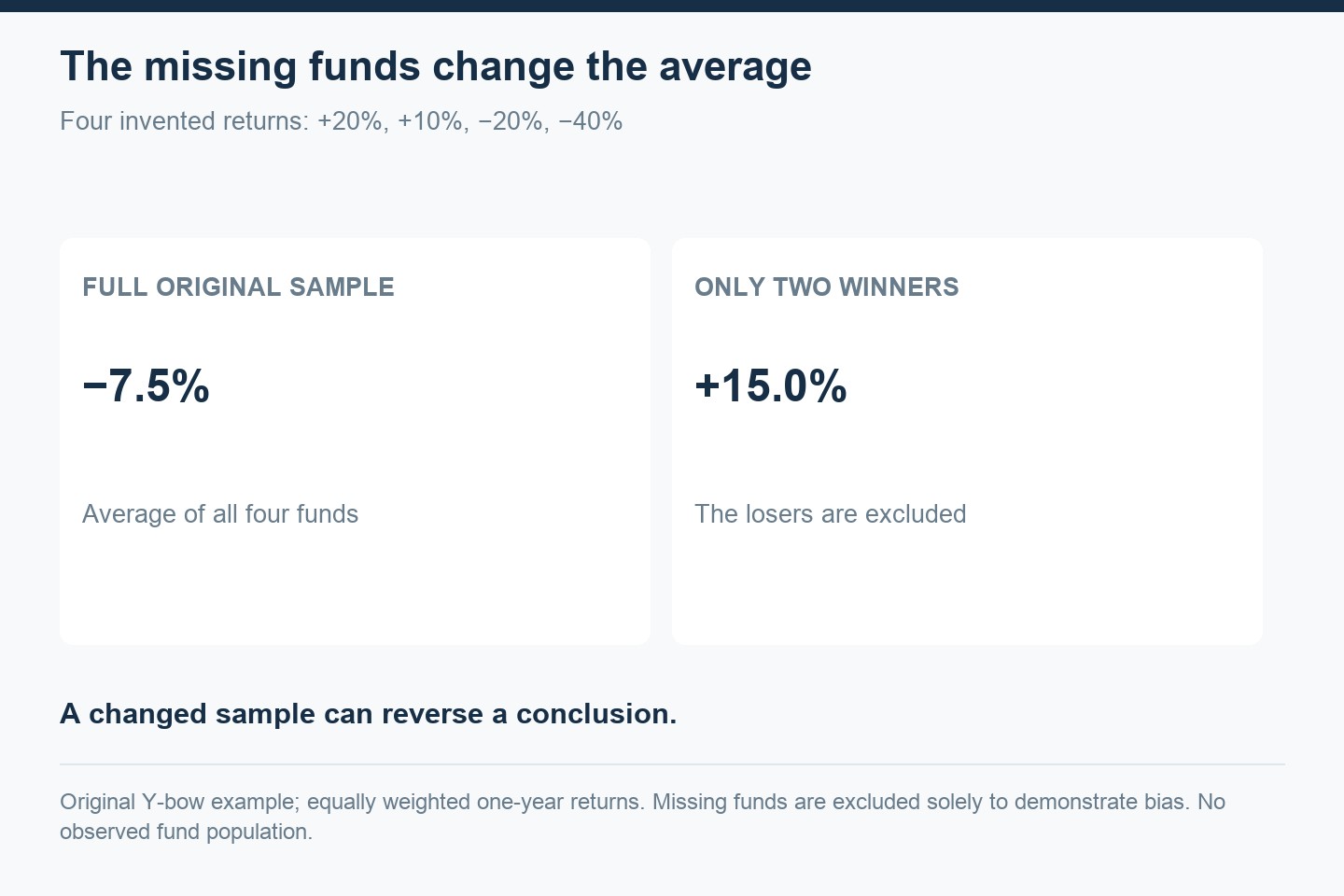
These are invented returns, not evidence about a real fund population. The example shows how sample construction alone can reverse the conclusion. Actual research must define what happened to each original investment, including liquidation proceeds or merger treatment, rather than assuming a missing fund necessarily became worthless.
Why serious comparisons track disappeared funds
S&P Dow Jones Indices’ SPIVA research compares active funds with benchmarks. Its scorecard methodology explicitly discusses survivorship bias correction. That is a methodological reason to read a study carefully; it is not a reason to transfer one country’s result to every market or every period.
When reading a report, check the original fund universe, category definitions, equal versus asset weighting, fee treatment and how closed funds enter the results. A percentage without a denominator is not enough to understand a comparison.
Social media has additional filters
Online stories face selection beyond fund survival. People choose whether to post, which account to show, and which period to emphasize. A spectacular outcome is more likely to attract attention than a routine or disappointing one. You may not see outside income, withdrawals, leverage, inherited capital or abandoned strategies.
This does not mean every successful investor is dishonest. A truthful account can still be unrepresentative. Respect the person’s experience while asking what evidence would support a general claim.
Leverage makes missing paths important
A strategy that succeeded after a favorable starting date may have failed with a different return sequence or cash-flow need. Averaging the returns of investors still holding a leveraged fund excludes some who had to sell earlier. Their actual losses remain part of the experience of using that strategy.
Our TQQQ guide explains the daily compounding mechanism. It does not convert the success of selected holders into proof that leverage is safe. Borrowing, drawdowns and the need to fund living costs deserve independent assessment.
Ask for the missing denominator
For a fund ranking, ask which funds existed at the beginning. For a trading claim, ask how many people or strategies tried. For a backtest, ask whether the rule could have been chosen using information available at that date. Also ask whether failures were measured consistently, rather than selectively removed.
The purpose is to improve inference, not to dismiss every success. A story can inspire a question; a defined sample and reproducible calculation are what help answer it. Read our backtesting checklist before treating a selected historical path as a reliable future. This article is educational, not investment advice.
Adapted for the English edition; sources checked October 11, 2026. Original calculations and diagrams by Y-bow. Japanese counterpart.







Comments