
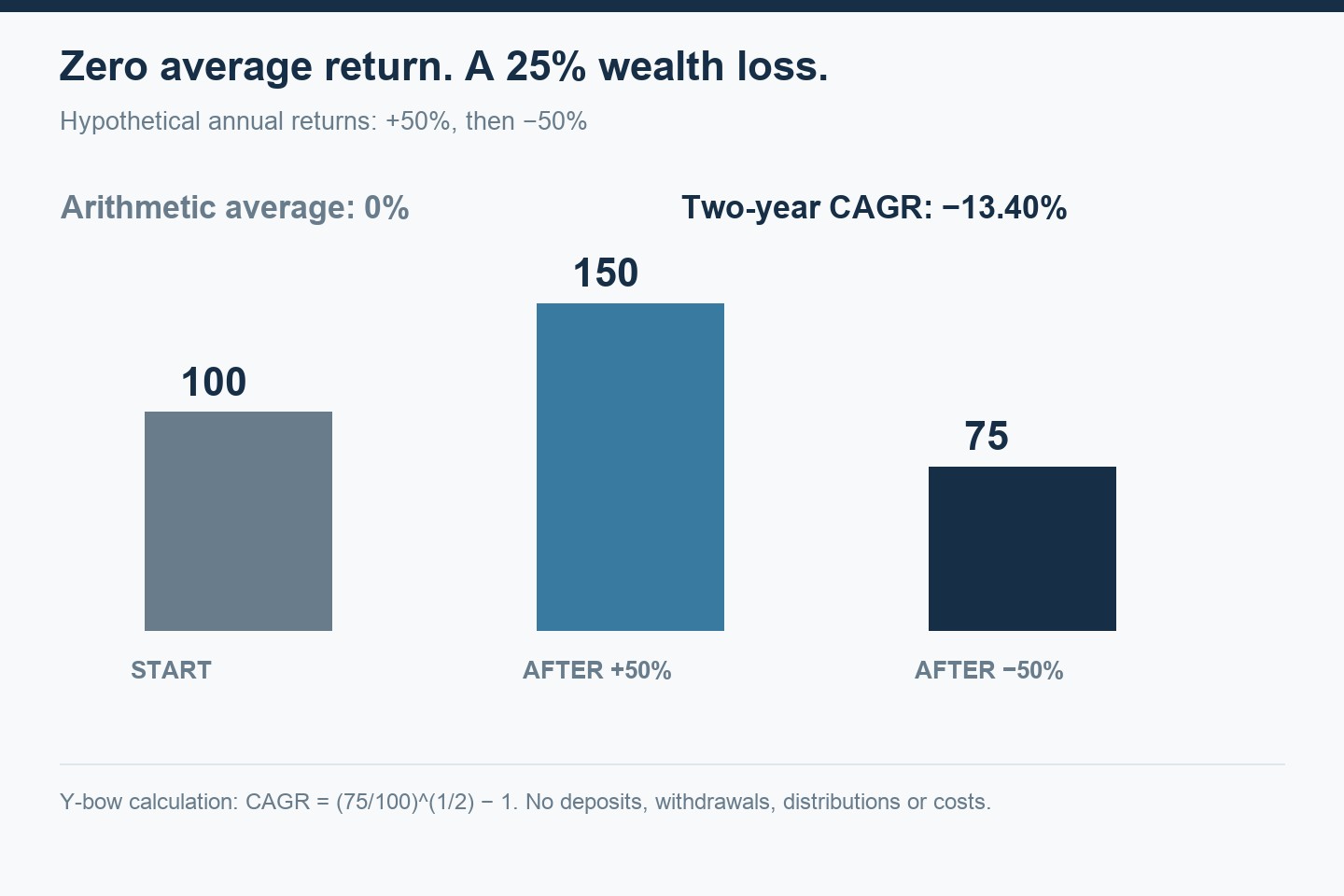
An investment that gains 50% and then loses 50% has not broken even. A starting value of 100 becomes 150, then 75. The average of the two annual percentage returns is zero, but your wealth has fallen 25%.
This is why investors need to distinguish an arithmetic average from the compound annual growth rate, or CAGR. One summarizes a list of annual returns. The other describes the constant annual rate that would connect a starting investment to its ending value.
Two averages answer different questions
The arithmetic average is the sum of the period returns divided by the number of periods. For +50% and −50%, it is 0%. It can be useful for statistical descriptions, but it does not tell you the growth of a continuously invested balance.
For an investment with no external cash flows, CAGR = (ending value ÷ starting value)1/years − 1. In the example, √(75 ÷ 100) − 1 = −13.40% per year. Applying that constant rate twice reproduces the ending value of 75.
Compound growth is powerful, but assumptions are not promises
At a constant 10% annual growth rate, 10,000 becomes about 67,275 after 20 years: 10,000 × 1.120. This is a mathematical scenario, not an expected result for any particular fund. Real investment returns vary, and costs, taxes and inflation change what an investor can spend.
If the ending balance is known, reverse the calculation rather than relying on an average stated in a headline. A rise from 10,000 to 18,000 over 20 years implies CAGR of roughly 2.98%, assuming no deposits or withdrawals. Nominal growth and purchasing-power growth should also be distinguished.
The order of returns and cash flows
With no external cash flows, exchanging the order of two returns does not change their product. A 20% gain followed by a 20% loss produces the same ending wealth as a 20% loss followed by a 20% gain: 100 × 1.2 × 0.8 = 96.
Withdrawals change the problem. Start with 100 and withdraw 4 at the end of each year. Gain first: (100 × 1.2 − 4) × 0.8 − 4 = 88.8. Loss first: (100 × 0.8 − 4) × 1.2 − 4 = 87.2. The same two market returns now produce different remaining balances. This is a small illustration of sequence risk, not a retirement-planning model.
Regular contributions need another calculation
If you add money over time, dividing the final balance by the total contributed and applying a CAGR formula gives a misleading result. Different deposits were invested for different lengths of time. A money-weighted return accounts for the amounts and dates of cash flows; a time-weighted return separates portfolio performance from investor cash flows.
Our dollar-cost averaging article gives a two-purchase example where the average purchase price falls but the investor still loses money. It is a useful reminder to check both units and cash flows before interpreting a percentage.
How we read a performance claim
First identify the dates, whether distributions are reinvested, and whether the figure includes fees. Then identify the return measure and cash-flow assumptions. Finally ask whether the result is nominal or inflation-adjusted and whether it represents a fund, an index or a model.
Past compounding does not establish future growth. This is especially important for daily leveraged funds, whose long-period returns depend on the daily path. The SEC’s Investor.gov learning materials provide a starting point for understanding investment returns and risk.
All numerical examples are Y-bow’s hypothetical calculations. Educational material, not individualized advice. Checked October 11, 2026. Japanese counterpart.
Comments
List of comments (1)
[…] For percentage arithmetic, see CAGR versus average returns. For portfolio concentration, read diversification by risk. No example here recommends buying or selling a fund. […]