

Saving for retirement and spending from a retirement portfolio are different mathematical problems. While building assets, you can often postpone a sale. Once a portfolio pays for living costs, a withdrawal can coincide with a fall in prices. The order of returns then affects how much remains to participate in a recovery.
This English adaptation of Y-bow’s retirement-withdrawal article uses an original, reproducible two-year example. It also puts a dated research estimate in context. No single spending percentage can settle the questions of longevity, taxes, inflation, pension income and the expenses your household can actually reduce.
Use the same returns in a different order
Start with 100 units. In each year, apply the investment return first and then withdraw exactly 4 units at year-end. There are no contributions, taxes, fees or inflation adjustments. The two invented returns are a loss of 20% and a gain of 25%. We reverse their order without changing either number.
With no withdrawals, both orders end at 100 because 0.80 × 1.25 = 1. The arithmetic average is 2.5%, but the compounded two-year return is zero. This already shows why an average headline can be misleading; our CAGR guide examines that distinction.
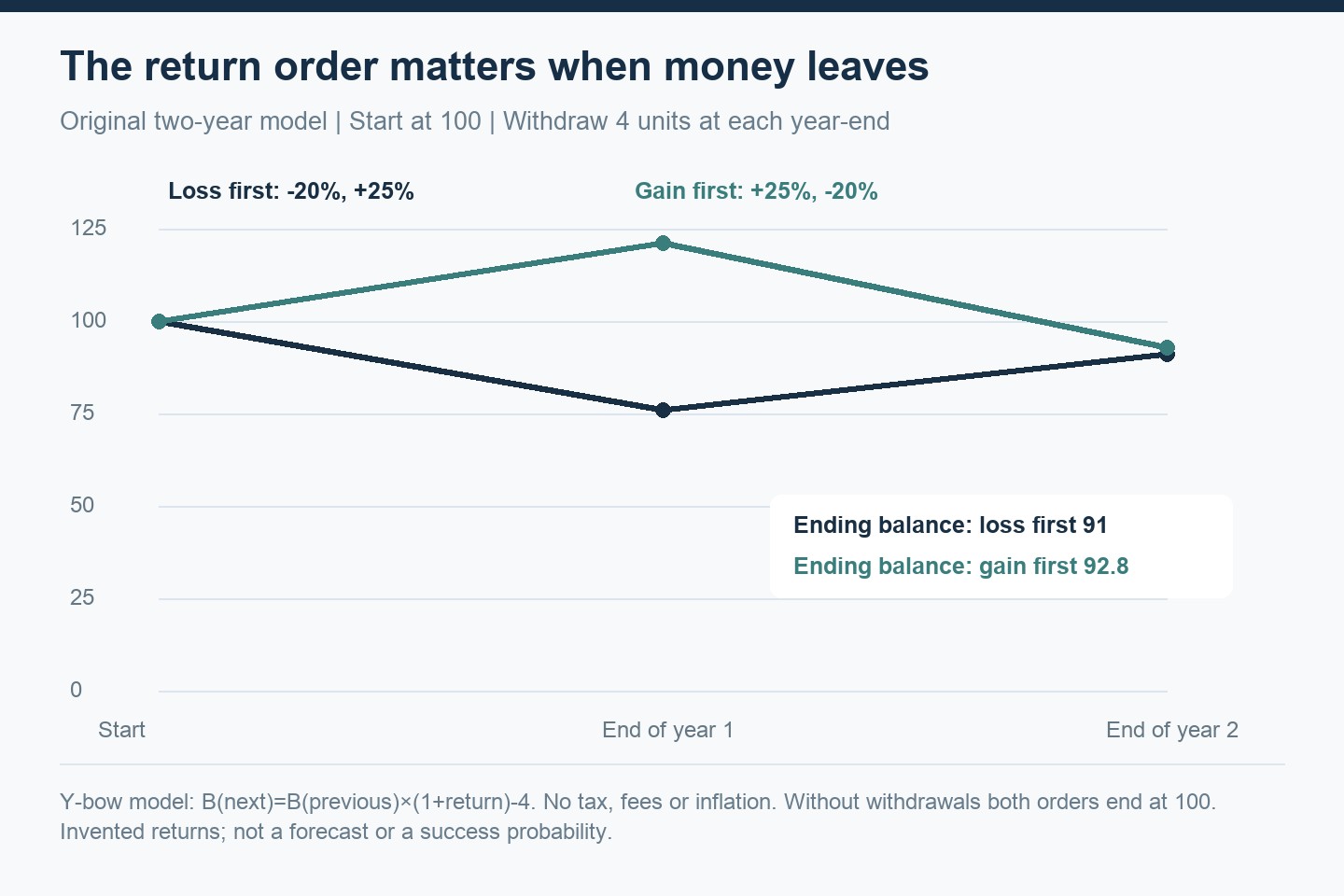
Loss first: 100 × 0.80 − 4 = 76; then 76 × 1.25 − 4 = 91. Gain first: 100 × 1.25 − 4 = 121; then 121 × 0.80 − 4 = 92.8. The gap is 1.8 units. It arises because money withdrawn after the early loss is no longer present for the later gain.
A percentage can describe two different spending rules
Taking 4% of an initial balance of 100 gives an initial withdrawal of 4. One possible rule then keeps that amount fixed, or adjusts it for inflation. Another rule takes 4% of whatever balance exists at each withdrawal date. These instructions do not produce the same cash flows.
Under a current-balance rule, a balance of 60 allows a withdrawal of only 2.4. That may help preserve some invested capital, but it requires accepting less spending. A rule that lowers withdrawals automatically cannot guarantee that the reduced amount covers rent, food or healthcare. Financial survival and maintaining a chosen standard of living are distinct outcomes.
What a dated research result actually describes
Morningstar’s State of Retirement Income: 2025, dated December 3, 2025, estimated a highest base-case starting rate of 3.9% for fixed inflation-adjusted spending over 30 years with a modeled 90% success rate. It used forward-looking return and inflation assumptions and excluded Social Security and other nonportfolio income. The highest base-case rates came from portfolios with 30%–50% equities.
The report defined success through simulated paths that could fund the scheduled withdrawals. That is a model result, not a promise about your future, and it does not automatically transfer to another currency, tax system or spending horizon. More flexible spending methods introduce different cash-flow tradeoffs; a higher initial rate is not a free improvement.
Make flexibility concrete before relying on it
Our interpretation is that a practical plan should distinguish expenses that must be paid from spending that can change. Write down the income arriving independently of the portfolio, the currency of each payment and the timing of major expenses. A general instruction to spend less during a downturn is less useful than knowing which bills can actually be reduced.
In our two-year model, reducing the first loss-year withdrawal by 1 leaves 1.25 more units at the end of the gain year, before any further spending adjustment. This is arithmetic under a known invented path, not evidence that spending cuts will always solve a real shortfall. It illustrates why the timing and size of withdrawals belong in the model.
Review backtesting limitations before trusting an attractive retirement chart, and diversification before equating one stock-market fund with a complete household plan. Sources checked October 12, 2026. Original model and interpretation by Y-bow; educational explanation, not an individual withdrawal recommendation. Japanese counterpart.








Comments