
The question “How much do I need to retire early?” is easier to answer with a spending plan than with a dream portfolio return. The number must support housing, food, healthcare, taxes and future changes in your household, not merely look impressive on a brokerage screen.
FIRE means financial independence, retire early. The financial independence part is a funding problem. Retiring completely is one possible lifestyle choice, not a requirement for making progress.
Start with the gap your portfolio must cover
Estimate annual spending and subtract reliable income that will actually be available at the relevant age. A pension starting in 20 years cannot cover next year's bills. Rental or business income has costs and risks of its own.
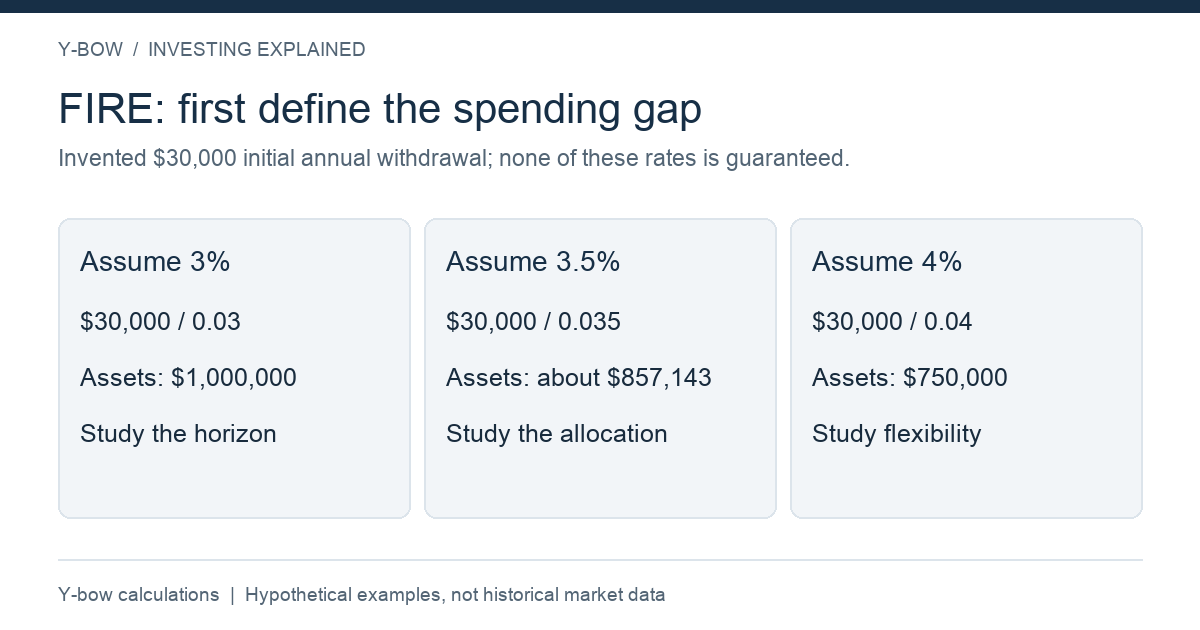
Suppose an invented household spends $40,000 a year and has $10,000 of net, dependable income available now. The initial portfolio-funded gap is $30,000. Taxes, large irregular expenses and future inflation still need attention; this is the beginning of the calculation, not the final retirement plan.
| Illustrative initial withdrawal rate | Assets needed for a $30,000 first-year withdrawal |
|---|---|
| 3% | $1,000,000 |
| 3.5% | About $857,143 |
| 4% | $750,000 |
The arithmetic is annual withdrawal divided by the assumed rate. No row promises that the assets will last. The model says nothing by itself about investment mix, market sequence, fees or the length of retirement.
What the 4% rule actually asks
A common interpretation starts with a withdrawal equal to 4% of the initial portfolio, then adjusts the dollar amount for inflation. That differs from withdrawing 4% of each year's current balance, which makes spending rise and fall with the portfolio.
A portfolio not running out over a chosen research period is also different from preserving its original principal. Success definitions matter. Research based on certain asset classes and a 30-year horizon is not automatically suitable for a 45-year early retirement or a concentrated leveraged fund.
Morningstar's 2025 retirement income research illustrates how assumptions about horizons, portfolio mix, success probability and spending flexibility affect the result. It is a planning study, not a guarantee for an individual household.
Early losses are especially important when withdrawing
If you must sell assets to fund living costs after a decline, fewer units remain for a later recovery. The order of returns matters even when a simple average return looks unchanged. Our retirement sequence-risk article explains the mechanism.
Keeping a spending reserve can reduce immediate forced sales, but it does not eliminate the long-term funding problem. Nor does selecting the fund with the highest recent return create a dependable income plan.
Flexibility can be more useful than a precise headline number
Separate essential spending from discretionary spending. Identify what you could reduce during a difficult period and how long that reduction would be acceptable. Include health insurance, dependants, housing repairs and local taxes.
Part-time work, a later retirement date or a lower spending target can change the funding gap materially. These alternatives are not failures. They are variables in the same plan.
Investment experience does not remove uncertainty, but it can help resist treating a backtest as a personal promise. Compare your plan with unfavorable market and household scenarios, not just its most attractive outcome.
This article adapts the Japanese FIRE planning discussion for international readers. Country-specific pensions, healthcare arrangements and taxes require local research. Read our backtesting limitations before using a historical success rate as the deciding number.
Sources and review date
Reviewed October 14, 2026. Background: Morningstar's linked 2025 report and the SEC's asset allocation guidance. The $30,000 table is an original hypothetical calculation. It is not an individually recommended withdrawal rate or a forecast of future investment returns.





Comments