
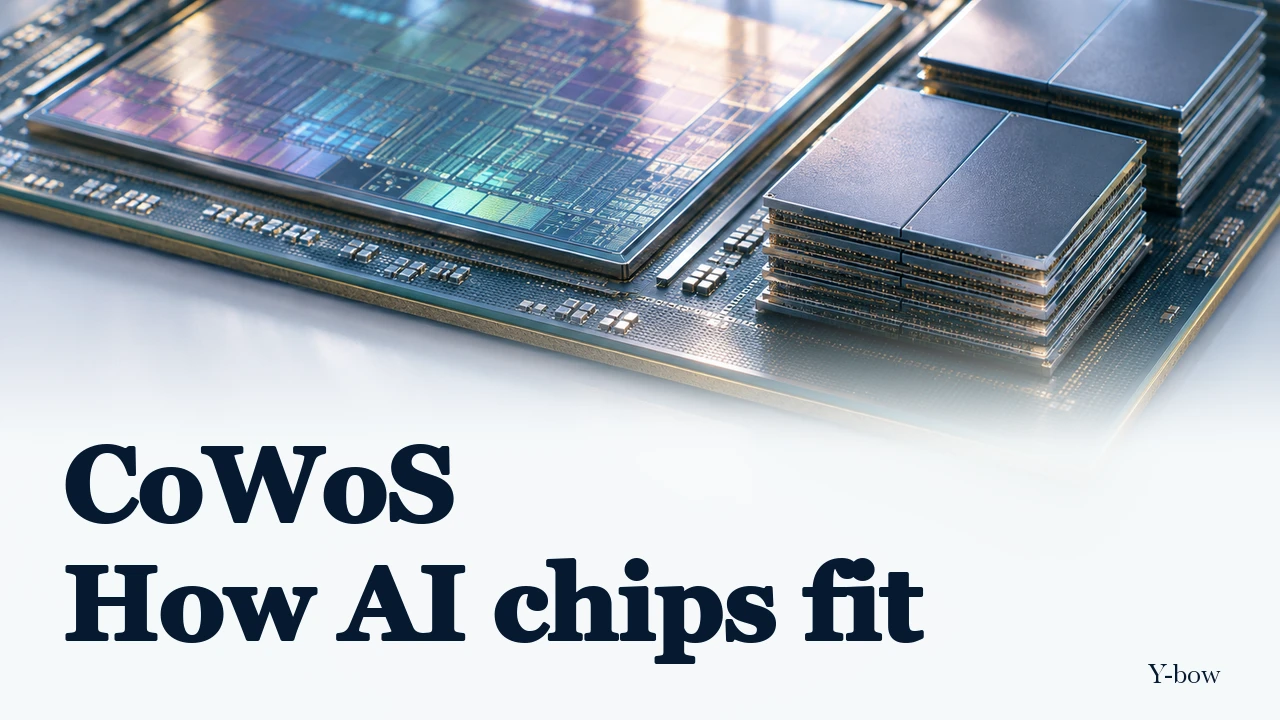
A company can announce more logic wafers and more memory while customers still wait for AI accelerators. The missing step may be integration: separately manufactured components must become a qualified, working package before they can enter a server.
What CoWoS connects—and why HBM is a different component
Front-end fabrication creates circuits on wafers. That is not the end of manufacturing. Dies must also be connected to one another, powered, tested and integrated into a usable product. A powerful compute die cannot process data it cannot receive quickly enough.
TSMC describes CoWoS as a 2.5D packaging platform that integrates multiple systems on chips and high-bandwidth memory stacks. HBM itself stacks DRAM dies. Building the memory stack and integrating that stack beside a compute die are different operations.
For the memory-generation differences, see our HBM4 vs HBM3E comparison of bandwidth, capacity and power.
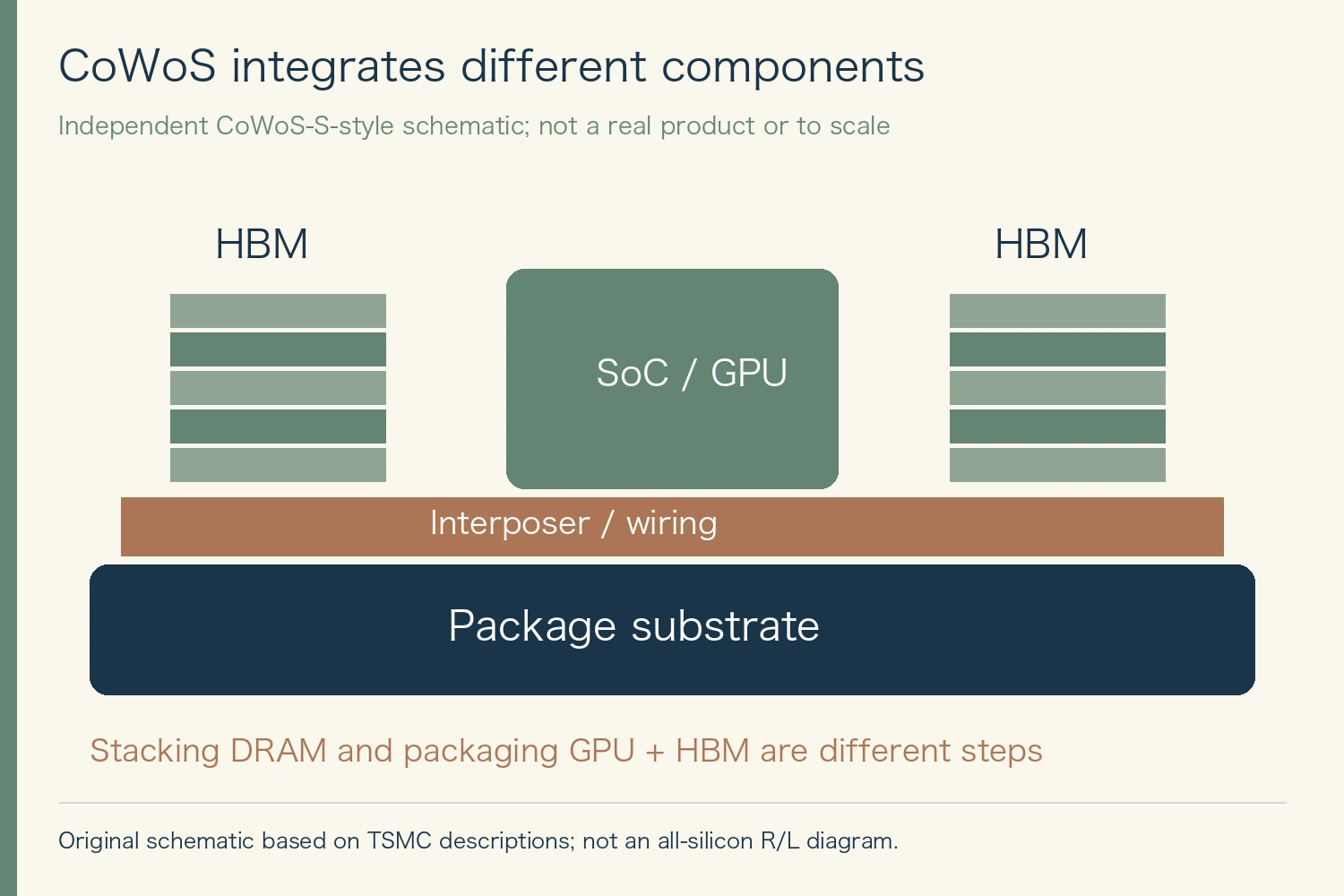
Our diagram is a simplified, CoWoS-S-style teaching schematic. It does not reproduce a particular GPU, scale, layer count or manufacturing recipe. CoWoS is also a TSMC technology name, rather than a generic label for every supplier’s advanced packaging. Keeping the names separate helps identify which company and which production step an announcement concerns.
CoWoS-S, R and L are not one identical silicon plate
The S approach uses a silicon interposer: an intermediate structure providing dense connections between components. But that description should not be applied unchanged to the entire family. The R approach uses a redistribution-layer interposer; the L approach combines redistribution layers with local silicon interconnect structures and other elements.
← Swipe to view the full table →
| Approach | Interconnect structure | Reading caution |
|---|---|---|
| S | Silicon interposer | Our schematic simplifies this approach |
| R | Redistribution-layer interposer | Do not assume an all-silicon plate |
| L | RDL with local silicon interconnects and other elements | Not a simple performance ranking |
These are integration choices, not a simple good-better-best ranking. A larger package can require more area, processing time or inspection. Consequently, an increase in processed area is not necessarily the same increase in finished units. Read the process type, package design and output unit together before comparing capacity statements.
Advertisement
Convert the stages into package-equivalent capacity
Consider an independent toy model, not a company estimate. Each finished package requires one compute die and eight HBM stacks. In a month, the supply chain can provide 120 compute dies, 640 qualified HBM stacks and assembly capacity for 110 packages.
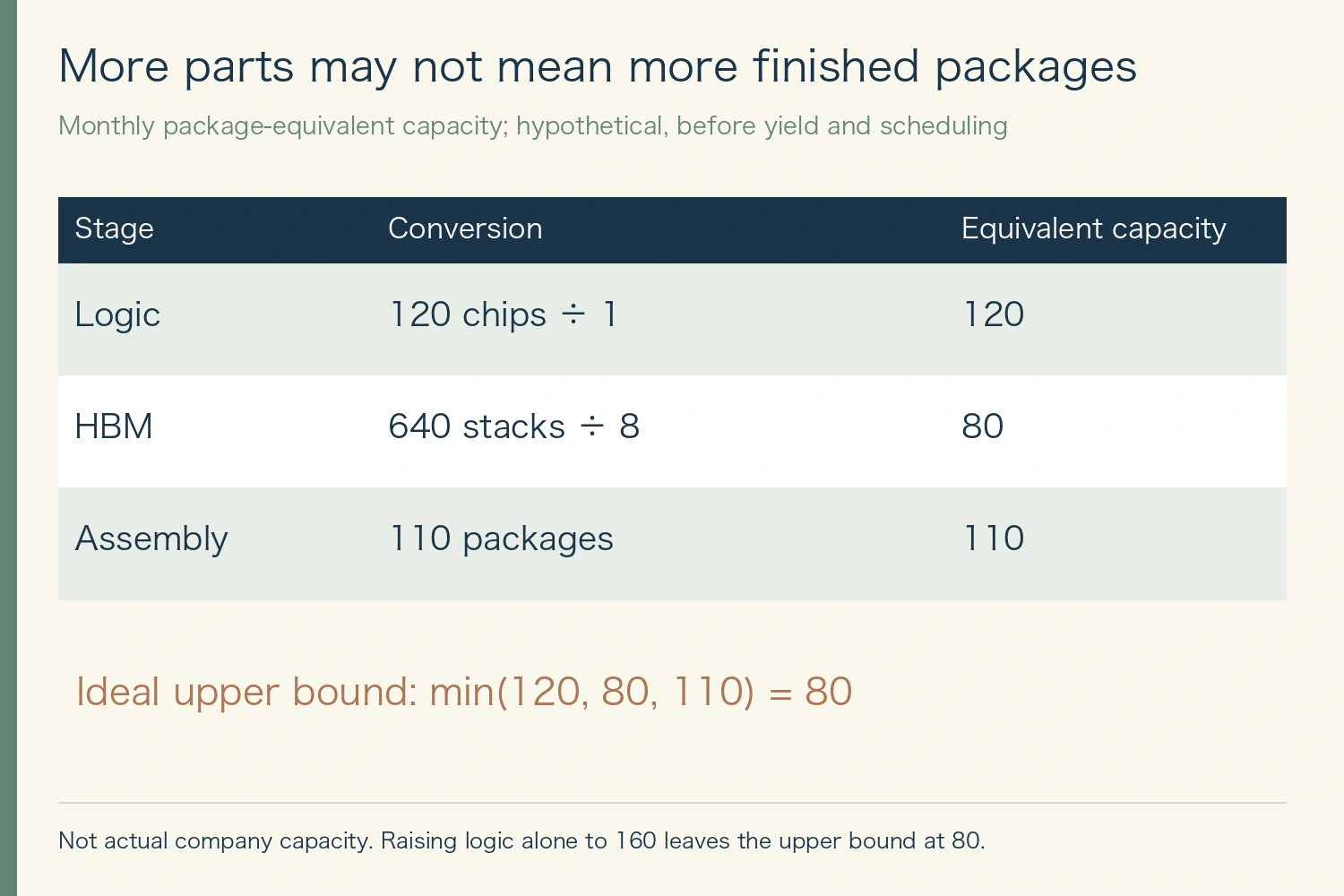
Memory supports 640 / 8 = 80 packages. Ignoring yields, timing and compatibility, the ideal upper bound is min(120, 80, 110) = 80. Increasing compute-die supply alone to 160 leaves that bound unchanged. If HBM supply instead rises to 960 stacks, memory supports 120 packages and assembly’s 110 becomes the limiting stage.
This is a constraint illustration, not a shipment forecast. It assumes compatible parts arrive in the same period, customers want the resulting product and every required stage is available. Actual scheduling, qualification, testing and yield losses can reduce output further. Nor should wafer counts, memory bits and finished packages be added as if they measure one thing. The useful question is how much of the same qualified final product each stage can support.
A supply agreement is not already-operating capacity
On October 8, 2026, GlobalFoundries announced a US silicon-interposer manufacturing agreement with TSMC. Such agreements matter to the supply chain. They do not, by themselves, establish that new output was already available on the announcement date.
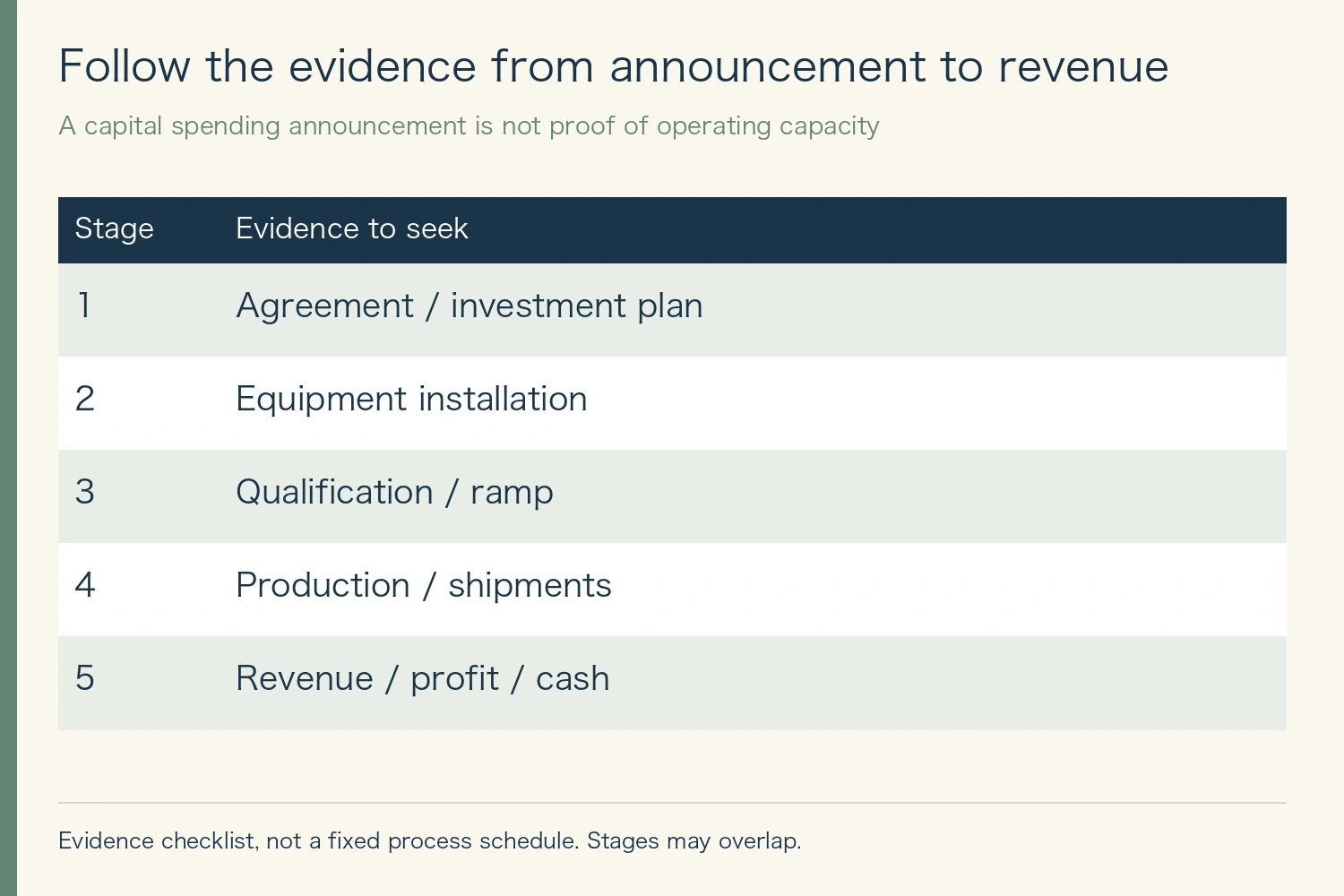
Follow the evidence through investment commitments, installation, qualification, ramp, shipments and financial results. Some activities overlap; this is a reading checklist, not a mandatory sequence or a forecast of elapsed time. Record planned dates separately from achieved milestones.
An announcement may concern an interposer rather than memory-stack production or final assembly. Expanding that one component can help without solving every constraint in the system. A headline saying that capacity will expand needs a named process, a defined unit and an operating date before it becomes a useful output assumption.
Why a critical bottleneck does not guarantee investor returns
A scarce manufacturing capability can create business opportunities. Whether it produces attractive returns depends on pricing, ramp expenses, capital spending, yield, competition and customer contracts. If demand weakens after expansion, capacity can become a cost burden instead.
For investors, “this process is essential” and “this stock is attractive at today’s price” are different conclusions. Even good operating results can fall short of expectations already embedded in valuation. Equally, early ramp costs alone do not prove that a technology has failed.
A practical research note records five fields: production stage, measurement unit, time period, operating status and qualified product scope. This turns an impressive-sounding expansion announcement into a claim that can be checked in later reports, without inventing a stock-price target.
Advertisement
Questions to ask when the next packaging headline appears
Does more HBM automatically solve a CoWoS shortage?
No. Memory and integration are different stages. Extra HBM helps when memory is the binding constraint for the relevant product; it does not automatically expand package assembly. Product compatibility and timing still matter.
Is the toy model a forecast for TSMC or Nvidia?
No. Its component counts are invented teaching inputs. They demonstrate unit conversion and a limiting-stage calculation, not actual capacity, order volume or market share.
What would count as stronger evidence than an expansion plan?
Look for the specified equipment or process operating for qualified products, then distinguish shipped units, recognized revenue, profit and cash collection. Do not promote an earlier milestone into proof of every later one.
Related guides, sources and update policy
For the product landscape, see our memory industry map. Packaging capacity is one constraint; it is not a substitute for analyzing demand, contracts and the price paid for an investment.
For a research checklist, the author’s free Japanese-language note Three ways to read semiconductor news separates operating results, stock flows and product mechanics.
Sources checked November 6, 2026: TSMC’s CoWoS descriptions and the GF announcement. The three diagrams and cover are independently produced editorial graphics. Capacity figures are hypothetical package-equivalent inputs, not measured results or forecasts. Update process descriptions and dated expansion examples separately.
This is general educational information. Evaluate an investment against your own objectives and the applicable product conditions.







Comments