
QQQM has the lower expense ratio. That is a useful fact when choosing where to put new money, but it does not automatically answer whether to sell appreciated QQQ. A switch can exchange a small recurring saving for an immediate tax payment, trading friction and a new cost basis. The question is not simply which fund is cheaper. It is whether changing an existing position improves your after-tax outcome.
Issuer information was checked October 31, 2026. The tax examples use explicitly assumed flat rates, not your personal federal or state rate. All growth paths are illustrations, not expected returns.
The QQQ–QQQM fee gap is three basis points
Invesco currently states expense ratios of 0.18% for QQQ and 0.15% for QQQM. The difference is 0.03 percentage points, or 3 basis points: multiply the investment by 0.0003, not 0.03. Older comparisons using 0.20% for QQQ overstate this particular gap. Both provide Nasdaq-100 exposure, but expense ratios alone do not describe execution and tracking. Source: Invesco’s QQQ Innovation Suite
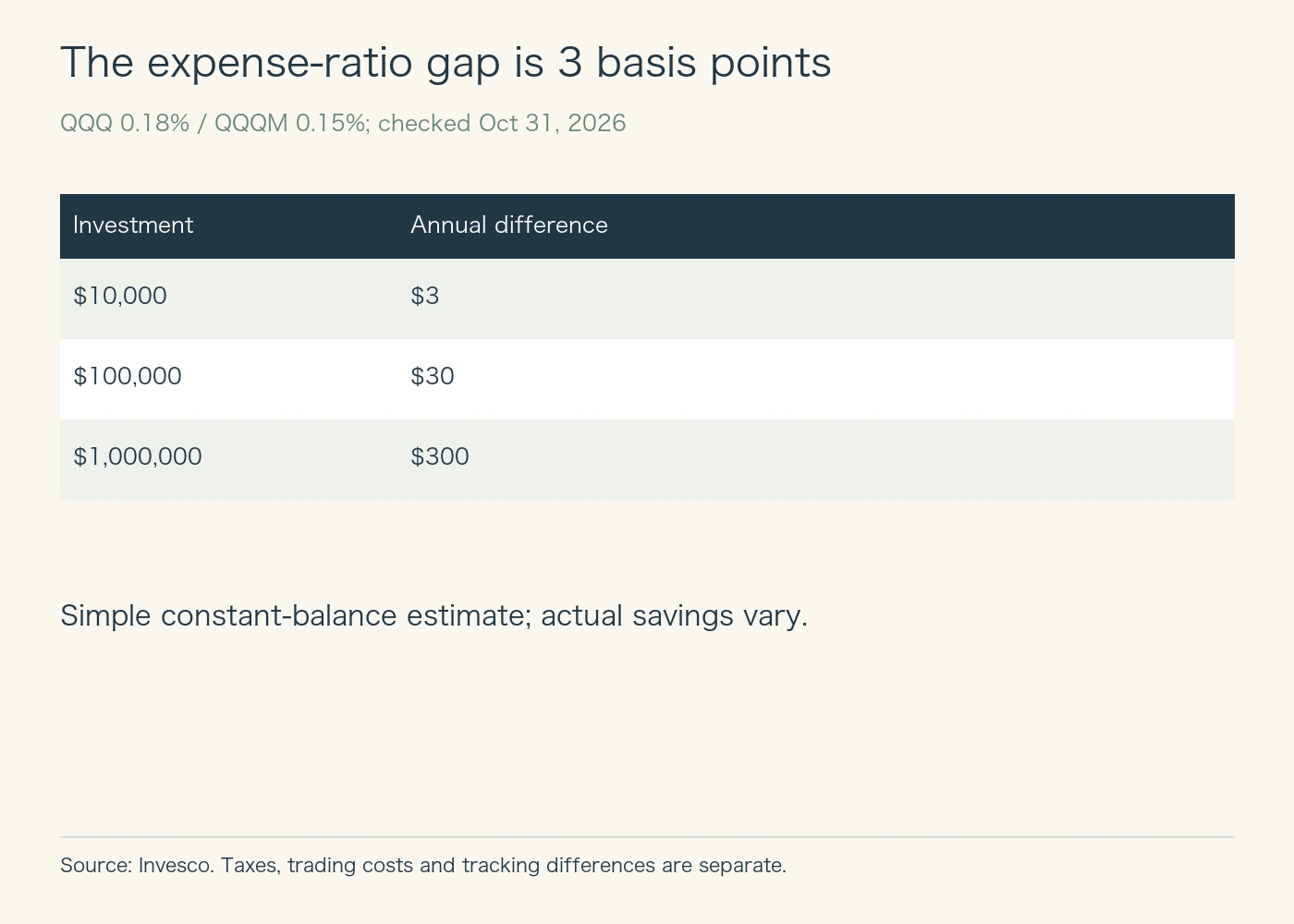
Fund expenses accrue through the fund’s assets rather than appearing as a one-time trading commission. They compound over time, but the amount at stake should be compared with the costs of obtaining that saving. A change in the balance or fee schedule changes the calculation.
Selling appreciated QQQ changes both cash available and basis
Consider a $100,000 position with a $70,000 adjusted basis. At a hypothetical flat 20% tax on the $30,000 gain, selling triggers $6,000 of tax and leaves $94,000 to reinvest if the tax is paid from the position. Actual US tax depends on holding period, income, state rules, offsets and other circumstances; 20% is not presented as a universal rate.
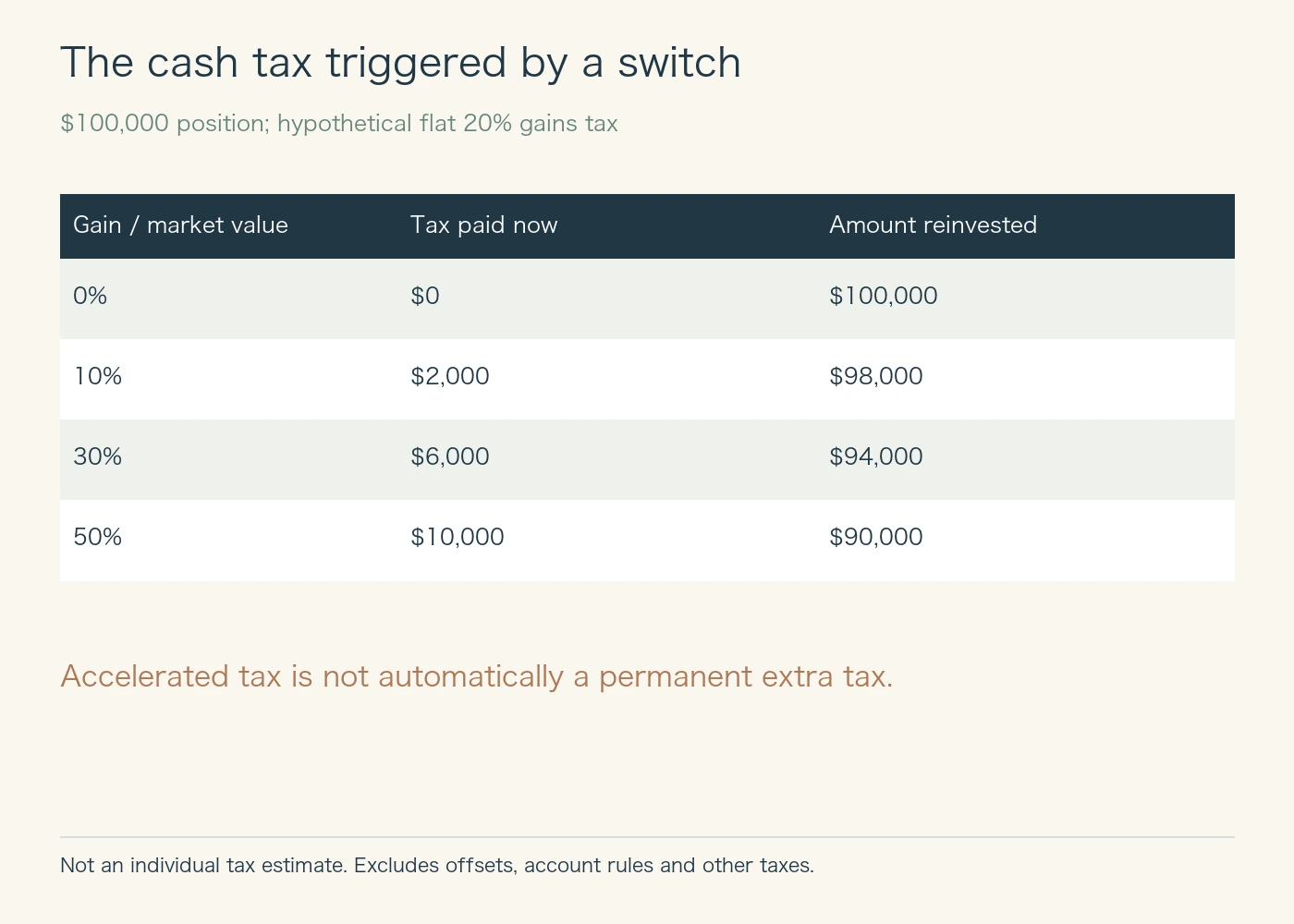
Two common mistakes point in opposite directions. Treating the entire $6,000 as a permanent extra tax ignores that a later sale of QQQ could also realize a gain and that the replacement has a new basis. Treating tax timing as irrelevant ignores the money that can no longer remain invested after paying early.
Why “tax divided by annual savings” is not the true break-even
$6,000 divided by $30 equals 200 years. That shows the immediate cash payment is large relative to the first year’s saving. It is not a correct economic break-even date, because the calculation ignores deferred tax, updated basis, changing balances and terminal realization. Even a smaller spread or commission divided by a fixed annual saving is only a first-pass screen.
A consistent comparison asks what each strategy leaves after tax on the same exit date. Otherwise the switch can be charged a realized tax while the hold strategy is credited with an unrealized pre-tax balance. Those are different units of wealth.
Advertisement
A same-exit-date, after-tax illustration
Assume the $100,000 position, $70,000 basis and flat 20% tax above. Both funds receive a hypothetical gross annual return of 6%; the simple annual growth factors are 1 + 0.06 − 0.0018 and 1 + 0.06 − 0.0015. Trading costs are zero. Both positions are fully sold at the end, with positive gains taxed relative to their own bases. Distributions and their taxes are omitted.
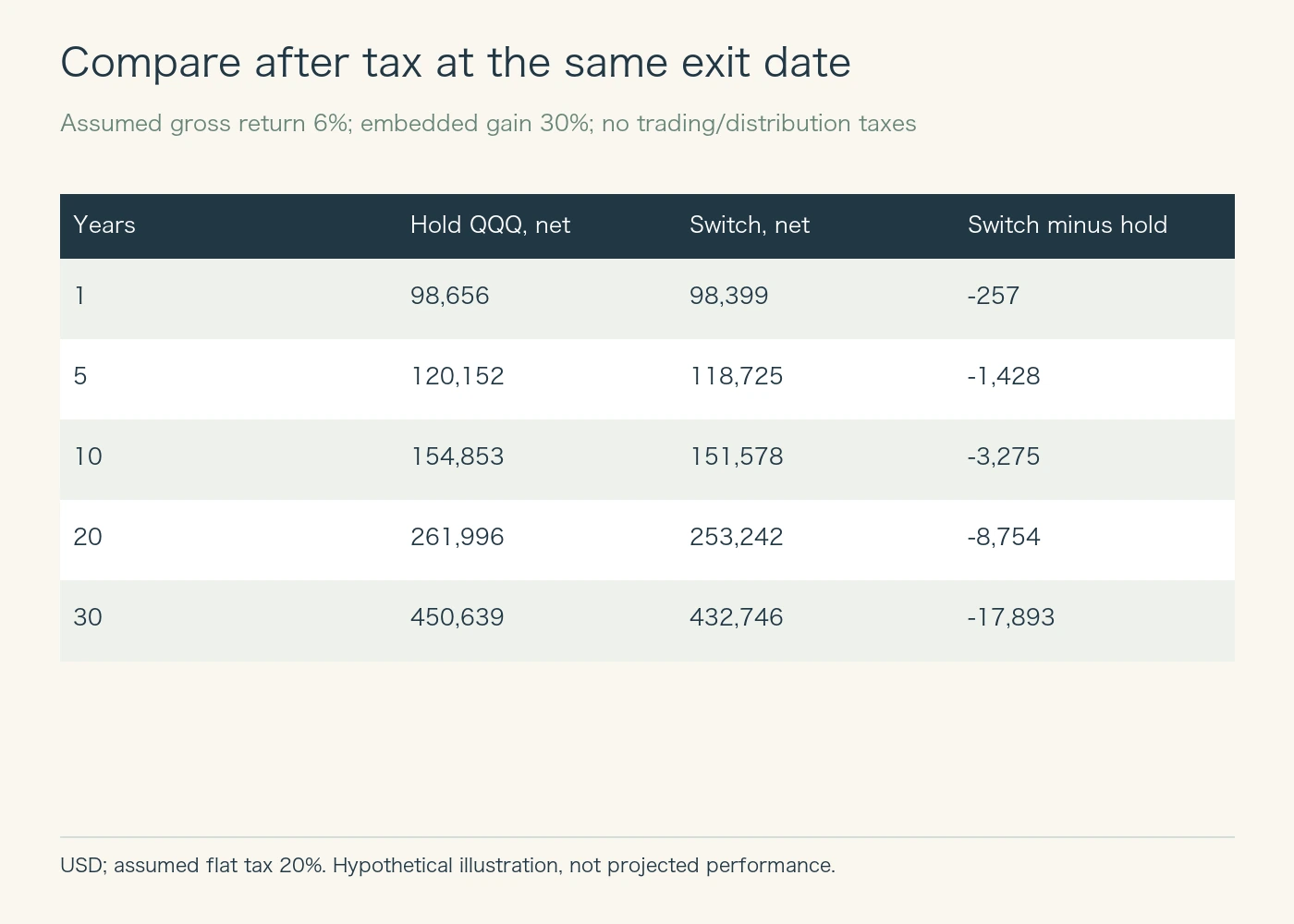
After ten years, holding leaves about $154,853 after tax; switching leaves about $151,578. The switch is roughly $3,275 behind. At twenty years the difference is about $8,754. In this scenario, keeping the deferred tax amount invested matters more than the small expense gap. This is not a universal recommendation to retain every appreciated position.
A small gain, a loss that can offset other gains, a different return path, a different tax rate or an account without current tax on internal trades can change the conclusion. Paying tax from outside the position also requires counting the opportunity cost of that outside money in both strategies; otherwise the comparison is biased. Distribution taxes and exact tax-lot treatment would need a more complete model.
Keep QQQ and send new contributions to QQQM
If the goal is to reduce the expense ratio on future purchases, new contributions can go to QQQM while existing QQQ remains untouched. That avoids realizing the existing gain solely for a fee change. It creates two holdings tracking the same broad exposure, not two independent sources of diversification.
← Swipe to view the full table →
| Choice | Potential benefit | What remains to check |
|---|---|---|
| Keep QQQ | Avoid current realization and trading | Ongoing cost and investment objective |
| Switch all or part | Lower expense ratio on the changed amount | Gain, tax timing, lot selection and trading friction |
| Use QQQM for new money | Lower new-money cost without selling old shares | Administration and continuing index concentration |
For a partial switch in a US taxable account, accurate lot records and the broker’s identification process matter. Do not assume a displayed average gain describes the tax consequences of the lot you actually sell. A position change justified by a new investment objective is also a different decision from a fee-only substitution.
Taxable accounts, IRAs and wash-sale rules are separate questions
An internal trade in a retirement account and a withdrawal from that account are different events. IRA rules should not be reduced to “every sale is taxed” or “every withdrawal is tax-free.” Review the specific account and distribution rules rather than importing taxable-account examples unchanged. IRS Publication 590-A provides official IRA background.
Wash-sale analysis concerns a realized loss and purchases of substantially identical securities within the relevant 30-day windows before or after the sale. It is not the same problem as selling at a gain. Different ticker symbols alone do not settle whether two securities are substantially identical. This guide does not claim an IRS ruling that automatically approves or disallows QQQ-to-QQQM loss harvesting. IRS Publication 550 (2025 edition) explains the general rule; the specific facts require separate evaluation.
For Japanese residents, tax calculations use the applicable yen-based proceeds and acquisition cost, not simply the dollar gain. Japan’s NISA also has its own annual limits and rules for reuse of sold cost-basis capacity in later years. These are not US IRA rules, and fund eligibility must be verified with the relevant institution.
Related book (affiliate advertisement)
Related background on diversification, costs and disciplined investing. This book is not presented as endorsing our hypothetical allocation rules.
A Random Walk Down Wall Street (English paperback)
View this edition on Amazon Japan
Check the linked page for price and availability. As an Amazon Associate, Y-bow earns from qualifying purchases.
Advertisement
Five numbers to write down before switching
Record market value, adjusted basis, incremental tax from this transaction, execution costs and the intended remaining holding period. Use an after-tax comparison with consistent end dates. Then consider whether a new-money-only change achieves your goal without realizing old gains.
The lower-cost product can be a reasonable destination for future purchases without making an immediate sale of the existing one worthwhile. Avoid trading just to feel that the portfolio has been “optimized.” The amount saved, the tax timing and the reason for holding Nasdaq-100 exposure should support the action together.
Related resources, calculation method and updates
Our JEPQ versus QQQM guide distinguishes distributions from total-return withdrawals; our ETF order guide examines execution friction. A Japanese full-length NISA video and Japanese note on NISA losses and limits (free introduction, partly paid) cover Japan-specific account context, not US tax treatment.
Model: holding after tax = M(1+r−eQ)^n − t·max[M(1+r−eQ)^n−B,0]. Set S = M−t·max(M−B,0); switching after tax = S(1+r−eM)^n − t·max[S(1+r−eM)^n−S,0]. M is market value, B basis, r the assumed gross return, e each expense ratio and t the assumed flat tax. No external cash subsidy, trading cost, distribution tax or tax-rate change is modeled.
Primary references are Invesco for expense ratios and objectives, IRS materials for general US tax principles, Japan’s National Tax Agency and Financial Services Agency for the localized Japanese context. We will update changed fees or rules rather than treating today’s gap as permanent. The three figures are original; the header is AI-generated conceptual artwork.





Comments