
“I don't have enough money to invest” can mean two different things. You may have no spare cash after essential spending, in which case investing can wait. Or you may have a small sustainable surplus but feel that it is too small to matter.
In the second situation, the first investment can be useful even before it produces a meaningful financial return. It can teach you how contributions, fees, price changes and your own reactions work. That learning should not require a complicated or highly leveraged product.
What a small contribution can and cannot do
The contribution itself is certain once made; the investment return is not. At $50 a month for five years, total contributions are $3,000. At $100 a month, they are $6,000. Those numbers do not depend on a market forecast.
For a purely hypothetical illustration, $50 contributed at the end of each month for 60 months grows to about $3,315 at a constant 4% nominal annual rate divided into monthly periods. At zero return the balance is $3,000; at a constant −4% nominal annual rate it is about $2,723. The model excludes taxes and fees and is not a realistic smooth market path.
| Monthly contribution | Five-year contributions | What matters most at the start |
|---|---|---|
| $25 | $1,500 | Affordable process and trading costs |
| $50 | $3,000 | Consistency without draining cash reserves |
| $100 | $6,000 | A sustainable household budget |
These are illustrations in dollars for convenience. Use your own spending currency and remember that foreign investments can add exchange-rate risk.
Fees matter when transactions are small
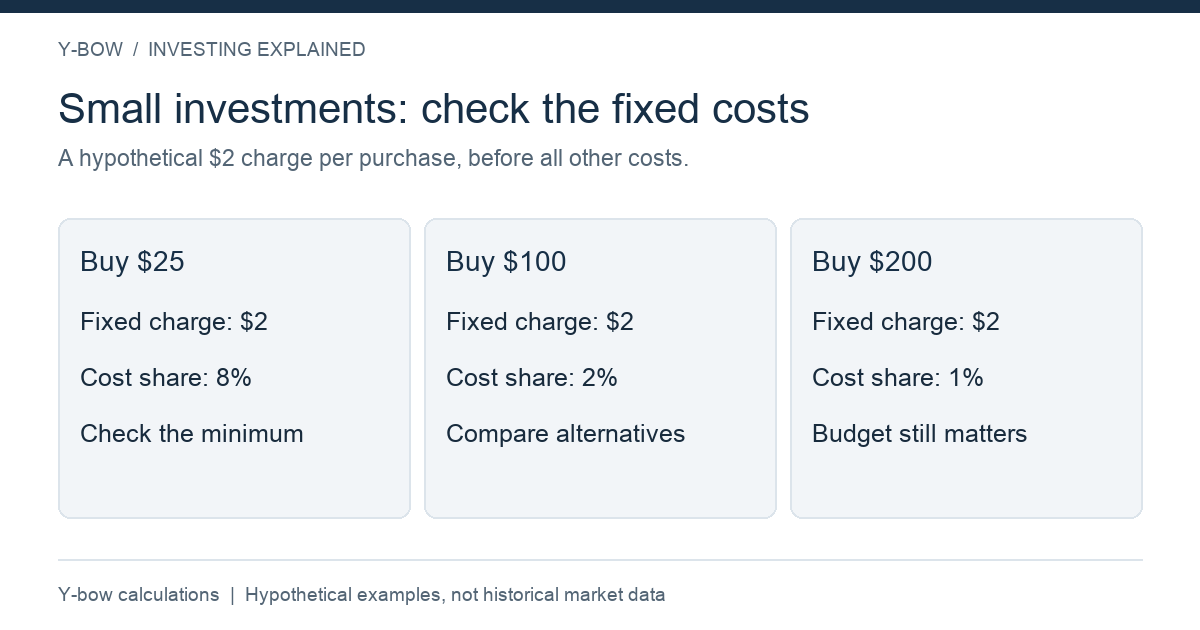
A $2 trading charge on a $25 purchase consumes 8% of the amount before the investment has done anything. On a $200 purchase, it consumes 1%. A broker with no explicit commission can still have spreads, foreign-exchange charges or other costs.
Check the minimum purchase amount, fractional-share rules, fund expenses and any account charges. Fractional shares are not available for every security at every broker. If a fixed fee makes frequent small purchases inefficient, compare a different eligible product or a less frequent schedule rather than assuming daily buying is always better.
Choose a simple first experiment
Start by deciding what the money is for and when you may need it. Then compare products by what they hold, how diversified they are and how their fees work. A broad fund can simplify company selection, but it can still lose value.
The first successful month is not necessarily one in which the market rises. It may be one in which you made an affordable contribution, understood the transaction and left essential spending money untouched.
Avoid using leverage simply to make a small balance feel larger. It changes the size and shape of potential losses. The useful habit is learning to invest within a budget, not trying to accelerate every outcome.
Build a routine you can explain
Write down the amount, frequency, product and reason for investing. Record a review date. If you later change the plan, write the reason before placing the order. This creates a small but practical barrier against replacing a budget with the latest popular ticker.
As income and obligations change, contributions can change too. Missing a contribution because of an unexpected bill is different from abandoning the whole plan. A household budget needs room for real life.
For the next step, read ETFs versus individual stocks and the cost differences between ETFs and mutual funds. This is an international adaptation of the Japanese article on small investments.
Sources and review date
Reviewed October 14, 2026. Background: the SEC's investing introduction and 2025 fee bulletin. The contribution, fee and future-value examples are original hypothetical calculations. Product availability, account protections and taxes vary by country.





Comments