
VOO, SPY and IVV are familiar routes to the S&P 500. Comparing their tickers is useful, but the question is bigger than which fund charges the lowest annual percentage. The exposure, trading process and costs that apply to your own account all matter.
This English adaptation removes the Japanese account-opening and NISA instructions from the original article. It focuses on U.S.-listed products that overseas readers may encounter. Access, taxes, investor documentation and available alternatives depend on the reader’s country and broker.
What the three funds aim to do
VOO’s April 28, 2026 summary prospectus identifies it as the exchange-traded share class of Vanguard 500 Index Fund, targeting a large-cap stock benchmark. Its total annual operating expenses are 0.03%.
The official IVV page identifies the iShares Core S&P 500 ETF and an expense ratio of 0.03%. State Street’s SPY page lists the S&P 500 benchmark and a gross expense ratio of 0.0945%. These figures were checked October 12, 2026; they can change.
The S&P 500 is a U.S. large-cap benchmark, not the entire U.S. stock market or the whole world. Holding all three does not create three independent equity exposures. Our portfolio-overlap guide explains why the number of fund names can be misleading.
Translate a percentage into a cash amount
To make the scale of the published fees concrete, assume an average holding value of exactly $10,000 for one year. Multiplying that amount by 0.03% gives $3; multiplying it by 0.0945% gives $9.45. The difference is $6.45 for this assumed balance and period.
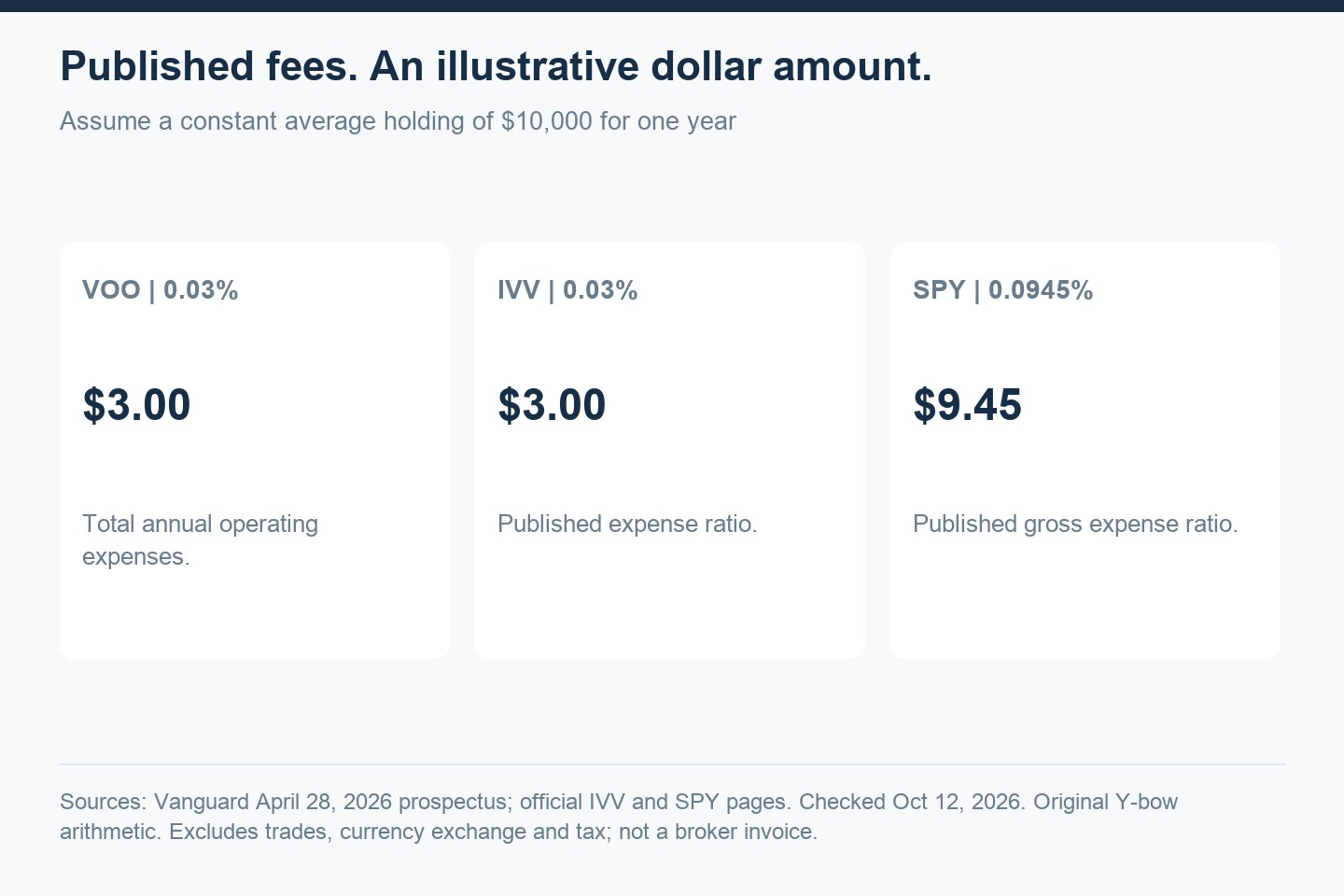
Fund expenses affect fund assets and returns; the diagram is not a separate annual bill from a broker. A changing holding value produces a different amount. A fund’s historical performance already reflects its expenses, so subtracting the published expense ratio from that same net return again would double-count it.
Trading costs answer a different question
Suppose a hypothetical broker charges $5 each time you buy a $100 position. That single charge is 5% of the purchase. It would overwhelm a $6.45 annual fee difference on the much larger $10,000 balance in our diagram. This invented comparison is not a statement about any particular broker’s current prices. It illustrates why order size and transaction frequency belong in the calculation.
A bid–ask spread, currency conversion charge and market price above or below NAV are separate considerations. The SEC’s fund-fee bulletin distinguishes ongoing fund costs from other charges. An advertised commission-free trade does not establish that every other cost is zero.
Use the exact product and the exact order
Before placing an order, match the full fund name, ticker, exchange and trading currency. Review the broker’s quote and available order types. An order with a price limit controls the acceptable execution price, but it may not execute. Automatic reinvestment, fractional shares and recurring purchases are broker features to verify, rather than assumptions that follow from the ticker.
Our interpretation is that the best comparison begins with the portfolio exposure you actually want. Then compare fund costs and the mechanics of implementing it in your account. No fee table establishes the best future return or resolves foreign withholding and local tax treatment.
Continue with ETFs versus mutual funds and benchmarks and compounding fees. Original analysis by Y-bow; educational explanation, not a personalized product recommendation. Japanese counterpart.


Comments