
Choosing an active fund instead of an index fund means making a decision about management, costs and the benchmark you want to own. The interesting question is not whether an active manager can ever win. Some do. It is whether the evidence you have is strong enough to justify the particular fund, price and process available to you.
This English adaptation of Y-bow’s active-versus-index article replaces its old comparisons with dated primary sources and an original cost calculation. It also separates ordinary index investing from daily leveraged products, which have a different objective.
Read the benchmark before the performance ranking
An index fund aims to follow a specified index. An active manager makes discretionary investment decisions within the fund’s mandate. Either strategy can be packaged as a mutual fund or ETF; our ETF and mutual-fund comparison explains the trading differences.
A U.S. large-company fund, an emerging-market fund and a bond fund do not face the same comparison. Before declaring a winner, match the investment universe, currency, period and treatment of distributions. A fund taking more risk may earn more in one period without demonstrating better selection skill.
What the latest SPIVA report says—and what it does not
The SPIVA U.S. Mid-Year 2026 summary, published September 17, reports that 67% of active U.S. large-cap equity funds underperformed the S&P 500 in the first half of 2026. Results differed by category: the reported underperformance rates were 49% for international funds and 38% for emerging-market funds.
Those percentages describe groups of funds during a past six-month period. They are not your probability of success next year, and they do not establish that every active fund loses. Combining categories or mixing six-month and ten-year results would answer a different question.
The full report’s methodology and glossary matter. SPIVA accounts for funds that disappeared through liquidation or merger, uses category-appropriate benchmarks and avoids double-counting share classes in count-based calculations. Its fund returns are net of fees, excluding loads. The comparison is with an index, rather than an individually purchased index fund after every investor-specific cost.
An original experiment: identical investments, different costs
Imagine two funds with the same investments earning exactly 7% before costs every year. Start with 10,000 units, make no further deposits and simplify annual charges to a subtraction from that return. The lower-cost example charges 0.20%, leaving 6.80%; the higher-cost example charges 1.00%, leaving 6.00%. These are invented funds, not current product fees.
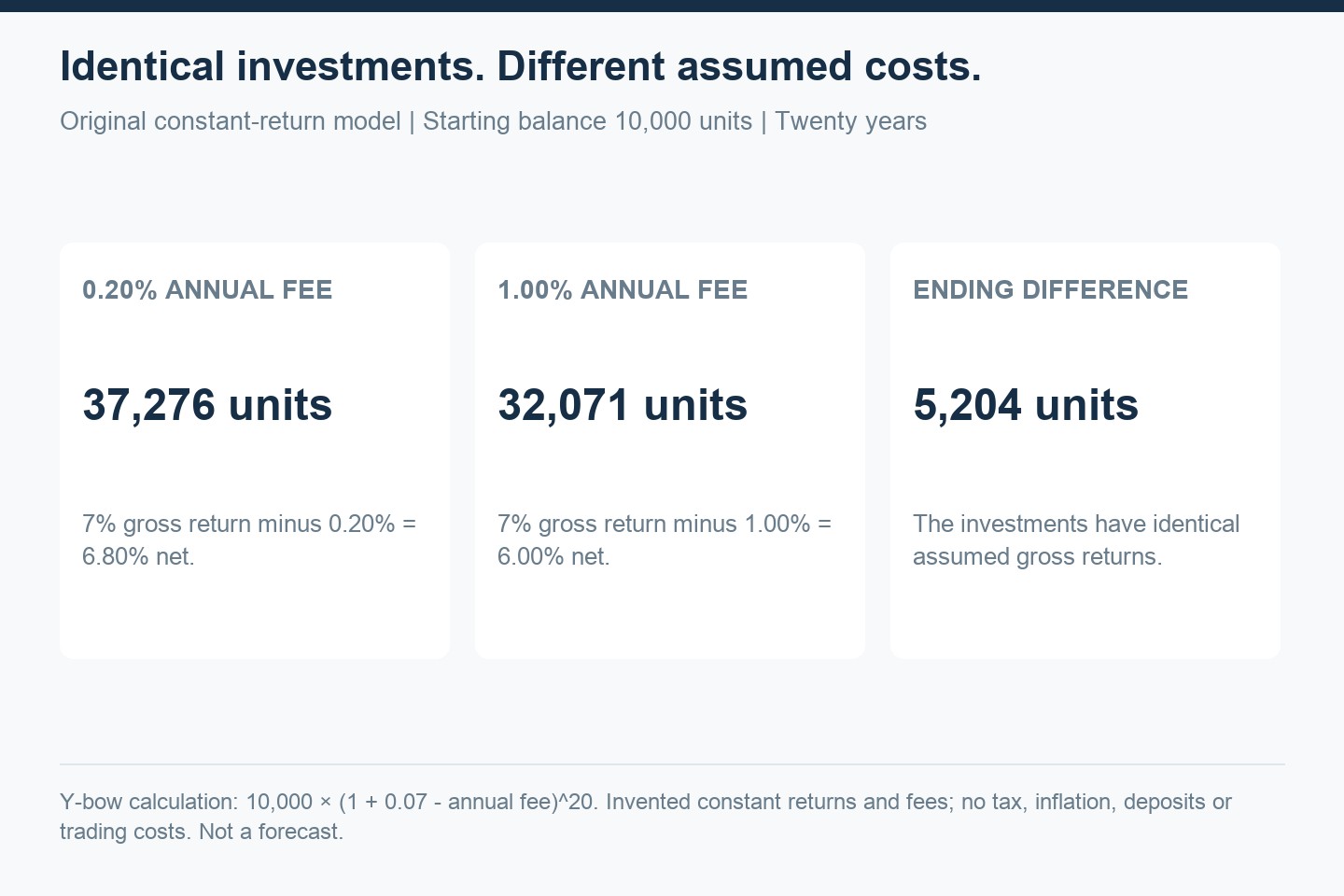
After twenty years, the balances are approximately 37,276 and 32,071 units. The gap is about 5,204 units, although the annual cost difference was only 0.80 percentage points. You can reproduce both results by multiplying the starting balance by 1.068²⁰ or 1.06²⁰.
Holding investments identical isolates the cost effect. Real managers hold different portfolios, so this experiment cannot tell you which real fund will outperform. It tells you how much of the argument still needs to come from investment results rather than the label on the fund.
An index is not a guarantee
The SEC’s index-fund guide explains that expenses and tracking differences can cause a fund to lag its index, and that not every index fund has lower costs than every active fund. Index investing also retains the risks of the underlying securities.
Daily leverage adds another layer. A fund targeting three times a single day’s return should not be read as an ordinary index fund with a permanently higher long-term return. Our TQQQ guide explains compounding and path dependence. Leverage is not a shortcut that settles the active-versus-passive debate.
The decision that survives a change in market leadership
Our interpretation is that a defensible fund choice should explain its benchmark, full costs, portfolio role and the reason for paying for discretionary management. Decide how you would evaluate the process during a period of underperformance before that period arrives. A recent ranking alone is too narrow a foundation.
Read the current prospectus, compare like with like and account for the rules and platforms in your country. For further perspective, see survivorship bias. Educational explanation, not personalized investment advice. Sources checked October 12, 2026. Calculation and diagram by Y-bow. Japanese counterpart.


Comments