
Earth orbits the Sun, but the Sun is also moving through the Milky Way. A planetary orbit drawn in a Sun-centred view and a planetary path drawn relative to the Galaxy are both descriptions of motion. They need not look the same.
This is why an appealing animation can be both useful and misleading. It may reveal a larger-scale journey while giving the wrong impression about geometry, orientation or the way the planets are bound to the Sun.
A galactic year
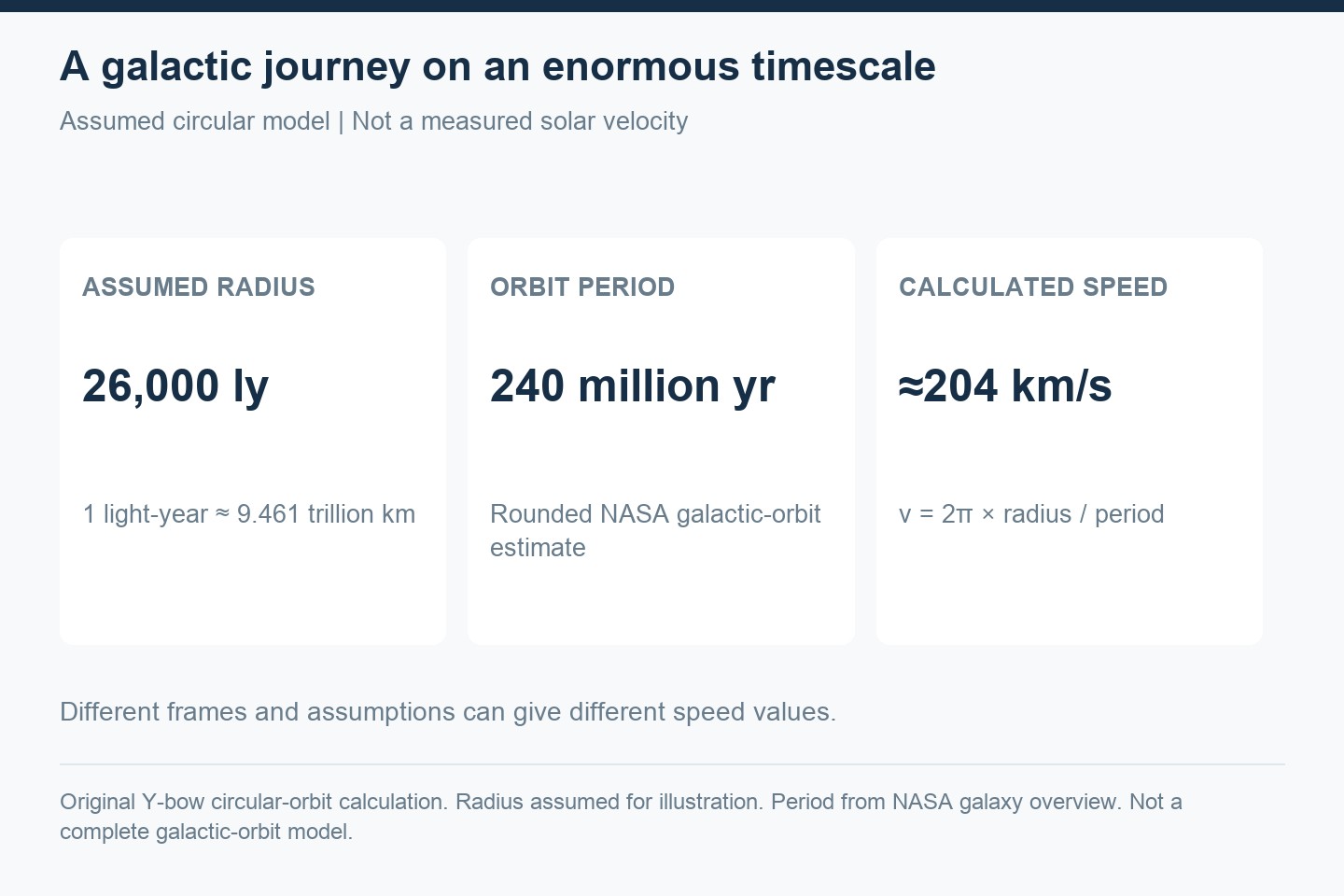
NASA’s galaxy overview gives roughly 240 million years for the Solar System to orbit the Milky Way once. The real orbit is influenced by the Galaxy’s distributed gravitational field. It is not simply a planet circling a central black hole as if the rest of the Galaxy were absent.
ESA’s Gaia explanation of stellar motion describes that collective field in terms of stars, gas and dark matter. The Sun’s journey is part of a galaxy-wide dynamical system.
A scale calculation
Assume, solely for an explanatory calculation, a circular orbit with radius 26,000 light-years and period 240 million years. Speed equals circumference divided by period: 2πR/T. With one light-year approximately 9.461 trillion kilometres, the result is about 204 km/s.
This is a rounded model calculation, not a precision measurement of the Sun’s velocity. Different radius and velocity definitions can produce different values. A number must be accompanied by its frame and assumptions to be meaningful.
Why a helix can appear
Take a simple two-dimensional orbit around a moving centre. In one coordinate description, x = vt + r cos(ωt) and y = r sin(ωt). In a frame translating with the centre, subtract vt from x and the orbit becomes a circle. The objects did not change; the reference frame did.
The real Solar System is three-dimensional. The planetary orbital plane is tilted relative to the galactic plane, and its long-term motion is more complicated than a straight-moving centre. A stylized corkscrew is therefore an illustration of combined motion, not a complete astronomical trajectory.
The planets are not being towed on a rope
Gravity binds the planets to the Sun. Saying that the Sun “leads” and the planets “trail behind” can suggest a persistent arrangement that the orbital geometry does not require. Their positions relative to the Sun change continuously through their orbits.
A moving train offers a helpful analogy: a ball can follow one path relative to the carriage and another relative to the ground. Neither view means that the carriage pulls the ball’s orbit into a special new shape within the carriage.
No universal stillness
Velocity is measured relative to a chosen frame. Relative to Earth’s surface, a seated reader is nearly still. Relative to the Sun, the Earth is moving. Relative to the Galaxy, the Solar System is moving. The statements can coexist without contradiction.
For a scientific claim about speed, ask what it is relative to and whether it describes an average, instantaneous value or simplified orbit. Those questions prevent a striking animation from becoming an incorrect physical explanation.
Keep the wonder, keep the geometry
The galactic journey is remarkable without exaggeration. Its timescale dwarfs a human lifetime, while familiar planetary motion continues within it. Read galaxy rotation curves to see how astronomers infer the gravitational field, and the Moon’s rotation for another reference-frame distinction.
Adapted for the English edition; sources checked October 11, 2026. Original calculations and diagrams by Y-bow. Japanese counterpart.


Comments