

A planet in a star’s habitable zone is a promising target for investigation, not a confirmed second Earth. The term describes a range of distances where liquid water might exist on a planet’s surface under suitable conditions. It does not establish that water, life or a breathable atmosphere is actually present.
Understanding the distinction makes exoplanet discoveries more interesting. Instead of treating “habitable” as a yes-or-no label, we can ask which physical conditions are known and which remain hypotheses.
Distance supplies only part of the answer
A star delivers energy to its planets. Too much incoming energy can make surface conditions inhospitable to liquid water; too little can leave a surface frozen. The NASA habitable-zone guide explains why distance matters, while also emphasizing the planet’s conditions.
Atmospheric pressure, greenhouse gases, clouds, reflectivity and the planet’s surface influence its temperature. A planet at a favorable distance can lack the atmosphere needed to keep water liquid. Conversely, a world outside a conventional surface habitable zone might contain liquid water below an icy surface, heated by internal processes.
A simple energy calculation
Ignoring the star’s spectrum, received energy varies approximately as stellar luminosity divided by distance squared. Express both relative to the Sun and Earth, and relative flux = L / d². To receive Earth-like flux, the required distance is √L astronomical units.
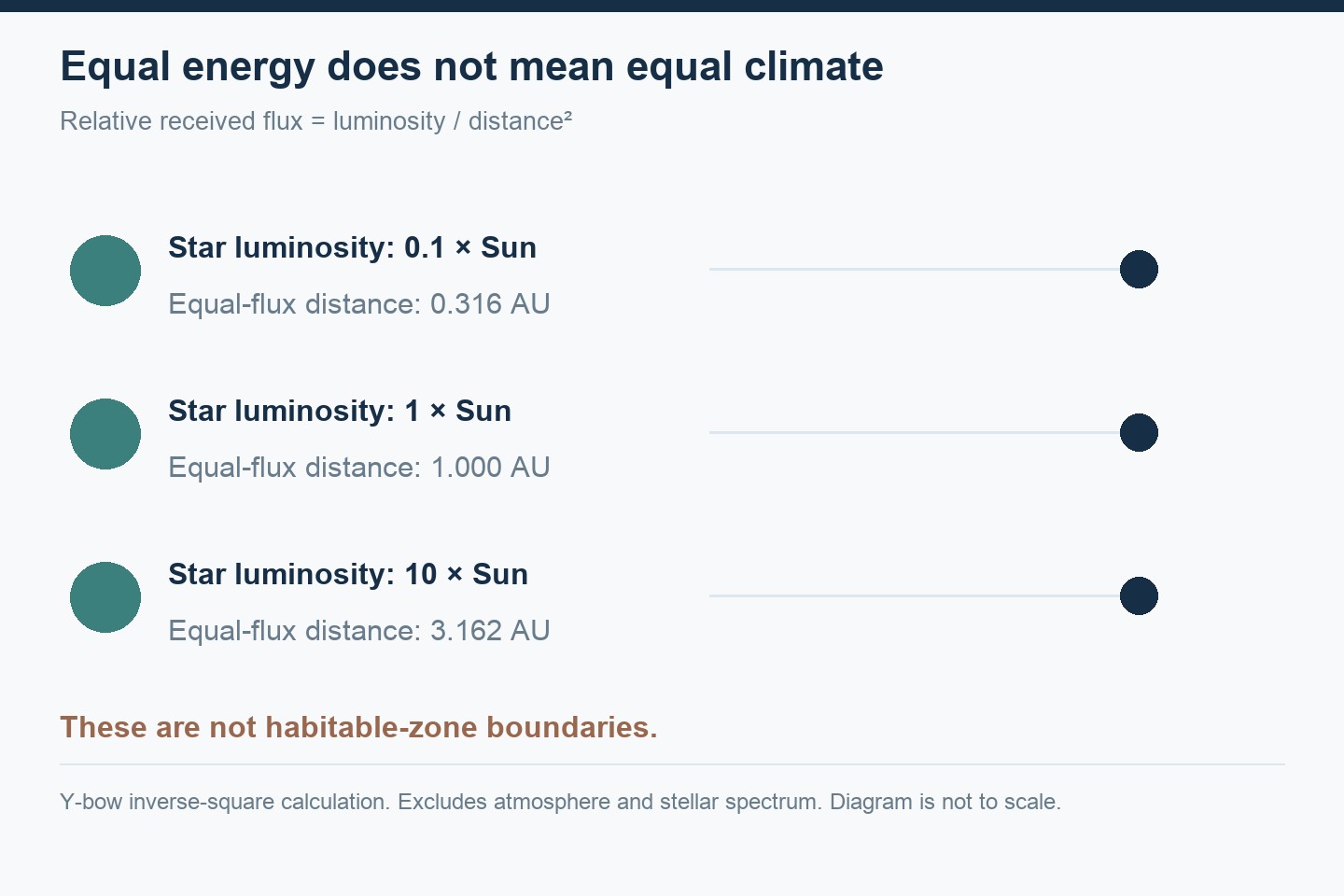
A star at one-tenth of the Sun’s luminosity gives the same simplified flux at about 0.316 AU; a star ten times as luminous gives it at about 3.162 AU. Equal flux does not imply equal climate. Different spectra interact with atmospheric gases and ice differently, so the diagram should not be used to declare a planet habitable.
What makes smaller stars complicated?
A cooler, dimmer star’s candidate surface-water region is generally closer to the star. Close-in planets may have rotational and radiation environments very different from Earth’s. Stellar activity and the long-term survival of an atmosphere can matter as much as an attractive orbital distance.
These are research questions, not reasons to rule every such planet in or out. A planet’s orbit and estimated radius alone leave many unknowns. The NASA introduction to exoplanets describes the diversity of worlds and how they are studied.
Four claims that should stay separate
First, an orbit may lie within a model’s habitable zone. Second, observations may support a rocky composition or an atmosphere. Third, stronger evidence might support particular environmental conditions. Finally, a claim of life requires evidence that cannot be explained convincingly by non-biological processes.
These steps are not interchangeable. An atmospheric molecule can have more than one origin, and a measurement can be uncertain. “Potentially habitable,” “inhabited” and “safe for humans” describe very different things. No orbital-distance calculation demonstrates that people could live unprotected on another world.
Our perspective: a search filter, not a destination label
The habitable zone helps researchers choose targets and frame models. Its value is in organizing a search that would otherwise involve a vast range of planets. The exciting next question is not merely whether a planet sits inside a colored ring, but whether observations can constrain the atmosphere and surface conditions.
For another example of a familiar label concealing different physics, read why the Moon’s far side is not permanently dark. Our ISS microgravity guide also separates popular wording from the physical mechanism.
Science explanation and schematic by Y-bow. NASA references checked October 11, 2026. Japanese counterpart.






Comments
List of comments (1)
[…] Continue with habitable zones and the limits of inference or gravity aboard the ISS. […]