
“The Sun has billions of years left” and “Earth will remain comfortable for billions of years” are different claims. The first concerns a star’s evolution. The second depends on planetary climate, atmosphere, water and biology. Treating them as one countdown hides the most interesting part of the science.
This English adaptation separates those clocks. It also avoids predicting how many generations humanity has left or assuming that future migration to another planet is inevitable.
A changing star
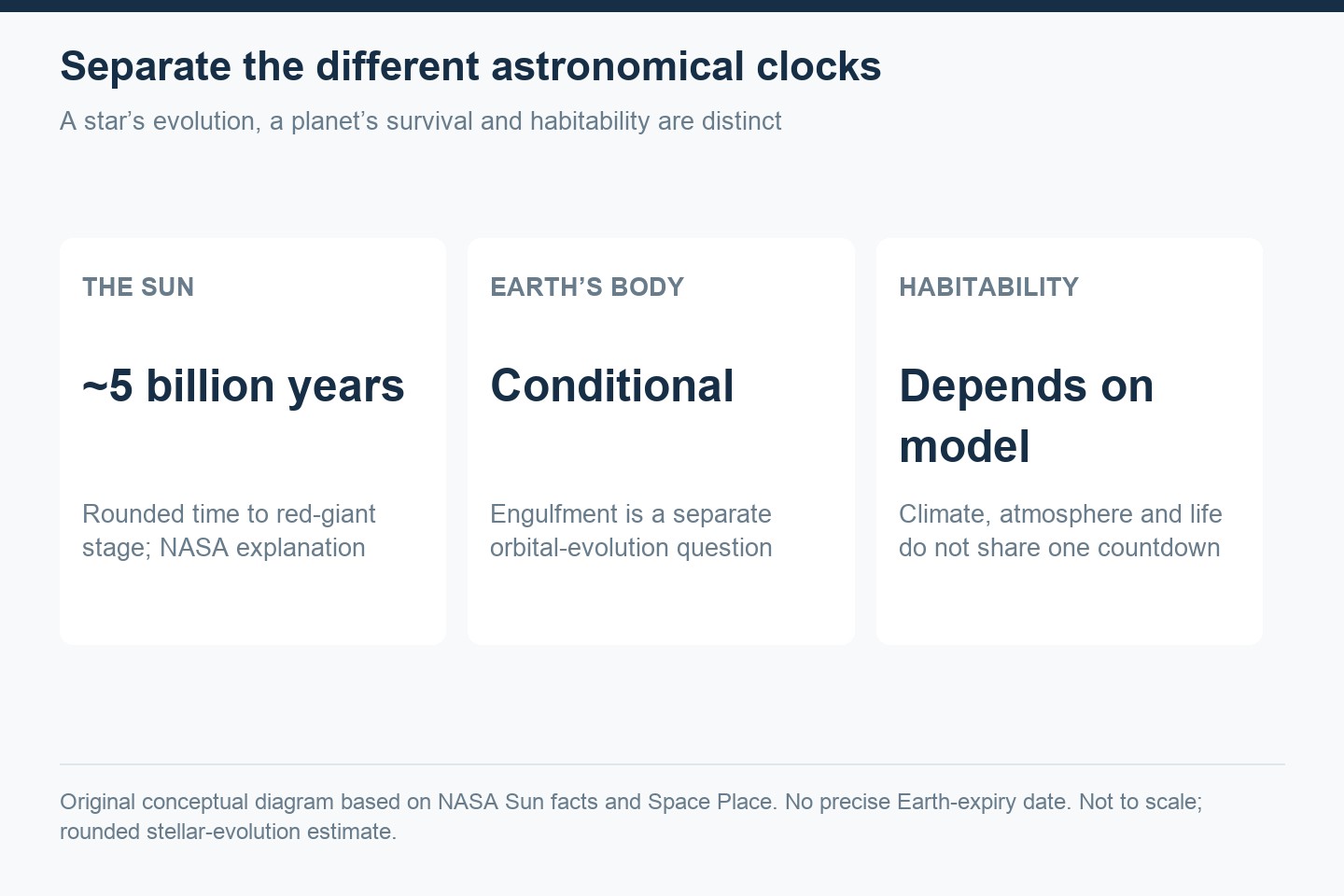
NASA’s Sun facts describes our star as roughly 4.5 billion years old. It fuses hydrogen in its core and will eventually enter a red-giant phase. NASA’s Sun age explanation gives about five billion years before that transition. These rounded educational estimates are not a date for a sudden switch.
Stellar evolution unfolds through stages. The Sun will ultimately leave a white dwarf remnant; it is not expected to explode as a supernova. The future of the planets depends on the Sun’s expansion, mass loss and their orbital interactions.
Three questions, three clocks
One question is when the Sun leaves its present main-sequence stage. Another is whether Earth is physically engulfed during later evolution. A third is when conditions become unsuitable for the kind of surface life we know. A planet can lose habitability before its solid body is destroyed.
NASA states that the red giant will engulf Mercury and Venus, and possibly Earth. “Possibly” matters. Do not replace a conditional statement about a complex orbital future with an exact date for Earth’s disappearance.
More sunlight changes the climate problem
The Sun’s output changes as it evolves. Earth’s response involves water vapour, clouds, carbon cycling and atmospheric structure, not just its distance from the Sun. Long-term climate models investigate these interactions under specified assumptions. Their outputs should be read as model-dependent scenarios.
Our habitable-zone guide explains why received stellar energy is a starting condition rather than proof of habitability. A simple inverse-square calculation cannot determine when oceans disappear or when a complex biosphere becomes impossible.
Why a generation count is misleading
Converting a rough astronomical timescale into generations produces an impressive integer but little additional knowledge. It assumes a generation length, continuous survival and stable interpretation of a distant model. The apparent precision comes from arithmetic applied to uncertain inputs.
Likewise, a statement about “life” can refer to microorganisms, complex animals or humans. Those categories tolerate very different environments. A single countdown that quietly switches between them is not a meaningful scientific conclusion.
What the long horizon does and does not mean
A distant red-giant future does not make present-day environmental risks irrelevant. Human societies operate on far shorter timescales. Astronomy explains one part of the setting; it does not replace evidence about climate, ecosystems or choices made today.
Nor does the existence of exoplanets establish a feasible destination for human migration. Detecting a planet, characterizing its environment and moving people there are vastly different challenges. A promising world is not a ready replacement Earth.
Read estimates with their conditions
When encountering a dramatic future timeline, ask which event it describes, which model supports it and how uncertainty is represented. A useful explanation can retain wonder without manufacturing certainty.
For another example of careful distinctions in astronomy, read why ISS astronauts float despite strong gravity. The common habit is to separate the measurement, the model and the interpretation before drawing a conclusion.
Adapted for the English edition; sources checked October 11, 2026. Original calculations and diagrams by Y-bow. Japanese counterpart.






Comments