
A galaxy’s rotation curve plots orbital speed against distance from its centre. It is a way to investigate the gravitational field, not just a pretty map of moving stars. Many galaxies show speeds that cannot be explained by the visible matter alone under standard gravitational modelling.
That does not mean every star ignores physical laws. It means the observed motion and the assumed mass distribution must be reconciled. Dark matter is a leading explanation within the standard cosmological framework; its physical identity remains unresolved.
Begin with a deliberately simple model
For a circular orbit in a spherical mass distribution, v² = GM( If speed instead remains roughly constant over a range of radii, the same simplified equation implies enclosed mass growing approximately in proportion to radius. That is a clue to an extended mass distribution. A disk galaxy is not exactly spherical, so real modelling must treat geometry more carefully. Our diagram is schematic. It contains no measured stars, uncertainties or named galaxy. It compares two mathematical patterns, not a fit that proves a specific dark-matter halo. ESA’s dark-Universe explanation describes stellar motions that exceed what visible matter can account for. Astronomers infer velocities from observations and combine them with models of stars and gas. Distances, viewing angles and departures from circular motion affect the result. A rotation curve is therefore evidence conditioned on measurement and modelling choices. The strongest conclusion requires more than noticing that one line is flatter than another. A 2023 ESA/Gaia discussion highlights research finding a declining outer Milky Way rotation curve. It illustrates why “all galaxies rotate at the same speed everywhere” is an overstatement. Different tracers, radial coverage and assumptions can lead to different inferences about the Galaxy’s total mass. A revised mass estimate does not automatically erase the wider dark-matter evidence. It changes part of the model being tested. Scientific progress often refines a claim rather than replacing it with its opposite. The dark-matter case also involves gravitational lensing, galaxy clusters and cosmological observations. Alternative gravitational theories are studied too, but a proposed explanation must address the broader set of observations, not just one attractive curve. Our dark matter and dark energy guide separates these subjects. Dark energy describes a different cosmological problem and is not simply the material making an individual galaxy rotate faster. Inferring unseen gravitational mass does not identify a particle. Nor does a successful halo model determine every detail of how galaxies form. Particle searches, astrophysical observations and theoretical models investigate complementary pieces of the problem. When reading a headline, ask whether it concerns the existence of a gravitational discrepancy, a galaxy’s estimated mass, a particle candidate or an alternative theory. Those are related questions with different evidence requirements. Check the axes, units, measured points, error bars and model assumptions. Distinguish an explanatory schematic like ours from observational data. The mystery is real, but it is more precise than “physics has stopped working.” Adapted for the English edition; sources checked October 11, 2026. Original calculations and diagrams by Y-bow. Japanese counterpart.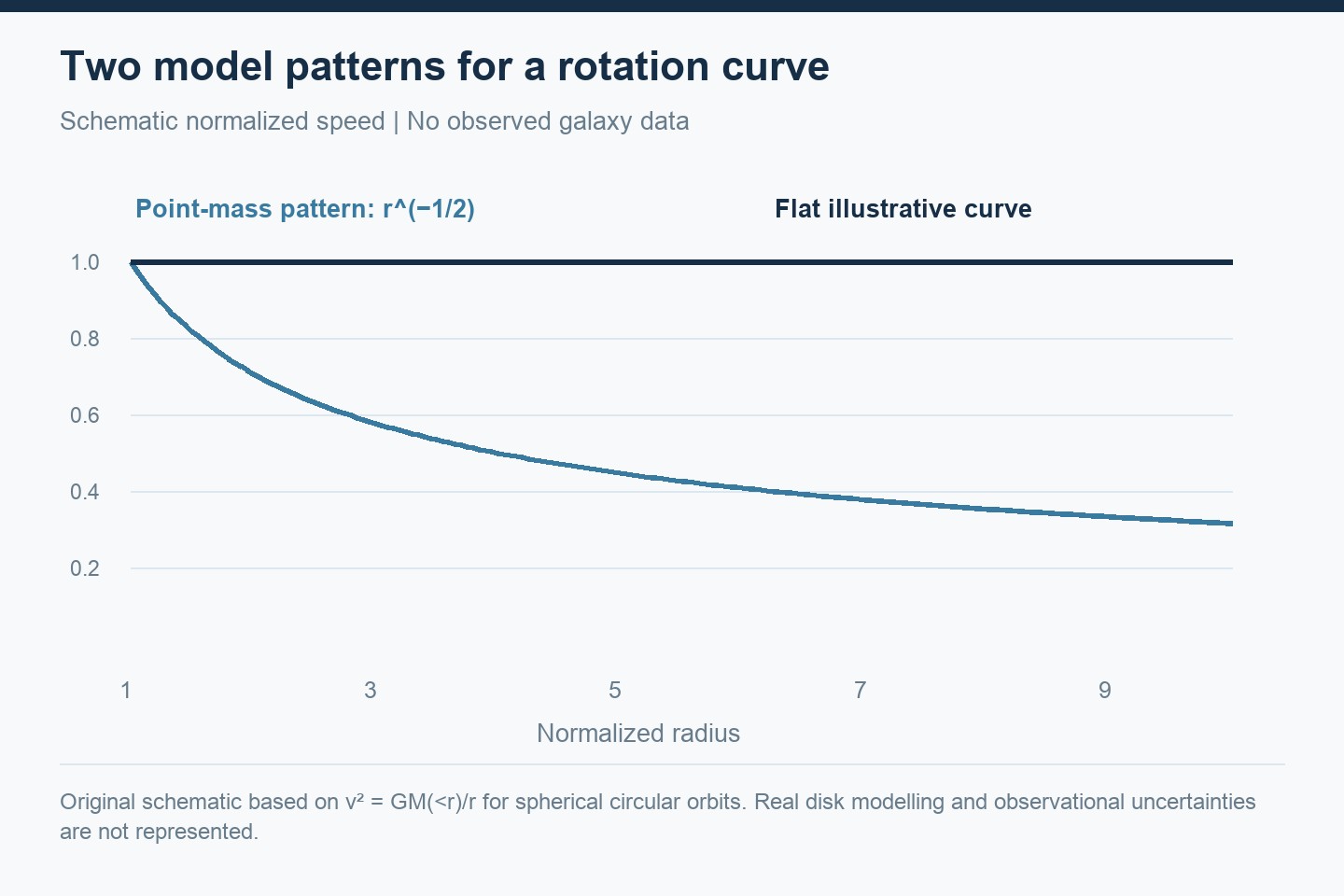
What observations add
Not every curve is perfectly flat
Rotation curves are one line of evidence
What remains unknown
A better way to read the graph




Comments