
Dark matter and dark energy are names for two different unresolved parts of cosmology. Dark matter helps explain gravitational effects that visible matter alone cannot account for. Dark energy describes the component associated with the universe’s accelerating expansion in the standard cosmological picture.
The names sound similar, but the observations, behavior and open questions are different. Neither should be described as a substance whose underlying physical identity has been conclusively established.
What the familiar 5–27–68 diagram means
A commonly presented approximate budget assigns 5% to ordinary matter, 27% to dark matter and 68% to dark energy. These represent the present cosmic energy-density budget in the standard model. They are not a count of objects, nor a statement about the mixture inside your room or a particular galaxy.
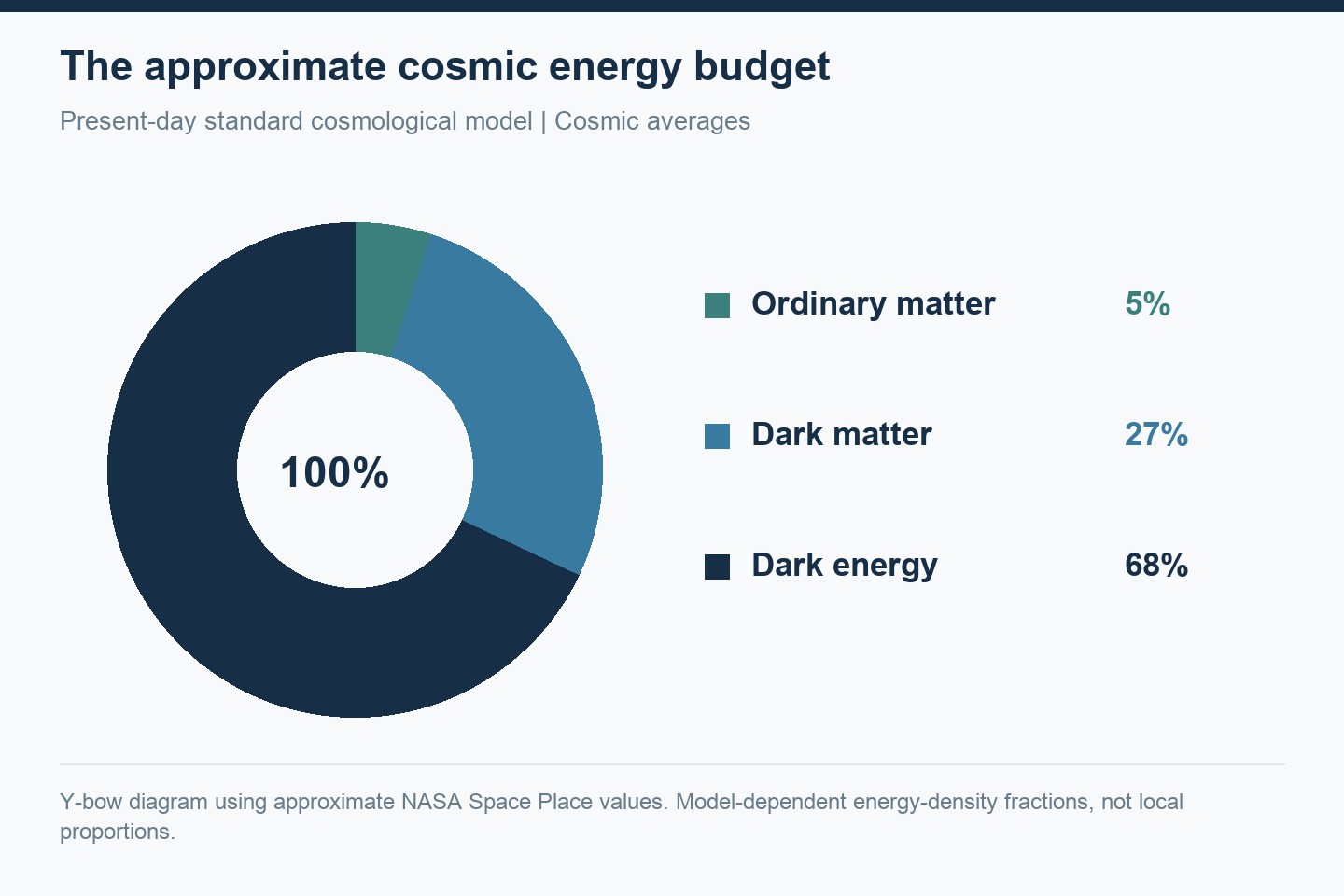
Within this schematic, matter totals 32% of the full budget. Dark matter therefore accounts for roughly 27 ÷ 32, or 84%, of the matter component. Saying “most matter is dark” is not the same statement as saying “most of the full cosmic budget is dark matter.”
The gravitational evidence for dark matter
Galaxy motions, gravitational lensing and cosmological observations point to more gravitating matter than the luminous material alone would suggest. The evidence is not just that a photograph contains dark areas. It comes from comparing observations with physical models and asking whether one explanation can account for several independent patterns.
NASA’s dark matter overview discusses these lines of evidence. The particle or other physical identity of dark matter remains an open research question. An explanation of its gravitational role should not be mistaken for a laboratory detection of a particular candidate.
Dark energy concerns expansion
Measurements of the expansion history of the universe led to the conclusion that expansion is accelerating. In the simplest standard description, a cosmological constant provides a dark-energy component. Whether that description is complete is a question for observations and theory.
Dark energy should not be described as invisible matter filling galaxies. Nor does the phrase mean that every bound system, such as the solar system, expands along with the large-scale universe. NASA’s universe building-blocks overview distinguishes the roles of ordinary matter, dark matter and dark energy.
What DESI’s hints do—and do not—establish
In March 2025, the Dark Energy Spectroscopic Instrument collaboration reported evidence, dependent on combinations with other datasets, that could favor dark energy evolving over time. The collaboration’s announcement described statistical preferences of about 2.8 to 4.2 sigma across combinations, below the conventional five-sigma discovery threshold.
That is a reason to investigate, not a declaration that a changing dark-energy law has been discovered. Dataset choices, calibration and model assumptions matter. A possible challenge to a simple cosmological constant also does not identify the microscopic nature of dark energy.
Why we avoid a countdown to the universe’s end
Predictions of a distant cosmic fate depend on how dark energy behaves over time. Different assumptions can produce different futures. Quoting a precise expiration date without those assumptions gives an impression of certainty that observations do not support.
Our perspective is that cosmology is most compelling when the inferential chain remains visible: observation, model, evidence across datasets, and unresolved physical explanation. An unknown component is not a failure to measure anything; it is a clear boundary between what patterns tell us and what they have not yet identified.
Continue with habitable zones and the limits of inference or gravity aboard the ISS.
Original educational diagram and interpretation by Y-bow. References checked October 11, 2026. Japanese counterpart.





Comments