
The Moon’s far side is not a permanently dark hemisphere. It receives sunlight as the Moon moves around Earth. “Far” tells us which side faces away from Earth; “dark” tells us whether a place is illuminated. They describe different things.
The familiar phrase “dark side of the Moon” has made an understandable misconception surprisingly persistent. The real explanation—synchronous rotation—also explains why the Moon’s rotation is essential to what we see.
The Moon rotates
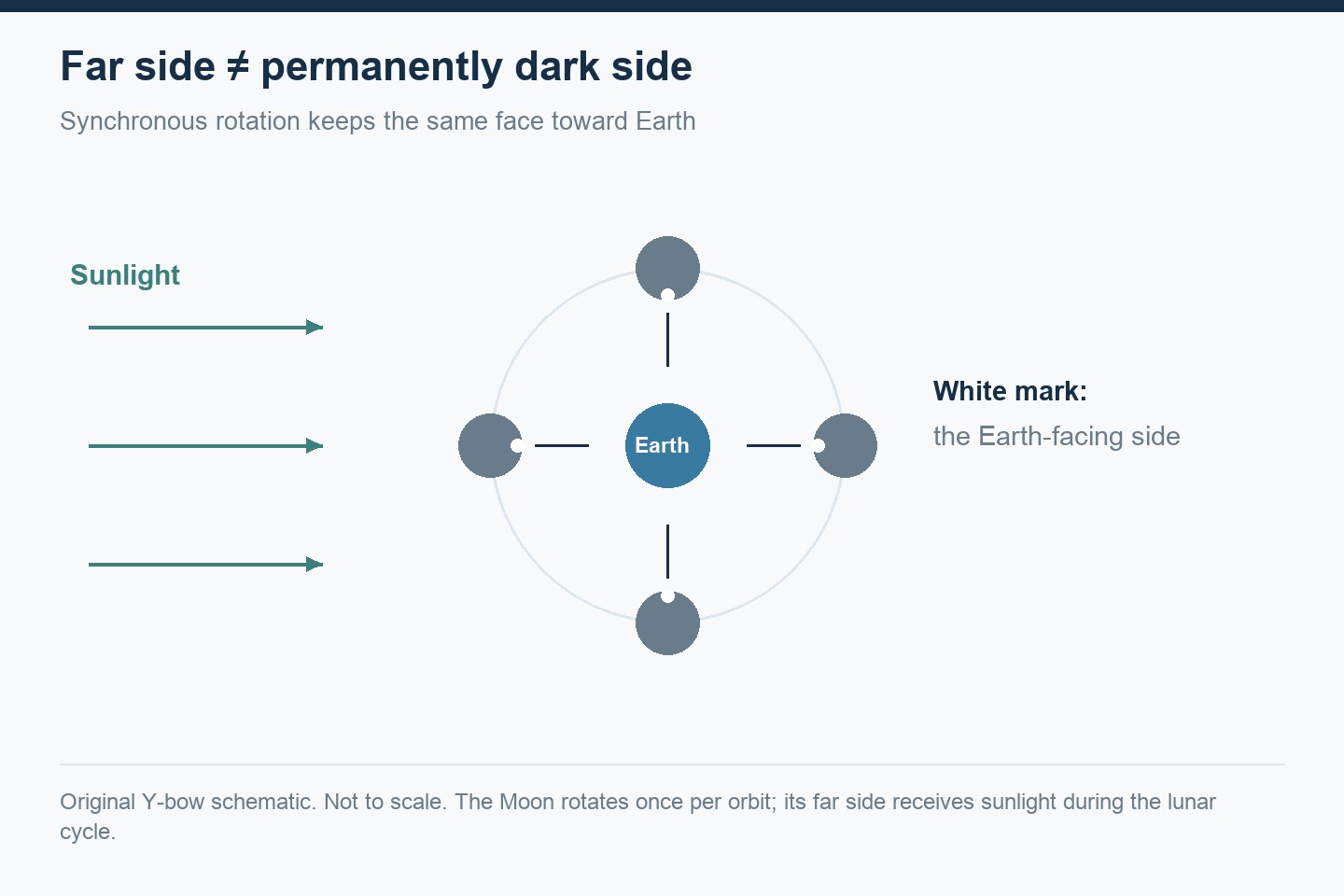
The Moon takes about the same time to rotate once as it takes to orbit Earth once, approximately 27 days. This is called synchronous rotation or tidal locking. Its rotation keeps roughly the same hemisphere facing Earth.
If it did not rotate relative to distant stars, different sides would face Earth as it orbited. A simple demonstration is to walk around a chair while always facing it: you must turn your body once during the circuit. The NASA Moon facts page describes the orbital and rotational relationship.
Far side and night side keep changing their relationship
At full Moon, the near side is broadly illuminated and visible from Earth. At new Moon, the side facing Earth is broadly unilluminated while the far side receives sunlight. The far side therefore has a day–night cycle, rather than permanent darkness.
A lunar solar day is about 29.5 Earth days, longer than the roughly 27-day orbital period because the Earth–Moon system also moves around the Sun. For visual context, NASA publishes 2026 near-side and far-side phase animations. Our illustration is independently drawn and does not reproduce those frames.
Why “roughly the same hemisphere”?
The view from Earth shifts slightly over time. This apparent rocking, called libration, lets observers see more than half of the lunar surface across a cycle. It does not mean that we routinely see the center of the far side from Earth.
The distinction matters when explaining tidal locking: it is a close rotational relationship, not a claim that every visible feature is frozen at an exactly constant viewing angle. NASA’s Moon questions guide addresses common misconceptions about illumination and viewing.
The hemispheres are geologically different
The far side has a very different surface appearance from the familiar near side, including less extensive dark volcanic plains. Crustal structure, impacts and volcanic history are important areas of lunar research. The visible difference is a geological question, not evidence that the far side never receives light.
Crater counts should also be interpreted carefully. The present appearance records a long, complicated history of impacts and resurfacing. A simple story that Earth protects one hemisphere from all impacts does not adequately explain that history. NASA’s lunar science focus areas show how researchers investigate the Moon’s evolution.
Exploring the far side has practical consequences
A spacecraft on the far side cannot maintain an unobstructed direct radio line to Earth through the Moon. Communication architecture therefore matters. The same geometry makes the region scientifically interesting for observations requiring shielding from some Earth-origin radio signals, though a usable observatory still needs power, communications and engineering.
Our perspective is that the far side is fascinating without adding mystery to its illumination. The more revealing questions concern geological asymmetry, ancient impacts and what new measurements can tell us about the early solar system.
Continue with why ISS astronauts float despite substantial gravity and what a habitable zone really means.
Science explanation and original schematic by Y-bow. NASA sources checked October 11, 2026. Japanese counterpart.

Comments