
A black hole’s event horizon marks a boundary from which light cannot escape to distant observers. Yet telescopes can study black holes through surrounding matter and their gravitational effects. Understanding the distinction between the horizon, the glowing material and the image we observe makes these objects less mysterious without making them any less remarkable.
This English adaptation of Y-bow’s Japanese introduction focuses on three questions: what the boundary means, how its size scales with mass, and what observations actually tell us. The original diagram below is a calculation for a simplified model, rather than an image of an observed black hole.
The event horizon and the bright material around it
The horizon is not a solid shell on which a spacecraft could land. It separates regions according to whether outward signals can reach distant observers. Gas outside a black hole can form a hot accretion disk and emit detectable radiation. NASA’s guide to black-hole anatomy explains why the surroundings provide so much of the information we collect.
Drawings often place a bright ring around a dark circle. Reading every part of that picture as the horizon is a mistake. The apparent dark region is affected by how light travels through curved spacetime, while the luminous material remains outside the black hole. Observing the neighborhood and observing the interior are different achievements.
An original size calculation
For an idealized, nonrotating, electrically uncharged black hole, the Schwarzschild radius is rₛ = 2GM/c². Here G is the gravitational constant, M is mass and c is the speed of light. Using G = 6.6743 × 10⁻¹¹ m³ kg⁻¹ s⁻², c = 299,792,458 m/s and an illustrative solar mass of 1.988 × 10³⁰ kg gives approximately 2.95 kilometers per solar mass. The value of G is documented by NIST.
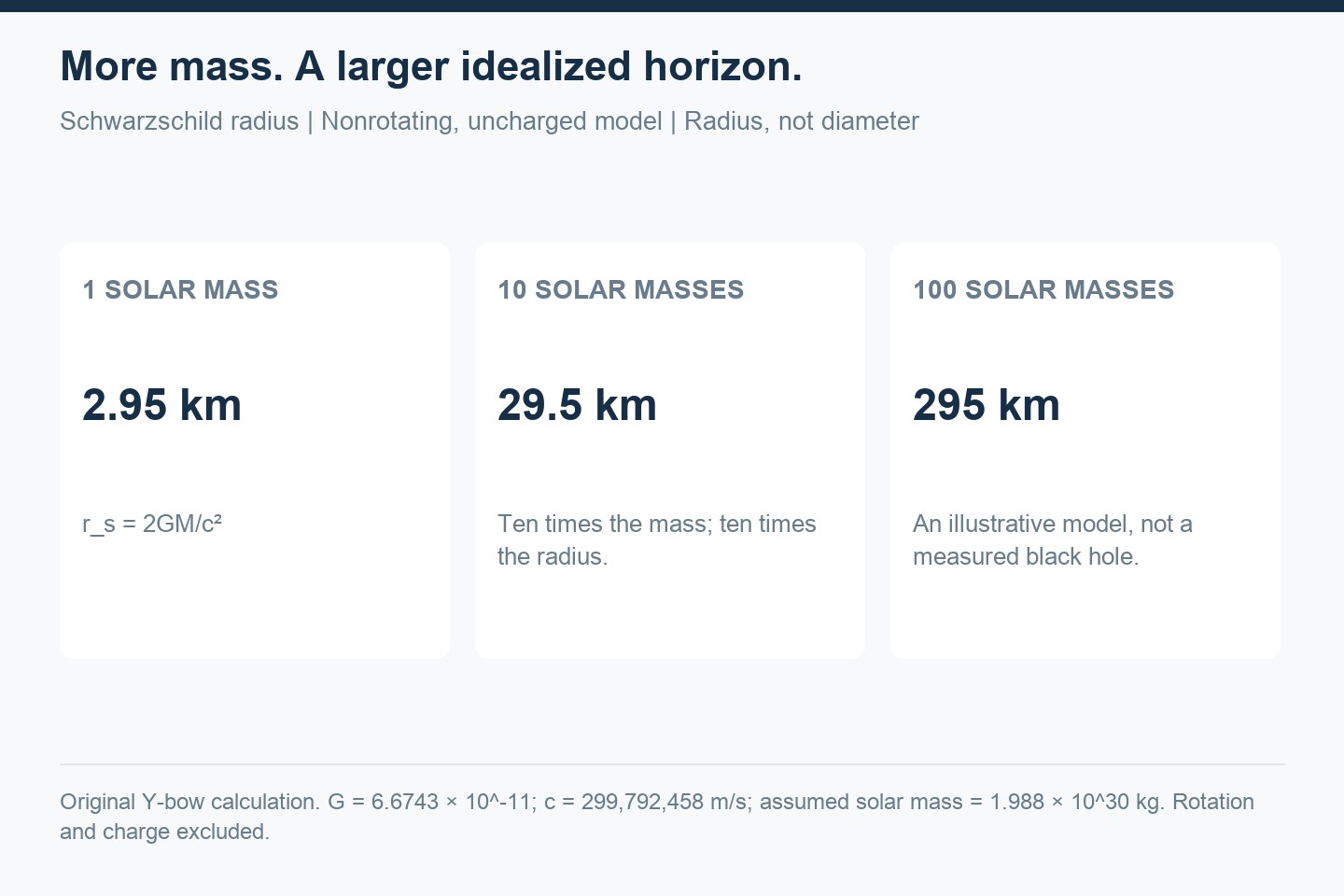
Ten solar masses therefore give ten times the radius, approximately 29.5 kilometers. One hundred solar masses give about 295 kilometers. To obtain a diameter, double these figures. Confusing the two introduces an immediate factor-of-two error, even before any sophisticated physics is considered.
This linear scaling is a model result. It is not a rule that every star with the stated mass becomes a black hole, and it does not describe every feature of a rotating black hole. NASA’s introduction also uses the roughly three-kilometer radius for an object with the Sun’s mass to communicate the scale.
Why “denser” needs a careful definition
The model lets us test a surprising statement. Define an illustrative average density by placing M inside the sphere of radius rₛ. Because the radius grows in proportion to M, the spherical volume grows in proportion to M³. The calculated average density M/(4πrₛ³/3) therefore scales as 1/M².
Under this definition, increasing the mass tenfold makes that average density one hundred times smaller. This arithmetic does not reveal the local density at the center, describe a material surface or tell us what an infalling observer measures. It shows why a familiar word such as “density” becomes misleading when its definition is left unstated.
Evidence at the center of our galaxy
The Milky Way’s center contains Sagittarius A*, a supermassive black hole with roughly four million solar masses. Stellar motion and observations of its immediate surroundings give complementary information. NASA’s galactic-center explanation and discussion of the Event Horizon Telescope image provide accessible background.
The useful reading habit is to ask what each observation measures: an orbit, a spectrum, changing brightness or a reconstructed image. Several kinds of evidence can support one physical interpretation without each independently showing the interior. Uncertainty about the interior does not erase the observations of the surrounding system.
From a dramatic picture to a precise question
Our interpretation is that black holes are most interesting when claims are separated by scale. The horizon is a spacetime boundary; a disk is surrounding matter; an image is an observation reconstructed from signals. A simple radius calculation can clarify size, while it cannot settle the deepest questions about the interior.
For a related clock-comparison problem, read time dilation and GPS. For another example of gravitational evidence, see galaxy rotation curves. Sources checked October 12, 2026. Diagram and numerical examples by Y-bow. Japanese counterpart.






Comments
List of comments (1)
[…] A related distinction appears in our black-hole guide, where the event horizon, surrounding bright matter and reconstructed image have different meanings. For another example of careful physical assumptions, read time dilation and GPS. […]