
Astronauts aboard the International Space Station float because they and the station are falling together around Earth. They are not beyond Earth’s gravity. At a representative altitude of 400 kilometers, gravitational acceleration is still about 89% of its surface value.
The ISS is in space. The useful distinction is between being in space and being free of gravity: the first does not imply the second. Orbiting is a way of falling that continually carries a spacecraft around the planet.
Gravity decreases gradually
Newton’s inverse-square relationship gives a simple estimate. Use Earth’s radius of 6,371 km and an assumed altitude of 400 km. The ratio to surface gravity is (6,371 ÷ 6,771)² ≈ 0.885. Starting from about 9.81 m/s² at the surface gives about 8.69 m/s² at that altitude.
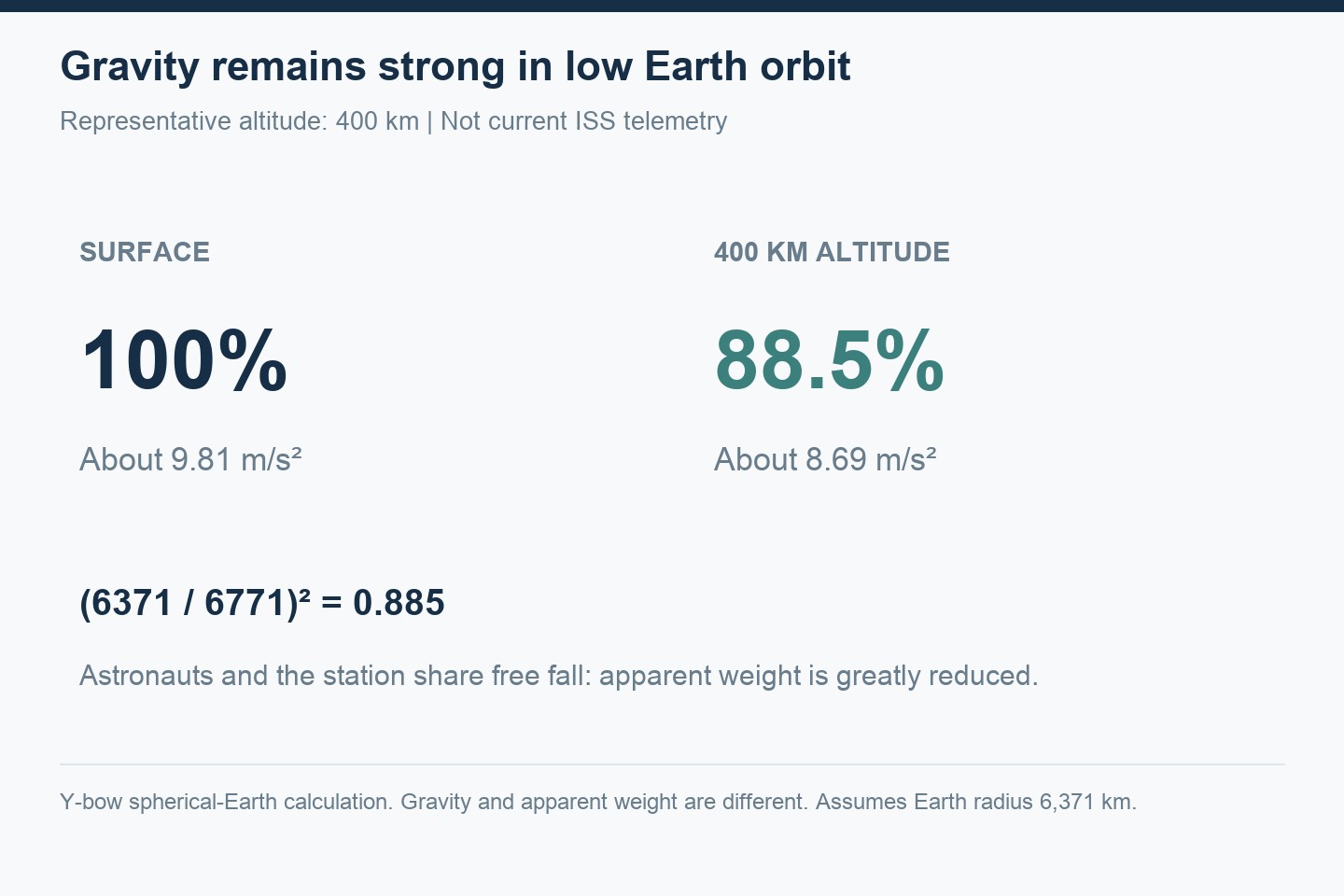
This simplified calculation neglects Earth’s oblateness, local variations and other effects, but the main conclusion is robust: gravity remains substantial. NASA’s microgravity explanation makes the same distinction between gravity and the floating experience.
Why you feel weight on the ground
Standing on a floor, gravity pulls you downward while the floor pushes upward. The support force is what a scale measures and what you experience as ordinary weight. In a falling spacecraft, there is no stationary floor continuously supporting you against gravity in the same way.
You, the cabin and an object released beside you share nearly the same falling motion. Relative to the cabin, the object can appear to hover. Gravity is acting on all of them; the difference is the absence of the familiar support force.
Falling while missing the ground
An object with enough sideways speed can fall toward Earth while the curved surface falls away beneath its path. In a simplified circular orbit at 400 km, using Earth’s gravitational parameter of about 398,600 km³/s² gives a speed of about 7.67 km/s and an orbital period of about 92.4 minutes.
Those values explain the scale of orbital motion; actual ISS altitude and orbit vary. “Falling around Earth” is not a claim that the station is plunging straight down or that it needs a continuous upward push to cancel gravity.
Why NASA says microgravity
The environment is not perfectly free from accelerations. Atmospheric drag, spacecraft maneuvers, vibrations and differences in gravity across the vehicle create small residual effects. “Microgravity” is useful wording for the resulting environment, while “zero gravity” is an imperfect shorthand.
The NASA Glenn guide discusses this environment and why researchers use it. Experiments can reveal behavior that is normally masked by sedimentation, buoyancy or other effects associated with ordinary support and gravity.
You do not need an orbit to experience free fall
Drop towers and aircraft following carefully controlled parabolic trajectories can produce brief periods of reduced apparent weight. This is not simply a matter of switching an aircraft’s engines off. The trajectory and acceleration of the cabin determine the experience. NASA describes the technique in its parabolic-flight overview.
Our perspective is that gravity and apparent weight should be taught separately. The distinction unifies falling elevators, orbital motion and floating astronauts without treating space as a region where gravity abruptly stops.
Related reading: the Moon’s synchronous rotation and how scientists infer invisible components of the universe.
Original illustrative calculations by Y-bow; NASA references checked October 11, 2026. Japanese counterpart.





Comments