
A clock does not keep one universal time for the entire universe. Motion and gravity change how elapsed time compares between observers. This is measurable physics, and satellite navigation depends on accounting for it. The useful question is not whether time feels slower, but which clocks are compared, along which paths, and under what assumptions.
This English adaptation of Y-bow’s Japanese time-dilation article replaces the folklore-based introduction with a practical guide to GPS and an original numerical example. The calculations below are explanatory models, not a proposal for a working spaceship or a measurement of a real journey.
Two effects that should not be confused
Special relativity describes the comparison of clocks in relative motion. General relativity adds the effect of gravity. Atomic-clock experiments have tested differences caused by motion and height. NIST’s explanation of these experiments is a useful starting point.
Neither effect makes a traveler experience their own seconds as strangely stretched. Their clock, bodily processes and local measurements proceed normally. A difference becomes apparent when clocks following different histories are compared. Always identify the reference clock before saying that another clock is “slow.”
An original calculation: ten years in one reference frame
For a clock moving at constant speed v in an inertial reference frame, the elapsed time on that clock is Δτ = Δt × √(1 − v²/c²), where c is the speed of light. Let Δt be ten years measured in the chosen reference frame. Applying this equation gives the following values.
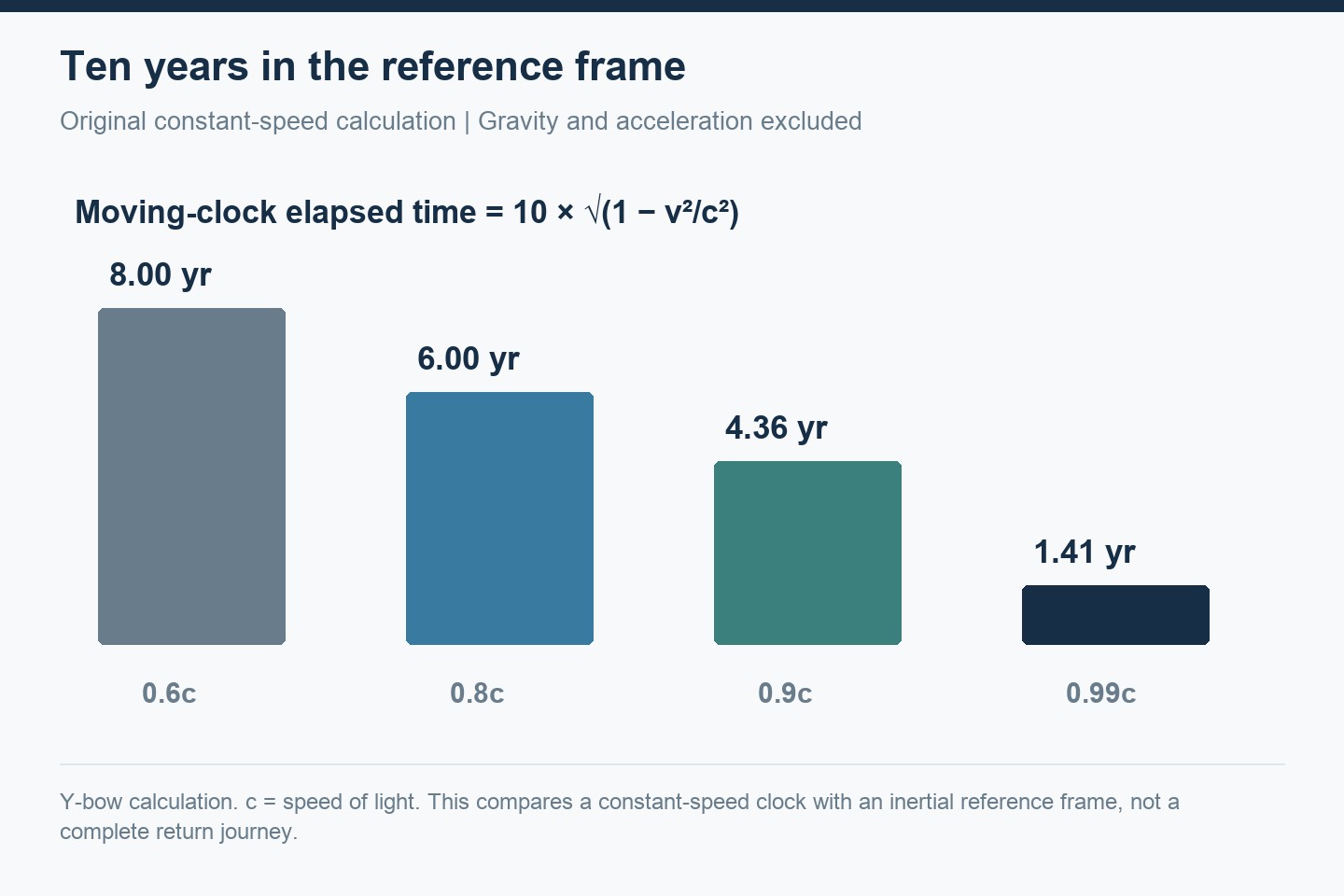
At 0.9c, the factor is √0.19, approximately 0.4359. Ten reference-frame years therefore correspond to about 4.36 years on the moving clock. At 0.99c, the factor is about 0.1411, giving 1.41 years. The trend is nonlinear: increasing the speed by a small fraction near c can change the comparison substantially.
This calculation deliberately omits departure, braking and turning around. A complete round-trip scenario must describe those stages and compare the full paths through spacetime. It would be misleading to treat the table as a finished travel itinerary. In particular, two observers moving uniformly can each describe the other clock as slow; a reunion requires a different comparison than indefinitely separated inertial frames.
Why GPS combines motion and gravity
NIST gives rounded GPS clock effects of about −7 microseconds per day from motion and +45 microseconds per day from the weaker gravitational environment in orbit. Together, that is approximately +38 microseconds per day relative to clocks on Earth. Satellite navigation accounts for these effects; the numbers are not an uncorrected error in the GPS position shown on your phone.
Thirty-eight microseconds sounds tiny. Multiplying 38 × 10⁻⁶ seconds by 299,792,458 meters per second gives about 11,392 meters, or 11.4 kilometers, of light-travel distance. This is our dimensional illustration of why timing matters, not a prediction that every receiver would drift by precisely that distance per day. Actual positioning involves several satellite signals and other corrections.
Gravity is a clock-comparison question too
Comparisons at different heights near Earth can detect gravitational time dilation even when the separation is small. This connects relativity with precision measurement rather than only with distant black holes. The same broad idea helps explain why “everyone shares the same now” is an unreliable guide to clock comparisons.
For the orbital context, read why astronauts float on the ISS. For the importance of specifying a reference frame, our guide to the Solar System’s galactic motion makes a useful companion.
What the examples establish—and what remains fiction
Our interpretation is that the most interesting lesson is already practical: a seemingly absolute everyday quantity becomes a careful measurement problem. GPS engineers need a consistent clock model, while readers need a consistent description of the observer and journey. Both benefit from making assumptions explicit.
The examples do not show that a massive spacecraft can reach light speed, travel into the past or safely approach a black hole. They show how to calculate one well-defined comparison. Separating the equation, the model assumptions and the engineering challenge makes the science more interesting and the claims more reliable.
Sources checked October 12, 2026. Physical context: NIST, Putting Einstein to the Test. Numerical examples and diagram calculated by Y-bow. Japanese counterpart.







Comments