
You own TQQQ and worry about a near-term decline. Could buying SQQQ let you keep the position while stopping the downside? An equal-dollar pair can offset the initial daily index target in an idealized model. It does not freeze the hedge after prices move.
Here, “holding both” means buying and owning both ETFs. This is not a strategy of shorting both products, using options or borrowing to trade. Official product objectives were checked on November 5, 2026. All calculations below are hypothetical: perfect daily +3× and −3× returns with costs omitted. They are neither actual fund results nor forecasts.
Daily targets do not reverse an entire holding-period return
ProShares describes TQQQ as targeting three times the Nasdaq-100’s daily performance before fees and expenses; SQQQ targets the daily inverse at three times. The objective is daily. It is not a promise that one fund earns three times the index’s weekly or annual return while the other earns its exact negative.
Also distinguish a fund’s internal daily exposure management from your account’s allocation. The funds do not automatically restore your TQQQ and SQQQ holdings to equal dollar values. Your own portfolio can drift even while each fund pursues its stated daily target.
Equal dollars are different from equal share counts
One hundred shares of each product does not imply equal dollar exposure. With hypothetical share prices of $50 and $20, those positions are worth $5,000 and $2,000. Splits and reverse splits change share counts and per-share prices, but they do not make share count a better basis for comparing the two sides.
Let T and S denote the dollar holdings, with initial capital of 100. A simplified initial daily target exposure is 3 T − 3 S net. Adding the absolute sizes of the two target exposures gives 3 T + 3 S gross. Gross exposure is a bookkeeping aid here, not value at risk or a maximum-loss estimate.
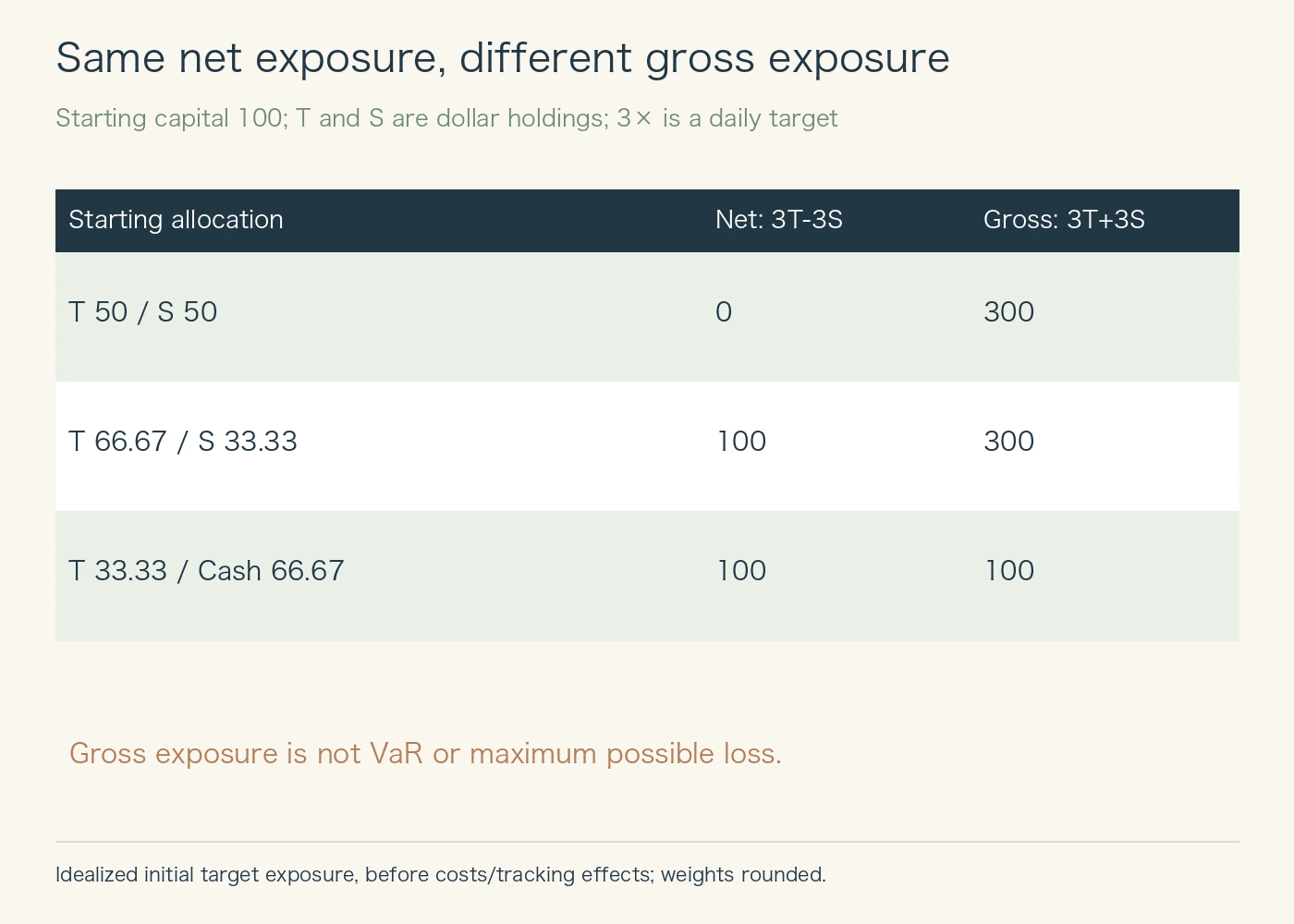
Focusing only on a zero net number makes the position look inactive. Yet both daily leveraged exposures remain. Gross 300 does not predict a loss of 300; it reminds us that offsetting a directional target is different from eliminating the two instruments and their implementation requirements.
Advertisement
An index round trip can leave the equal-dollar pair below its starting value
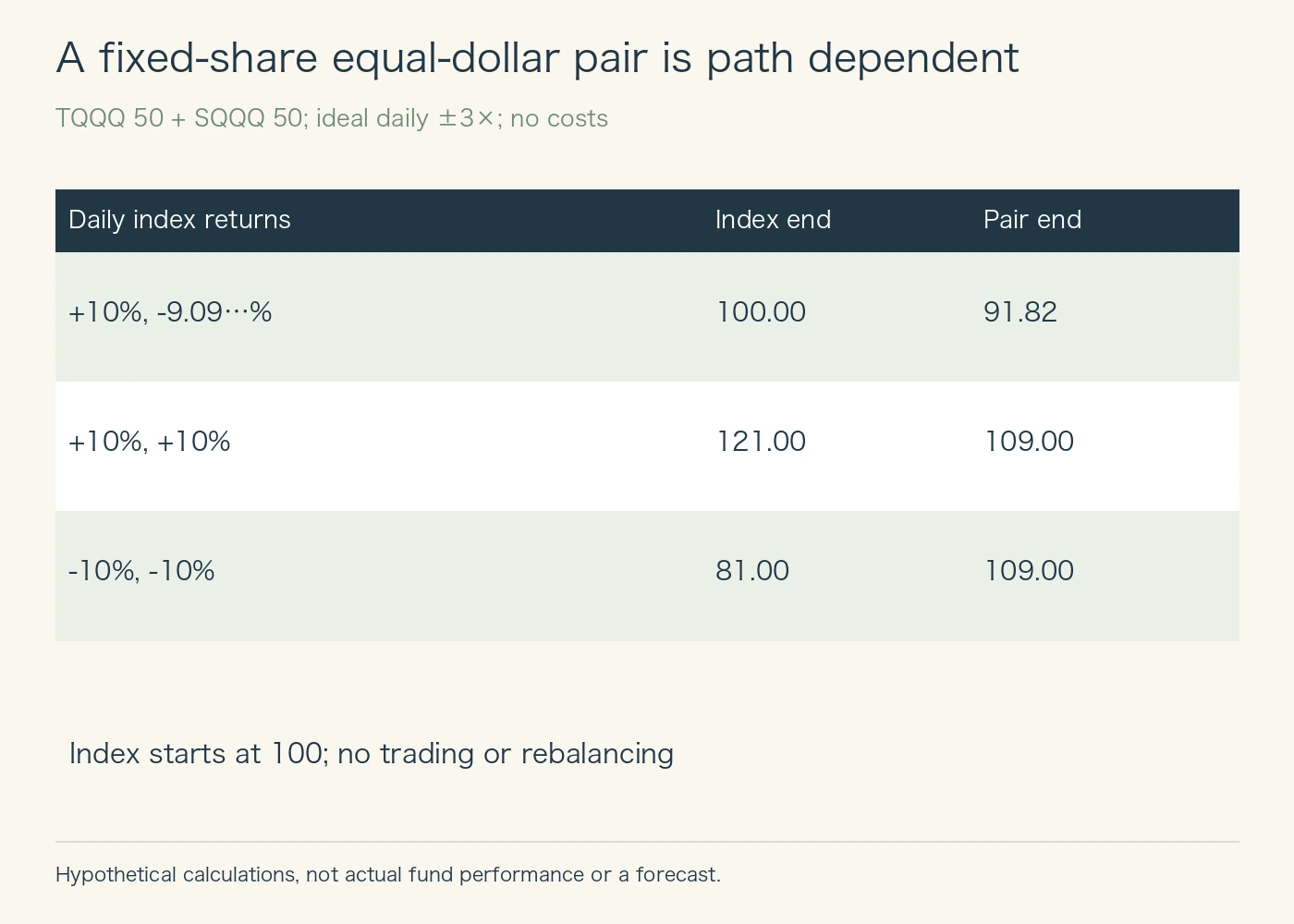
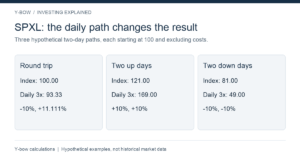
Start with TQQQ 50 and SQQQ 50, then keep the share counts unchanged. If the index rises 10% on day one, the ideal fund values become 65 and 35. The total is still 100, but the allocation is now 65/35.
On day two, let the index fall 9.0909…%, returning from 110 to 100. The ideal fund returns are −27.2727…% and +27.2727…%. The combined value is 65 × (1 − 3/11) + 35 × (1 + 3/11) = approximately 91.82. Initial cancellation did not preserve the starting value across the round trip.
But “the pair always loses” is also incorrect
Under the same assumptions, two consecutive 10% index gains produce TQQQ 50 × 1.3² = 84.5 and SQQQ 50 × 0.7² = 24.5: a total of 109. Two consecutive 10% index declines reverse the roles and also produce 109.
That result is not a profit guarantee. For an initially equal-dollar pair over exactly two days, algebra gives total value 100 × (1 + 9r₁r₂), where r₁ and r₂ are the index’s daily returns. Same-sign returns make the product positive; opposite signs make it negative. A longer sequence adds further path terms, so do not apply this two-day expression unchanged to a multi-month holding.
Selecting only a round trip would overstate the case for inevitable loss. Selecting only a trend would overstate the case for a profitable strategy. Real funds have expenses, financing, execution and tracking effects, and the daily objective is not guaranteed. The simple arithmetic should not be extrapolated through extreme moves that would imply a negative fund value.
The next day’s hedge is no longer neutral
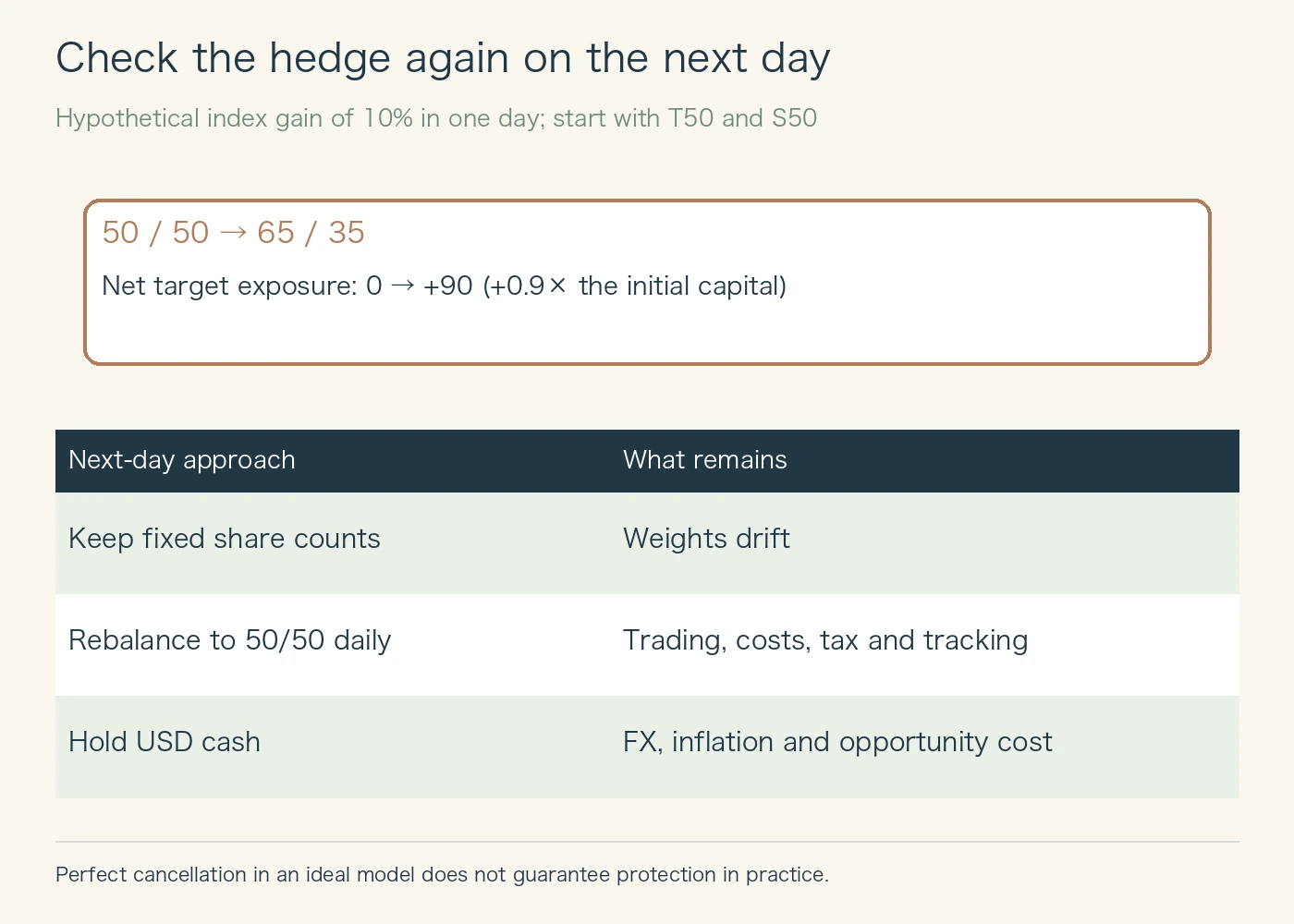
After that first gain, the next day’s net target is 3 × 65 − 3 × 35 = 90. Relative to account value 100, the pair now has approximately +0.9× directional target exposure. Yesterday’s equal-dollar entry is not evidence that today’s position remains neutral.
To restore 50/50, you would need to sell some of the larger side and buy more of the smaller side. If the pair were restored to equal dollars every day, both funds achieved perfect opposing daily returns, trades occurred at the same reference time and all costs were zero, the daily changes would cancel. Those assumptions describe a mathematical limit, not a practical cash substitute.
Spreads, execution timing, trading costs, fund expenses, taxes and tracking differences break the ideal equality. A rule that demands repeated trading also requires repeated monitoring. Fund-level daily resetting and investor-level rebalancing are separate operations.
Related book (affiliate advertisement)
Background reading on diversification, investment discipline and trading costs. It is not an endorsement of the ETF combinations or allocations discussed here.
A Random Walk Down Wall Street (English paperback)
View this edition on Amazon Japan
Check the linked page for price and availability. As an Amazon Associate, Y-bow earns from qualifying purchases.
Advertisement
Adding SQQQ versus reducing TQQQ and holding cash
Use the same capital when comparing alternatives. Adding 100 of fresh cash to buy SQQQ alongside an existing TQQQ 100 position creates a 200 account. Comparing it directly with a 100 cash account confuses a strategy difference with a funding difference.
Instead, start both alternatives with 100 and the same initial net target exposure of +100. Portfolio A holds two-thirds TQQQ and one-third SQQQ. Portfolio B holds one-third TQQQ and two-thirds zero-interest USD cash. A’s gross target exposure is 300; B’s is 100. Keep share counts fixed through the same two-day paths.
← Swipe to view the full table →
| Index path | A: 2/3 TQQQ + 1/3 SQQQ | B: 1/3 TQQQ + 2/3 cash |
|---|---|---|
| +10% then −9.0909…% | 92.73 | 98.18 |
| +10% then +10% | 129.00 | 123.00 |
| −10% then −10% | 89.00 | 83.00 |
A retains more value in the sustained-decline example, while B retains more in the round trip. Neither outcome identifies a universally optimal allocation. A retains an inverse leveraged position with its own changing value; B keeps a fixed cash component in this model. Matching the initial net exposure does not match future behavior.
USD cash removes the stock-index exposure of that portion, but does not eliminate every financial risk. Investors spending in another currency still face exchange-rate changes. Inflation, foregone investment returns and the terms of the particular cash arrangement remain relevant. “Cash” should identify the currency and vehicle rather than stand for unconditional safety.
Write down the objective before choosing the implementation
← Swipe to view the full table →
| Question | What to document |
|---|---|
| What am I trying to reduce? | A daily index move or a longer-term portfolio drawdown |
| Did I align capital? | Fresh contributions and borrowing in each alternative |
| What remains fixed? | Share counts, dollar amounts or target weights |
| What costs apply? | Current fund terms, spreads and trading charges |
| What tax treatment applies? | Residence, account type and offsetting-position rules |
| How does the hedge end? | Monitoring conditions and an explicit exit or review rule |
Buying an inverse fund instead of selling an existing holding is not automatically a tax-saving technique. Offsetting positions can receive different treatment across jurisdictions and account types. Do not book an assumed tax deferral or loss offset as a benefit without checking the complete transaction.
If the goal is less stock-index sensitivity, compare adding an opposing instrument with reducing the original position under the same funding assumptions. Complexity is not evidence of superiority, and simplicity alone does not establish optimality. The useful test is whether the position and its maintenance requirements match a clearly stated objective.
Frequently asked questions
Will equal share counts hedge the two funds?
Not necessarily. First calculate shares multiplied by price to obtain dollar holdings, then evaluate the initial daily targets. Recheck after prices change.
Does daily 50/50 rebalancing make the pair cash?
Only the idealized no-cost, perfect-tracking model cancels exactly. Real execution, taxes, fund expenses and tracking effects remain. The model is not a guarantee of capital preservation.
Does holding both always lose money?
No. Even this simple two-day model produces different outcomes for a round trip and a sustained trend. Unknown future paths prevent those examples from becoming reliable return forecasts.
Related reading and reproducible calculations
For a different cash allocation comparison, see TQQQ plus cash versus QLD. For rules governing allocation changes, see TQQQ rebalancing frequency and cash limits. The author’s free Japanese-language SOXL calculation guide is optional background on daily targets; SOXL follows a different index.
At each step, multiply the preceding T balance by (1 + 3r) and the preceding S balance by (1 − 3r). Carry full precision and round only the displayed result to two decimals. Cash interest, distributions, expenses, taxes and tracking differences are omitted. Initial capital 100 is an arbitrary unit, not actual share prices or a backtest. Official objectives: TQQQ and SQQQ. The hero is an AI concept image; the three body figures are original calculations and diagrams.
This article provides general education, not personalized investment advice.




Comments