
A headline says “the Nasdaq rose,” but QQQ in your account shows a different percentage. Before blaming tracking error, identify the benchmark. Nasdaq Composite and Nasdaq-100 are different indices, while Nasdaq is also the name of an exchange. Similar labels can hide different comparisons.
Official materials were checked on November 5, 2026. This is a guide to interpreting benchmarks, not a prediction about which ETF will outperform. We have not obtained complete holdings for both products on the same date, so the allocation example below is explicitly hypothetical rather than a disguised current portfolio comparison.
Exchange, index and fund are three different layers
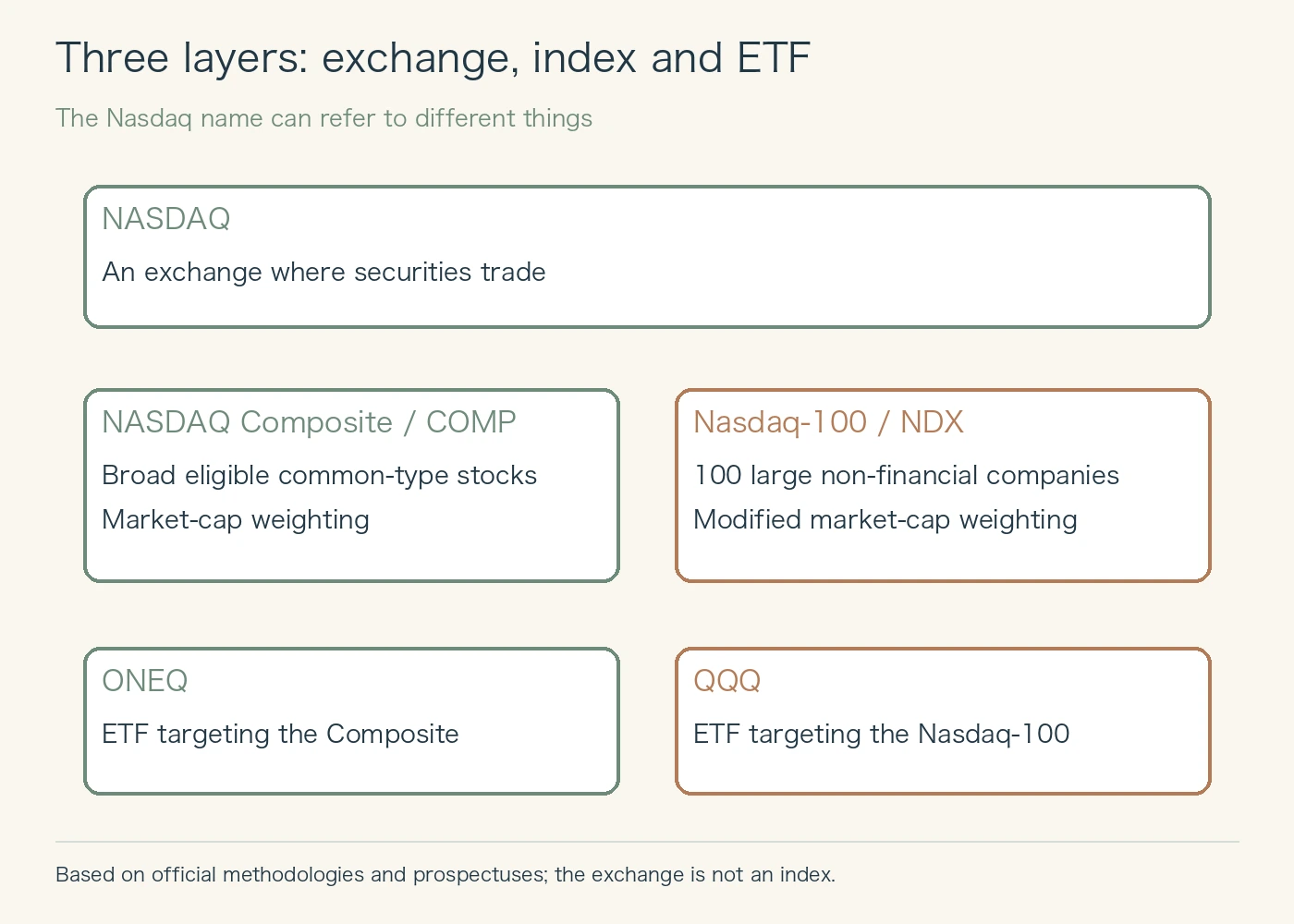
An exchange is a marketplace where securities trade. An index combines selected securities under a defined methodology. An ETF is a tradable fund that implements an investment objective, often tracking an index. Being listed on Nasdaq is not the same as being included in every index bearing its name.
A headline’s shortened “Nasdaq” frequently refers to the Composite, but the label alone is insufficient. Check the full index name or symbol. COMP and NDX are useful distinctions. Comparing QQQ with the Composite can answer a question about different market exposures; it cannot, by itself, measure how accurately QQQ followed its own benchmark.
Composite versus Nasdaq-100: scope and weighting
← Swipe to view the full table →
| Feature | Nasdaq Composite | Nasdaq-100 |
|---|---|---|
| Primary scope | Broad eligible Nasdaq-listed common-type securities | 100 large Nasdaq-listed non-financial companies |
| Financial companies | Can be included | Excluded by definition |
| Weighting | Market capitalization | Modified market capitalization |
| Counting constituents | Eligible security count changes | Company count can differ from security-line count |
| ETF example | ONEQ | QQQ |
These definitions follow the official Composite methodology and Nasdaq-100 methodology. The Composite does not simply include every product traded on the exchange: ETFs, preferred shares and certain other securities are ineligible. Nasdaq-100 is not a list of the world’s largest technology businesses regardless of where they trade.
One company can also have multiple eligible share classes. That is why a constituent file can contain a different number of security lines from the “100” companies in the name. Read the selection framework before treating the row count as proof of an inconsistency.
Index rules can evolve. The 2026 Nasdaq-100 methodology includes provisions for expedited entry of certain large new listings and treatment of low-float securities in weighting. For details, use the current methodology rather than assuming every rule from an older comparison remains unchanged. The durable point is the distinction between a broad eligible universe and a selected non-financial-company benchmark.
Advertisement
A broader constituent list can still be driven by large companies
Including smaller companies and financial businesses does not mean those groups dominate daily index changes. Capitalization weighting gives larger companies more influence. More names in a list do not automatically produce equal weights or many independent sources of risk.
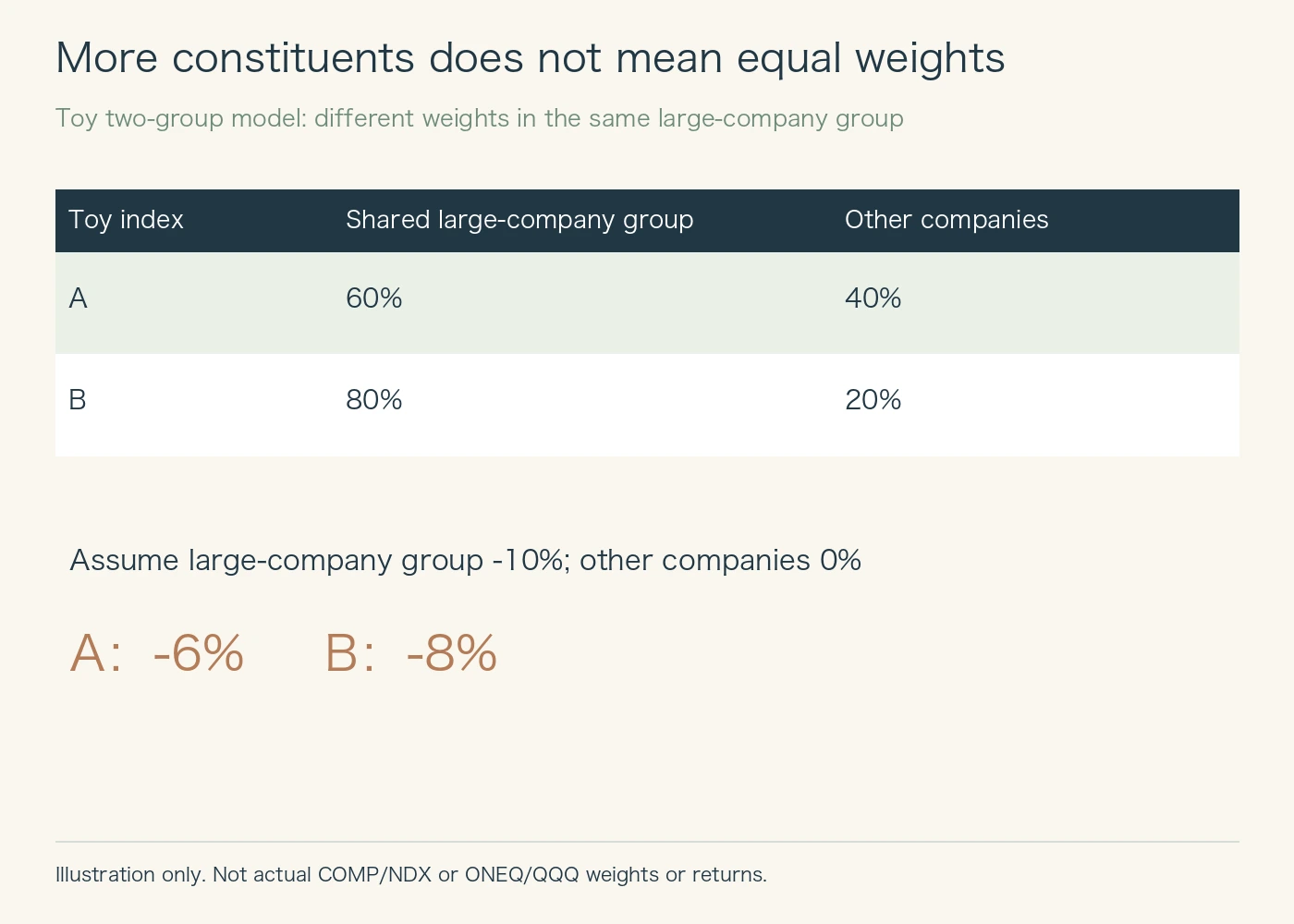
Imagine two indices with a shared large-company group. The group has a 60% weight in A and 80% in B. If it falls 10% while everything else is flat, A falls 6% and B falls 8%. The example isolates a weighting difference: owning many of the same businesses does not require identical performance.
If the other companies rise instead, the index with greater exposure to that group gets the larger contribution. Neither case tells us which pattern will occur next. To measure actual concentration, use complete holdings or constituent data from a common date. Decide whether to combine share classes and check that sector classifications are comparable.
ONEQ holdings are not automatically the entire Composite
The January 29, 2026 Fidelity prospectus describes ONEQ’s objective of closely corresponding to the Composite’s price and yield performance and its use of statistical sampling. A fund holdings list and a complete index constituent list therefore answer different questions.
Think of the index as the specification and the ETF as an implementation. Sampling does not mean holding every constituent at precisely the index weight. A shorter fund holdings list is not, on its own, proof that the manager follows a different benchmark. Examine the stated objective, implementation method and actual tracking difference separately.
Invesco identifies the Nasdaq-100 as QQQ’s benchmark. Fund expenses and trading conditions matter, but attributing the whole difference between QQQ and the Composite to fees skips the much larger question of whether the comparison used the correct index. Benchmark mismatch comes before small implementation differences in the diagnostic order.
Five checks when a headline and your ETF disagree
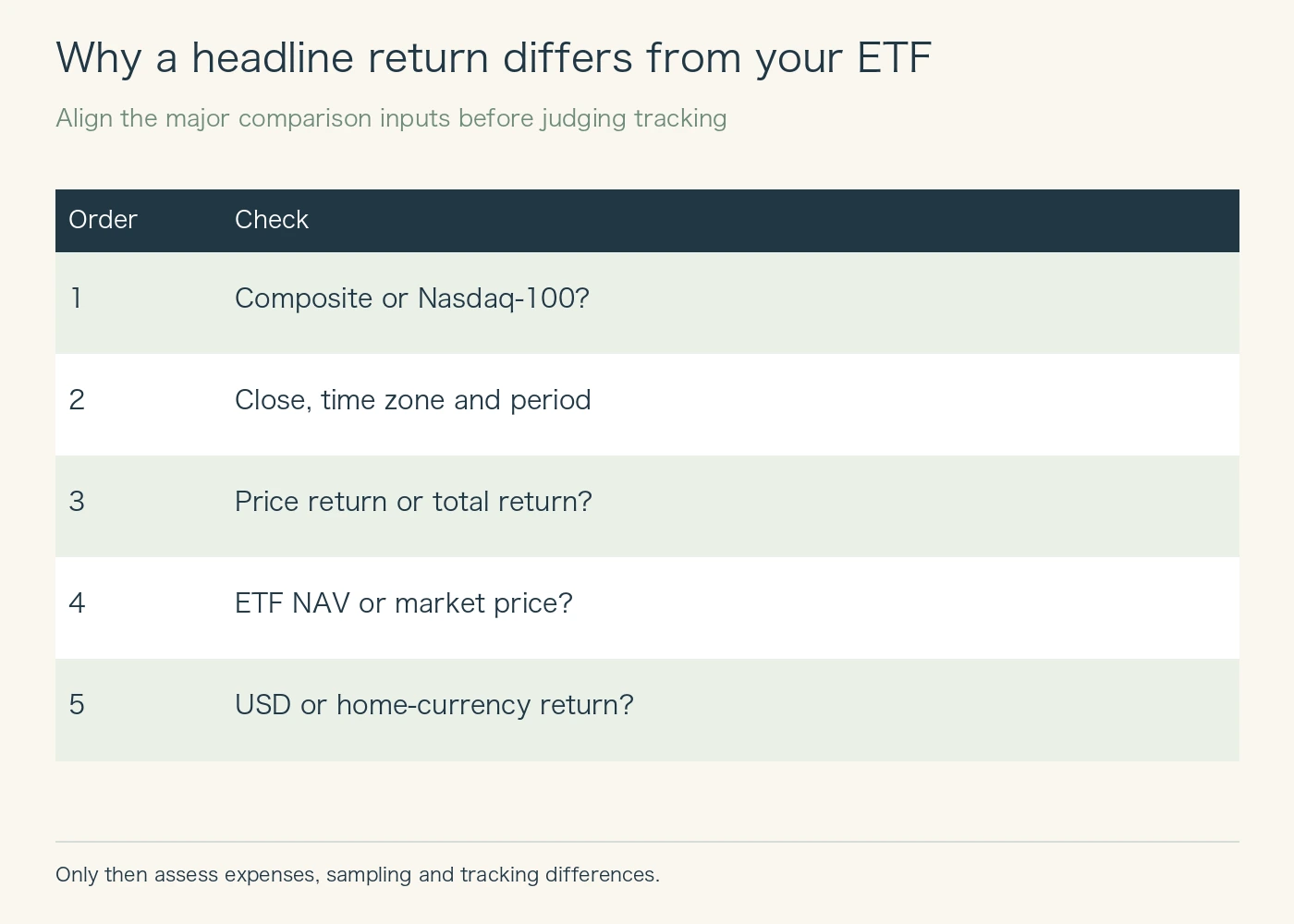
1. Match the actual index
Identify Composite or Nasdaq-100. Comparing their returns is valid when you want to understand different exposures. Label it accordingly. For QQQ tracking analysis, compare QQQ with its stated benchmark using compatible return definitions.
2. Match the clock and the interval
An official US close, an after-hours ETF quote and an account valuation viewed in another time zone can refer to different moments. “Today” is not a universally identical interval. Record start and end dates, the pricing time, the time zone and any quote delay. A start-of-day contribution also changes an investor’s personal return calculation.
3. Match price return and total return
A price-only index is different from a return series including distributions. An ETF’s ex-distribution price adjustment should not be assessed while ignoring the distribution itself. Look for “price return,” “total return” and reinvestment assumptions in the data notes. Do not repair the mismatch by manually adding a current yield to an unrelated historical price change.
4. Separate NAV from market price
Net asset value per share reflects the fund’s assets and liabilities, while market price is the price at which its shares trade. Spreads, supply and demand, and the timing of a trade can create differences. A published NAV return is not a promise about the exact execution prices an individual investor receives.
5. Use a common currency
For a simple unhedged example, suppose a dollar asset rises 5% but the dollar falls 10% against the investor’s home currency. The converted return is 1.05 × 0.90 − 1 = −5.5%, before costs and taxes. A positive dollar return can coexist with a negative home-currency return. US-dollar investors do not have that particular conversion; investors elsewhere should use their own spending currency.
Related book (affiliate advertisement)
Background reading on diversification, investment discipline and trading costs. It is not an endorsement of the ETF combinations or allocations discussed here.
A Random Walk Down Wall Street (English paperback)
View this edition on Amazon Japan
Check the linked page for price and availability. As an Amazon Associate, Y-bow earns from qualifying purchases.
Advertisement
Access, tax treatment and diversification are separate decisions
An ETF’s existence does not ensure it is available through every broker or account. Verify product access, local documentation and tax treatment in your own jurisdiction. A US-focused comparison does not automatically apply to a Japanese NISA account or to an investor resident elsewhere.
Holding ONEQ and QQQ together also does not remove overlapping companies. In a hypothetical 50/50 allocation, a company weighted 8% in one fund and 12% in the other represents 10% of the combined portfolio. Those percentages are illustrative, not current holdings. Count the combined company and sector exposures rather than the number of tickers in the account.
← Swipe to view the full table →
| Question | Relevant evidence | Misleading shortcut |
|---|---|---|
| Which companies are eligible? | Current index methodologies | Infer the universe from the ETF name |
| What does the fund actually own? | Fund holdings from the same date | Treat all index members as fund positions |
| How well did it track? | Compatible index and NAV return series | Mix benchmarks, currencies or dates |
| What will it cost me? | Current prospectus and broker conditions | Treat expense ratio as every cost |
After those comparisons, assess any remaining difference from expenses, sampling and implementation. A residual gap deserves examination, but it should be measured on equal terms. This sequence makes the question more precise without assuming one fund is faulty whenever its percentage differs from a news headline.
Common questions
Does QQQ track the Nasdaq Composite?
No. QQQ’s benchmark is the Nasdaq-100. ONEQ is an example of a fund seeking to track the Composite. Check the formal index name whenever a screen abbreviates both to “Nasdaq.”
Is the Nasdaq-100 exactly 100 technology stocks?
It targets 100 large non-financial companies, not exclusively technology companies. Company count and security count can differ when multiple share classes are included.
Does a larger number of holdings make ONEQ automatically safer?
No. Company weights, sectors and related business exposures matter. A broad equity decline can affect both funds; a longer constituent list is not a guarantee of lower future losses.
Related guides, sources and future updates
For a different benchmark comparison, see S&P 500 versus Nasdaq-100. That guide addresses the company-selection and risk question against the S&P 500; this article addresses Composite/100 confusion and the connection to ONEQ and QQQ.
Sources: Composite methodology, Nasdaq-100 methodology, ONEQ prospectus and QQQ official overview, checked November 5, 2026. Update definitions when methodology changes. Any future holdings or performance comparison should state its date, currency, dividends and valuation basis. The hero is an AI concept image; the three explanatory figures are original. No missing current holdings were inferred to create the toy example.
This article provides general education, not personalized investment advice.


Comments