
Choosing between an ETF and a mutual fund starts with how you want to own and trade an investment. It does not, by itself, decide whether you will own stocks or bonds, use an index strategy or hire an active manager. Those are separate decisions that are easily mixed together in product comparisons.
This English adaptation of Y-bow’s Japanese fund-comparison article uses the U.S. mutual-fund and ETF framework as an example. Availability, minimum investments, tax treatment and investor protections differ by country and platform. In particular, the U.K. term “investment trust” commonly refers to a different, closed-ended structure; it should not be treated as a direct translation of every Japanese investment fund.
Separate the wrapper from the investment strategy
Mutual funds and ETFs pool investors’ money. Either wrapper can hold a portfolio managed actively or following an index. The SEC’s comparison of their characteristics is a useful reference. An ETF label does not establish that a fund is inexpensive, broadly diversified or suitable for long-term holding.
For example, a broad equity index fund and a narrowly focused leveraged ETF differ in much more than trading mechanics. Comparing only the wrapper would hide the larger decision about exposure. Our TQQQ explanation illustrates why the underlying objective deserves its own examination.
Net asset value and the price you actually pay
For the ordinary U.S. mutual funds discussed here, purchases and redemptions generally use the next calculated net asset value, or NAV. Retail investors trade ETF shares on an exchange during the trading day. The market price can differ from NAV. See the SEC’s ETF investor bulletin.
Use an invented ETF with NAV of 100 per share. If its ask price is 100.20 and its bid price is 100.00, buying at the ask and immediately selling at the bid loses 0.20 per share, before any commission. The underlying portfolio did not have to fall for the investor to incur this trading cost.
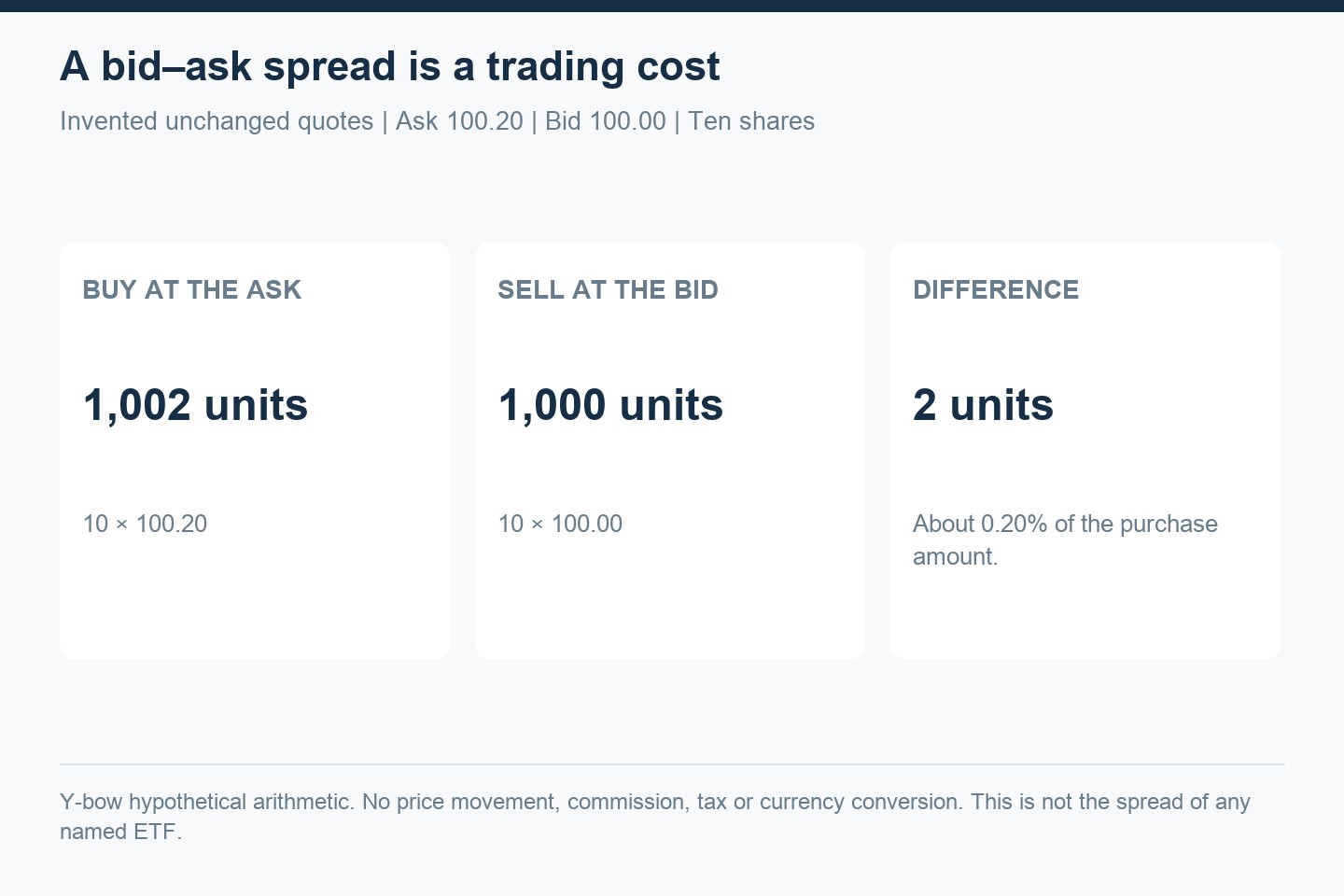
For ten shares, the purchase costs 1,002 units and the immediate sale returns 1,000 units. The difference is two units, about 0.20% of the purchase amount. This does not show the cost of any named ETF; it shows why “no commission” and “no trading cost” are different statements.
Compare the complete set of costs
Annual operating expenses, transaction charges, spreads, premiums or discounts to NAV, and currency conversion can all affect an investor’s result. The SEC’s fees and expenses bulletin distinguishes fund expenses from ETF trading costs that may not appear in the fee table.
A low published expense ratio can be valuable without answering every practical question. If you make small, frequent purchases, a fixed platform charge may matter more than it does for a large occasional purchase. Calculate the charge as a percentage of your own transaction size before assuming the product with the lowest annual fee is the cheapest route.
Automation and reinvestment are platform questions
Check whether your particular broker supports fractional shares, recurring purchases and dividend reinvestment for the specific product. These features should not be inferred from an ETF or mutual-fund label. A process that works well on one platform may be unavailable on another.
Also distinguish receiving a distribution from earning a return. Cash paid out of a fund is part of the investment’s total result, alongside changes in its value. Our guide to distributions and total return explains the distinction in a different product context.
A practical order for the decision
Our interpretation is that the cleanest comparison starts with the exposure you need, then the strategy, then the available wrapper and platform. Compare two products pursuing a similar objective before attributing a difference in returns to ETF versus mutual-fund mechanics. Finally, check the dated prospectus and your local rules.
Educational explanation, not personalized investment advice. Sources checked October 12, 2026; SEC references linked above. Diagram and invented trading example by Y-bow. Japanese counterpart.


Comments
List of comments (1)
[…] Our ETF-versus-mutual-fund guide explains NAV and market-price differences. For why discontinued funds matter when reading past performance, see survivorship bias. Sources checked October 12, 2026. Educational explanation; original analysis and diagr […]