

You check your portfolio before bed. It is down again. You close the app, then reopen it. Selling feels dangerous because the market might rebound; holding feels dangerous because the next loss could be worse.
“Think long term” can sound thin when the money came from years of work. But the decision does not have to begin with selling everything or holding everything. Start with a different question: what, specifically, is the falling market putting at risk in your life?
I have 17 years of investing experience. That does not make my allocation a template for someone else’s household. Income, spending deadlines, debt and the investments themselves change what an investor can reasonably do during a drawdown.
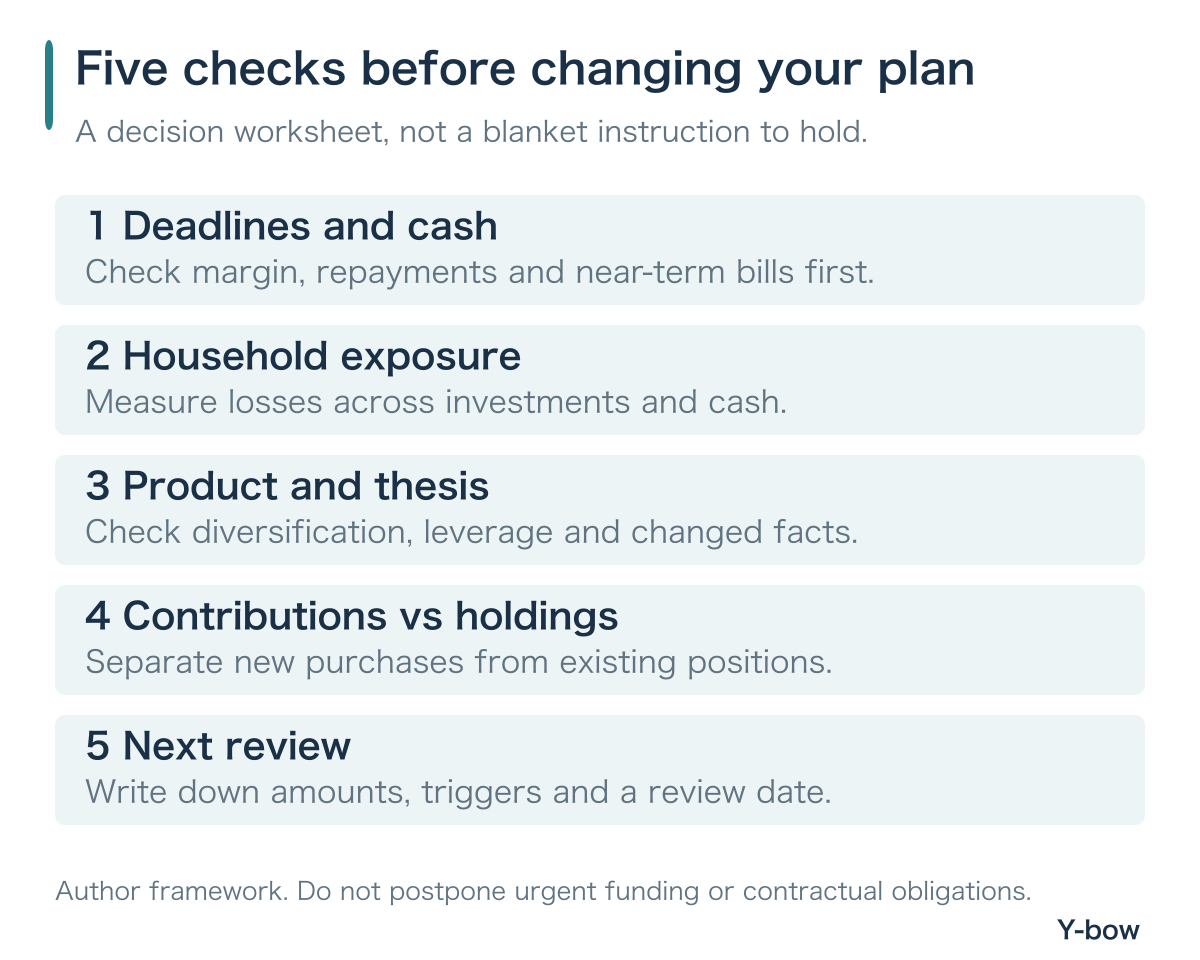
This is a five-check worksheet for stock market anxiety, unrealized losses and the urge to panic sell. It does not predict the bottom. It separates urgent funding problems from portfolio decisions, and separates future contributions from investments you already own.
The practical answer
- Address bills, margin requirements and repayment deadlines before treating everything as an emotional problem.
- Changing contributions and selling existing holdings are separate decisions.
- A diversified fund, a single stock and a daily leveraged product need different analysis.
- Write down amounts, decision triggers and a review date.
Sources checked October 17, 2026. Original figures use hypothetical arithmetic, not forecasts. The featured image is an editorial illustration.
Does stock market anxiety mean you should not invest?
Feeling a loss is not proof of incompetence. Equally, every concern should not be dismissed as something experience will cure. Your position might actually be too large for your financial circumstances.
Risk tolerance combines the capacity to absorb losses with the willingness to experience them. Those are related but different. Someone may have a long time horizon and still have too little accessible cash for an upcoming bill.
Benartzi and Thaler’s research on myopic loss aversion combines sensitivity to losses with frequent portfolio evaluation. It provides a framework for thinking about short-term feedback, not a diagnosis or a promise that checking less often will improve every investor’s return.
Before changing your screen-time habits, check the financial constraints. An investor facing a margin deadline and one with ample cash but uncomfortable price fluctuations need different responses.
Check 1: Do you have a cash need or a contractual deadline?
Your household may set the deadline before the market does
Rent next month, tuition in six months and a planned home purchase cannot necessarily wait for stock prices to recover. A long-term investment label does not extend a bill’s due date.
Write down accessible cash, essential spending, large scheduled expenses and debt obligations. The right reserve depends on income stability, dependents and other resources; one universal number of months cannot settle the question.
| Item | What to record |
|---|---|
| Accessible cash | Amount available without selling volatile assets: ____ |
| Essential spending | Housing, food, education and repayments per month: ____ |
| Large expenses | Amount and date needed: ____ |
| Borrowing or margin | Shortfall, maintenance requirements, deadlines and liquidation terms. |
Do not apply “sleep on it” to an urgent margin obligation
Borrowing can turn a price decline into an immediate funding problem. FINRA notes that a U.S. brokerage can sell assets to meet a margin deficiency, potentially without contacting the investor first. Rules and contracts differ by jurisdiction and firm. Check your own agreement and notices. Source: FINRA’s explanation of margin risks.
Delaying an impulsive trade is different from ignoring a payment or collateral deadline. Also distinguish a trade date from the date its proceeds become available. A decision to sell does not necessarily provide immediately spendable cash.
Check 2: How much has your whole household portfolio lost?
A brokerage account down 30% can feel like a 30% loss of everything you own. If you have cash elsewhere, the household number is different.
Imagine a $100,000 portfolio split between stocks and cash. Stocks fall 30% and nominal cash is unchanged. With $30,000 in stocks, the loss is $9,000. With $60,000, it is $18,000. With $90,000, it is $27,000.
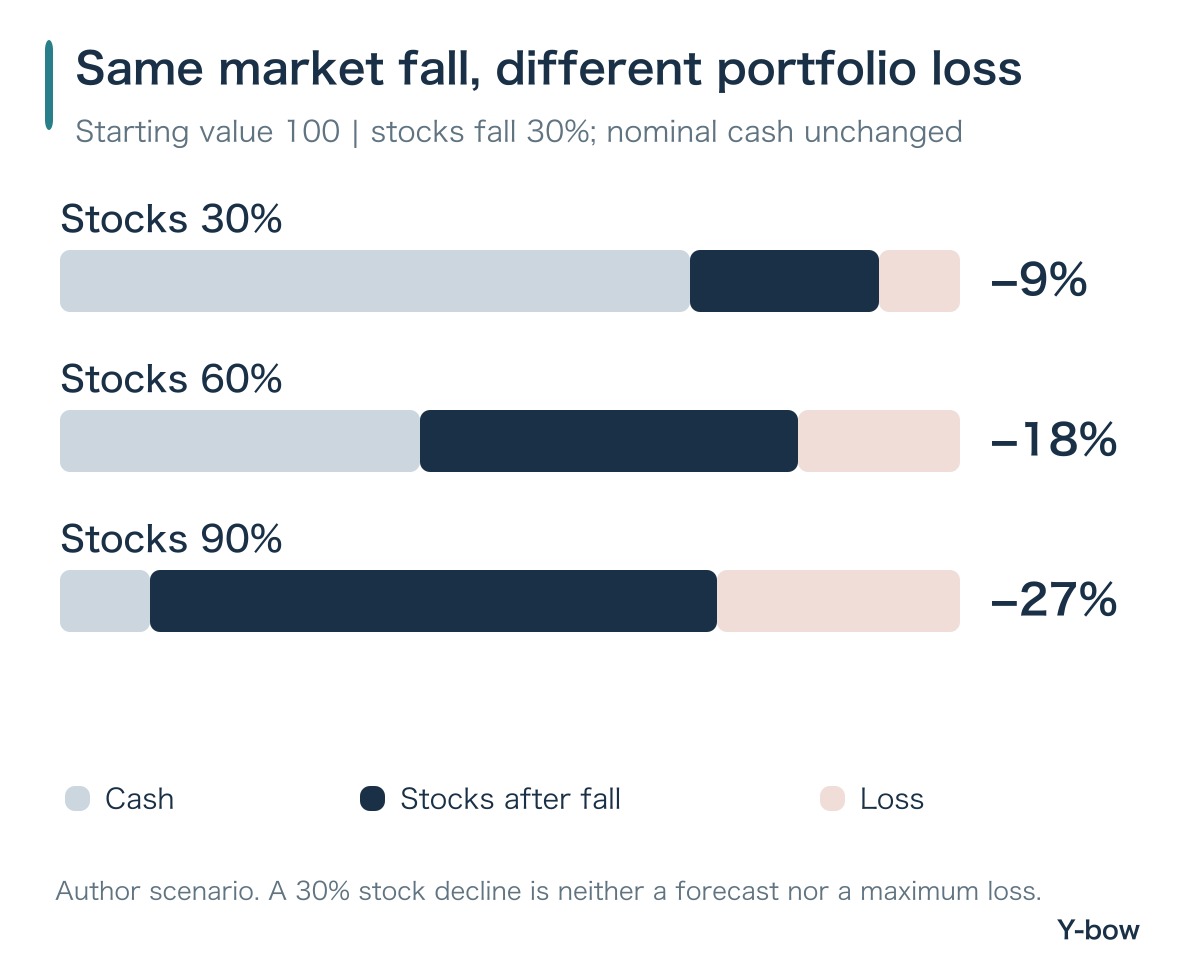
The same stock-market move produces household losses of 9%, 18% or 27%. You cannot choose tomorrow’s market price, but you can examine how much of your household is exposed to it. This example ignores interest, tax, foreign exchange and inflation; a 30% decline is neither a forecast nor a maximum possible loss.
Work backward from a further loss you could absorb
Suppose, purely for illustration, you could absorb another $6,000 loss without disrupting essential plans. Under a hypothetical further 30% stock decline, $6,000 ÷ 30% corresponds to a $20,000 stock position.
That is not a recommended allocation. A 50% shock gives $12,000 instead. Concentrated or leveraged positions may require much more severe scenarios. The exercise is useful because it makes the assumption visible, rather than disguising a comfortable percentage as a complete risk assessment.
Check 3: What is the reason to hold this investment now?
An unrealized loss still changes your wealth
If an investment bought for $100,000 is worth $70,000, its current economic value is $70,000. Not selling does not make the decline disappear. Selling also does not, by itself, destroy the remaining $70,000: it changes the asset in which that value is held, before costs and taxes.
Separate “I do not want to realize a loss” from “this remains an appropriate place for today’s $70,000.” The purchase price matters for tracking performance and potentially taxes. It does not oblige the market to return to that price.
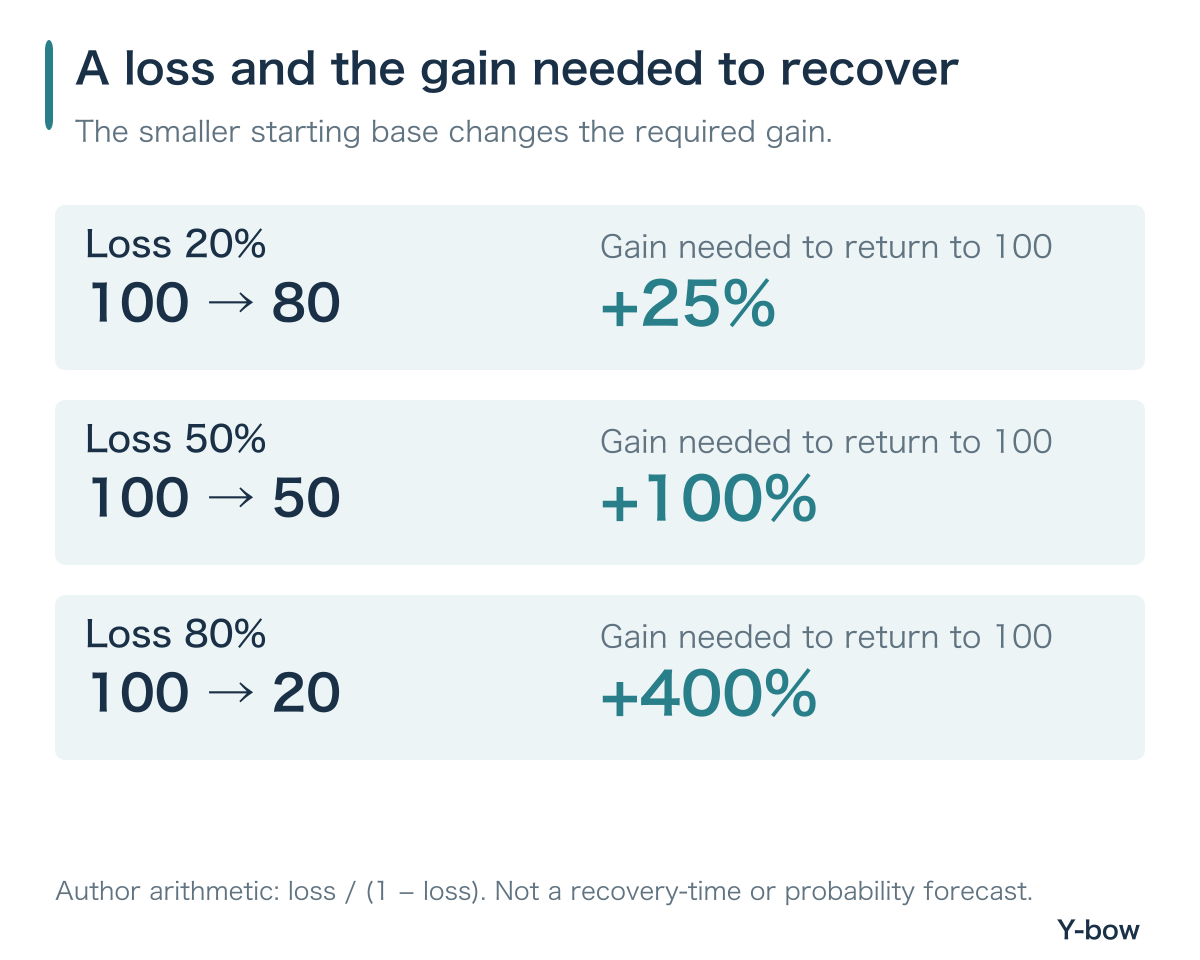
| Loss | Required gain from the lower value |
|---|---|
| 10% | 11.1% |
| 20% | 25% |
| 30% | 42.9% |
| 50% | 100% |
| 80% | 400% |
Diversified funds, single stocks and leveraged ETFs are different
For a single company, check whether the business, financing or disclosure underlying the original thesis changed. For an index fund, check its actual exposure and concentration. Holding several funds does not necessarily diversify the underlying risks; see our guide to diversification.
Daily leveraged ETFs add a separate issue. The SEC explains that performance over multiple days can differ materially from the stated daily multiple. A benchmark recovering does not guarantee its leveraged fund will return to your entry price. Source: SEC leveraged and inverse ETF bulletin.
Our guides to TQQQ and daily compounding and SOXL’s semiconductor exposure explain why a blanket instruction to hold every product is inadequate.
Check 4: Are you confusing contributions with existing holdings?
Reducing new purchases and selling assets already held are separate choices. A contribution plan can become unaffordable even when the investment still fits the long-term plan.
For example, monthly take-home income of $5,000, regular spending of $3,800 and another $400 reserved for annual or irregular costs leave $800. Contributing $1,200 would reduce cash by $400 a month. That shortfall exists independently of whether the market rebounds.
| Choice | What changes—and what remains |
|---|---|
| Reduce contributions | Less future cash leaves the household. Existing positions remain exposed. |
| Pause contributions | New purchases stop. Set a review date and conditions for reconsideration. |
| Sell part of a holding | Current exposure falls. Participation in a rebound can fall too. |
| Keep the plan | Check that cash needs, horizon and product still fit. Future losses remain possible. |
The SEC and other regulators discuss diversification, planning and periodic investing in their 2026 investor bulletin. Regular contributions can support a plan; they do not make losses impossible or fix an unsuitable product.
A partial sale changes future exposure, not the past
Compare keeping $70,000 invested with selling $20,000 into cash and retaining $50,000 invested. Ignore taxes, fees and cash interest.
| Next stock move | Keep all invested | Move $20,000 to cash |
|---|---|---|
| Down 20% | $56,000 | $60,000 |
| Up 20% | $84,000 | $80,000 |
The partial sale reduces the effect of a further decline and the benefit of a rebound. “It went up after I sold” is therefore not the only test of decision quality. Also ask what obligation or risk limit the sale was intended to address.
Check 5: Can you write the next decision trigger and review date?
“I will buy again when I feel safe” leaves the definition of safe unresolved. Prices rising can make an investor feel safe after the fact, just as falling prices can make the same investor feel unsafe.
Use observable conditions alongside any investment thesis: a cash target that includes planned bills, a business metric to check in the next earnings report, or a scheduled household budget review. Margin and security alerts still require attention when they arrive; a review calendar is not permission to ignore them.
| Field | Your entry |
|---|---|
| What is worrying me? | Cash needs, loss size, product concerns, too much news, or something else? |
| What did I verify? | Cash ___; near-term bills ___; risky assets ___. |
| What will I change? | Asset and amount, or a reason for leaving the position unchanged. |
| When will I review? | Date, source and condition that could change the decision. |
Another investor’s confident post on X does not disclose their whole balance sheet, entry price, borrowing or incentives. FINRA and the SEC discuss risks in relying on social-sentiment investing tools. Trace a claim back to its evidence rather than using the volume of agreement as a substitute.
Stock market anxiety and panic selling: common questions
At what percentage loss should I sell?
There is no percentage suitable for every investor and product. Translate the decline into money, then examine spending deadlines, borrowing, position size and the investment thesis. Follow any applicable contractual requirements rather than substituting a general article for them.
Will averaging down help me recover faster?
It may lower the average entry price, but it also commits more money and can increase concentration and future losses. Check whether the additional position fits the household before trying to recover a previous loss. Recovery is not guaranteed.
Does selling after a decline always mean failure?
No. A sale to fund a scheduled bill serves a different purpose from a prediction that tomorrow’s market must fall. Evaluate the decision against its stated purpose and the information available at the time, as well as its later outcome.
Do taxes or retirement-account rules change the answer?
They can change the costs and practical consequences. Rules differ by country, account type and circumstances. Check current official guidance before an account withdrawal or a trade with material tax consequences. A tax advantage does not prevent an investment from falling.
Start with the household, then the market
A person who sells is not automatically weak, and one who holds is not automatically disciplined. The useful question is whether the decision fits the money’s purpose, the product and the losses the household can absorb.
Check deadlines and cash first, then total exposure, product assumptions, contributions and a written review condition. You can make progress on those questions without knowing tomorrow’s closing price.
If the amount invested needs a fresh start, see our first-steps guide to investing. A sustainable plan should be workable for your finances, not merely something you feel obliged to endure.
This article provides general education and the author’s decision framework, not individualized financial or tax advice. Figures are original hypothetical calculations, not a recovery guarantee, loss limit or optimal allocation. Primary sources are linked alongside the relevant claims.






Comments