

You set a stop before going to bed because you do not want an overnight TQQQ selloff to become an uncontrolled loss. The next morning, the shares have sold far below the number you entered. Or a more restrictive order has not sold at all. Neither outcome necessarily means the broker ignored your instructions.
This guide uses original hypothetical price paths, not actual TQQQ history, a backtested trading system or recommended stop levels. Official references were checked on October 31, 2026. The discussion concerns selling shares you already own, not short-covering orders or margin liquidation.
How a TQQQ stop-loss becomes an execution instruction
A sell stop might say: send an order when the specified reference falls to 90. A stop-market then becomes a market order. A stop-limit instead becomes a limit order with a separate minimum acceptable selling price. The distinction between the trigger and the resulting order determines what happens next. The SEC’s order bulletin explains the price guarantee that a stop does not provide.
← Swipe to view the full table →
| Order | After triggering | Risk retained |
|---|---|---|
| Stop-market | A market sell instruction | Available execution may be far below the stop |
| Stop-limit | A limit sell instruction | The shares may not sell |
| Trailing stop | A trigger that follows favorable prices | A moving trigger still does not guarantee a fill |
These instructions are not substitutes for deciding how large a position to own. An order can change how you attempt to exit; it does not erase the economic exposure while you still hold the shares. The position can remain exposed during an ineligible session, a halt or an unfilled order.
A 90 stop and an assumed fill at 84
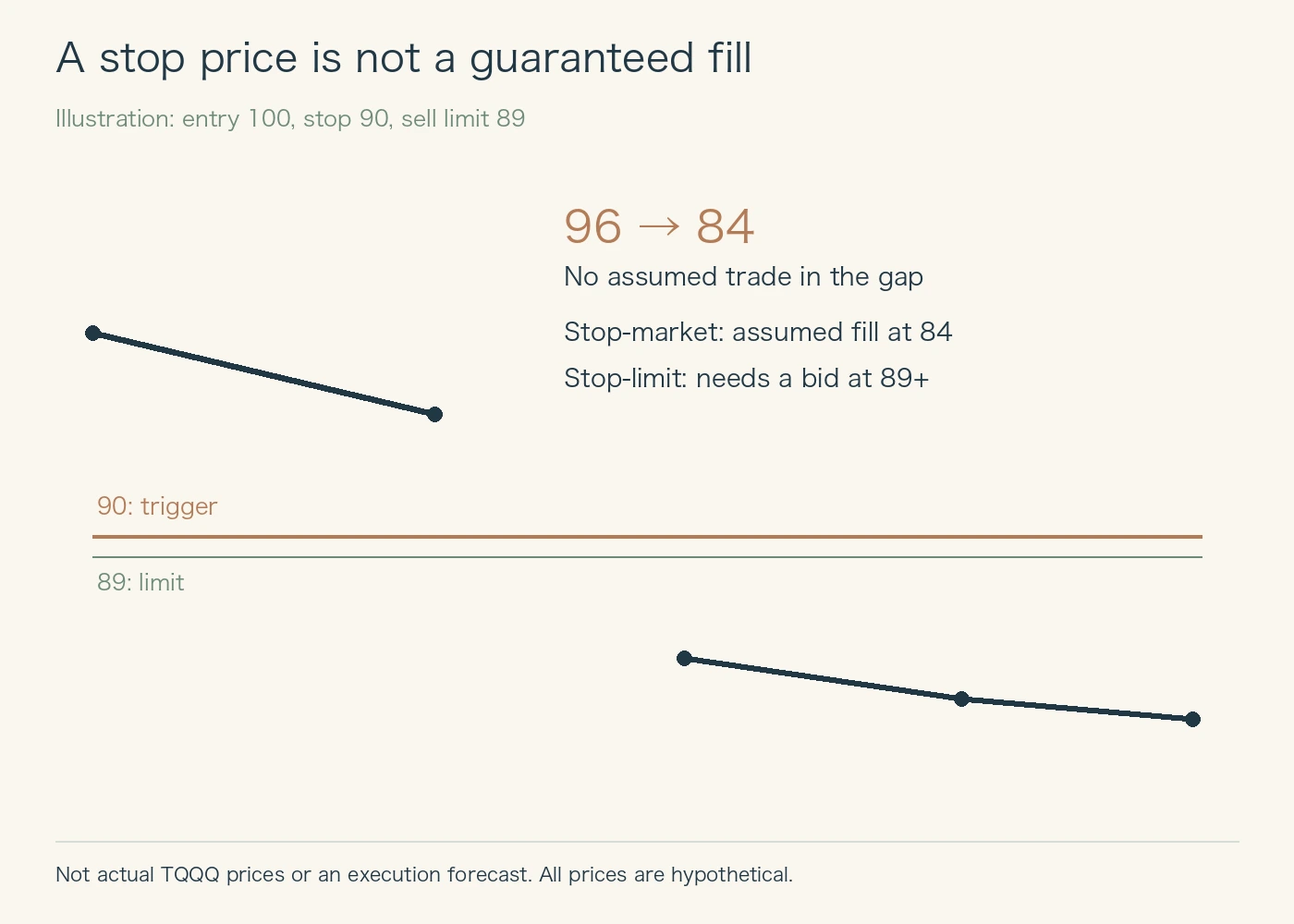
Assume you bought 100 shares at 100, set a 90 sell stop and encounter a gap from 96 to 84 during an eligible monitoring session. If sufficient buyers exist at 84 and the market order fills there, the hypothetical loss is $1,600. An assumed fill at 90 would have lost $1,000. The $600 difference is execution risk, not a larger quantity of shares.
A line drawn between two points on a chart does not establish that a buyer was available at every intermediate price. Do not insert a fictional fill at 90 simply because the line crosses it. Actual routing, reference prices, order size and the available book can produce different outcomes, including partial fills.
Advertisement
Why a stop-limit can leave the loss in the account
Now use a 90 trigger and an 89 sell limit. A bid at 84 does not satisfy that selling condition. The order may remain unfilled. Protecting an acceptable selling price and stopping the position’s market loss are different objectives. FINRA’s discussion of volatile markets covers both fast reversals and the execution trade-off.
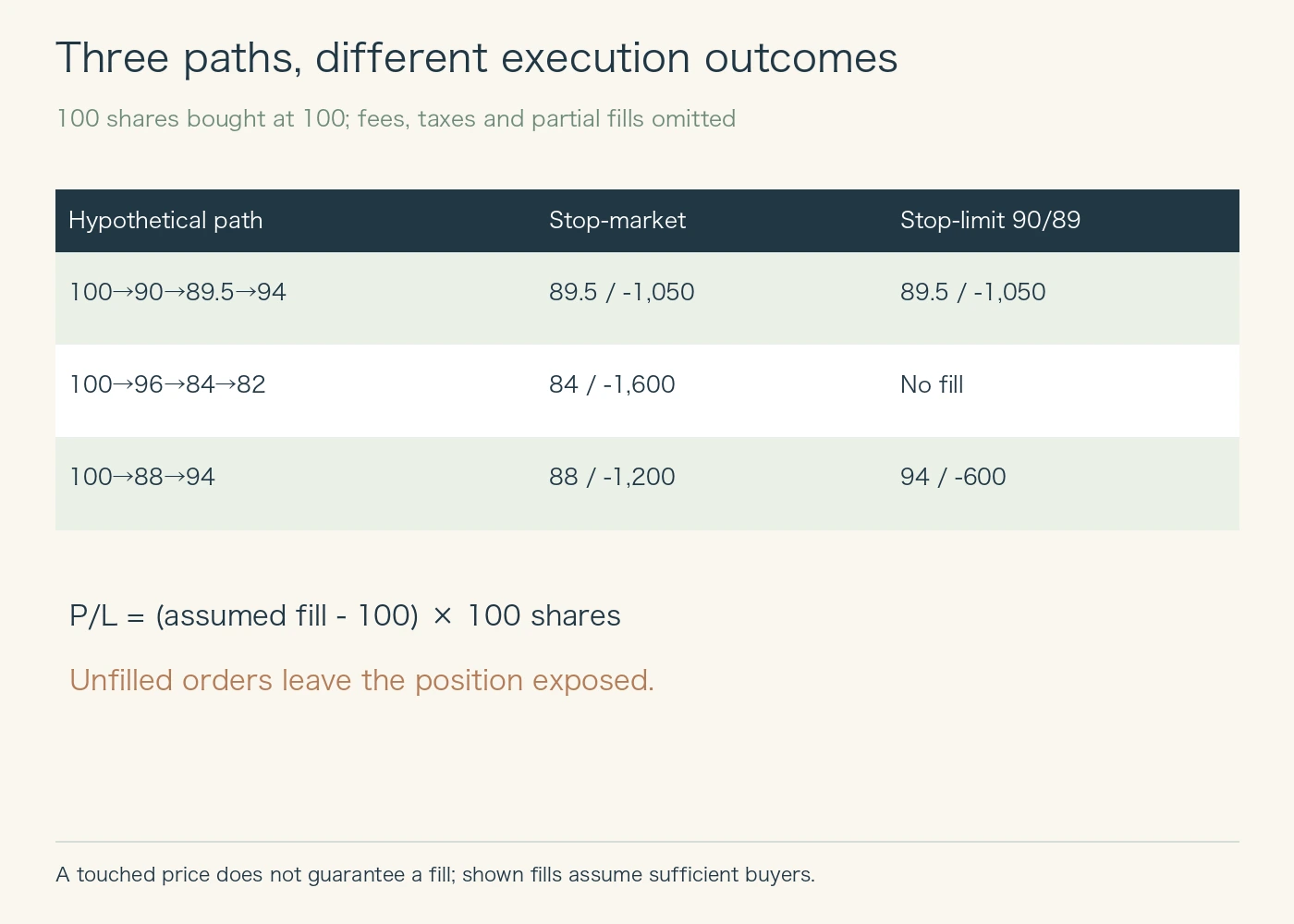
Consider a second path: 100 falls to 88 and later rebounds to 94. Suppose the market order sells at 88, losing $1,200. Suppose the limit order first finds adequate eligible buyers at 94, losing $600. That example favors waiting. But remove the rebound and the unfilled order keeps the downside exposure. Selecting only the rebound path is hindsight, not evidence of a superior strategy.
A smooth path can produce the same assumed fill for both instructions. In our 100→90→89.5→94 path, both sell at 89.5 under the stated liquidity assumption, for a $1,050 loss on 100 shares. The examples isolate mechanics; they do not assign probabilities to the paths or estimate expected returns.
Do not treat triggered, accepted, partly filled and fully filled as interchangeable account statuses. A partly filled order can leave a smaller but still material position. Replacing it without understanding the remaining quantity can create a new mistake.
Overnight sessions, opening gaps and trading halts
Being able to enter an order is different from having its trigger monitored, and both differ from being able to execute a trade. Check the broker’s eligible sessions and trigger reference rather than assuming every stop responds to every overnight quote. The same name can cover different implementation details across firms.
For a non-US example, Monex Japan’s official US-stock help distinguishes stop-market and stop-limit and says stops cannot be placed with its extended-hours setting enabled. That is an example of broker-specific rules, not a universal description of US accounts. Monex’s documentation (Japanese) also distinguishes monitoring before triggering from carrying an unfilled instruction afterward.
An opening auction or a resumption after a halt can establish a price far from the last price you saw. A standing instruction cannot create liquidity while trading is suspended. Verify how your broker handles expiry, cancellation and resumed trading. You need a plan for the position that remains, not just a plan for submitting the initial order.
Daily leverage does not determine a reliable stop distance
ProShares describes TQQQ as targeting three times the Nasdaq-100’s daily return before fees and expenses. That daily objective does not make every intraday interval, overnight change or multiday result exactly three times an observed index move. Multiplying an overnight futures change by three does not establish your executable TQQQ price.
A 10% stop can mean a threshold below acquisition cost, a trailing distance below a high, or a rule relative to a previous close. These are different instructions. A trailing stop moves a trigger after favorable prices; it does not fill the gap when prices jump through that trigger. A narrower distance can respond to shorter fluctuations, but a wider distance is not automatically more profitable or safer.
Related book (affiliate advertisement)
Background reading on diversification, trading costs and investment discipline. It is not presented as endorsing the specific orders or products discussed here.
A Random Walk Down Wall Street (English paperback)
View this edition on Amazon Japan
Check the linked page for price and availability. As an Amazon Associate, Y-bow earns from qualifying purchases.
Advertisement
Five broker settings to verify before using a stop
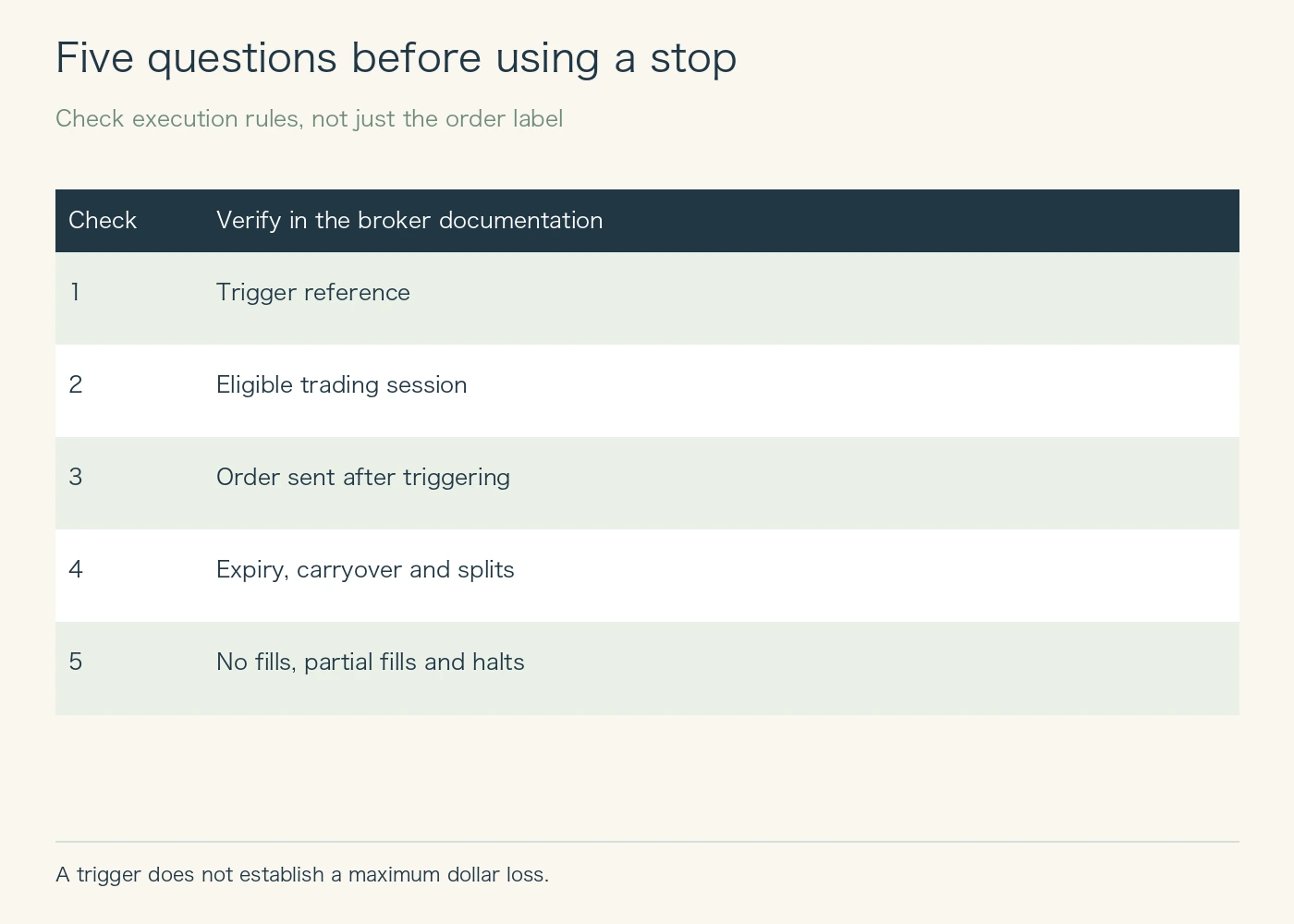
Record the trigger reference, eligible sessions, resulting order, expiry and treatment of splits or other corporate actions. Confirm how unfilled or partially filled orders are reported. Check that the share quantity matches the position and does not conflict with another standing sell instruction. A maximum loss calculated from the trigger alone leaves out the central execution uncertainty.
If an unexpected fill occurs, examine the trigger time, available trading prices, order type and filled quantity before immediately buying back to recover the loss. A misunderstood order and an oversized position require different responses. Neither is solved by finding a more reassuring name for the next instruction.
Sources, related guides and calculation method
For ordinary entry orders, see our ETF limit-order and spread guide. Our TQQQ-plus-cash comparison addresses allocation drift rather than execution. This article does not test a profit-maximizing stop distance.
Hypothetical dollar P/L equals (assumed selling price − 100) × 100 shares. Fees, taxes, currency effects and partial fills are excluded. We will revisit changed broker rules and issuer objectives; examples remain explicitly hypothetical. The featured image is AI-generated conceptual art; the three figures are original diagrams and calculations.






Comments