

You picked a low-cost ETF. The broker charges no commission. Then a volatile session leaves your purchase price higher than the quote you thought you saw. Where did the extra cost come from?
A limit order is a boundary on execution price, not a prediction of a bargain. That distinction matters when you want to buy a dip or sell quickly. The last traded price, the current ask, the fund’s NAV and your eventual average fill are different numbers.
Check the bid and ask, available quantity, your maximum purchase price or minimum sale price, and whether the underlying market is open. A limit can protect the stated price boundary; it cannot guarantee a fill or prevent a later loss.
ETF limit vs market orders: what do you want to control?
A market order prioritizes execution without a specified price limit. A buy limit specifies the highest acceptable price; a sell limit specifies the lowest. A buy limit of 100 means 100 or better, not necessarily a fill at exactly 100. The trade still requires an available counterparty.
| Order | Priority | Remaining risk |
|---|---|---|
| Market | Execution opportunity | The fill can be far from the expected price |
| Limit | A price boundary | No fill or only a partial fill |
| Stop or stop-limit | A trigger condition | The order sent after triggering determines the outcome |
Trading halts and broker restrictions can affect any order. Fractional-share programs and recurring purchases may use execution rules that differ from a standard whole-share order. Read the actual terms instead of assuming every “ETF buy” screen gives identical controls.
What is the bid-ask spread? The cost after zero commission
The bid is the best quoted price from buyers; the ask is the best quoted price from sellers. An immediate purchase typically starts at the ask, and an immediate sale at the bid. The last transaction shown on your app is not necessarily the current price at which you can buy.
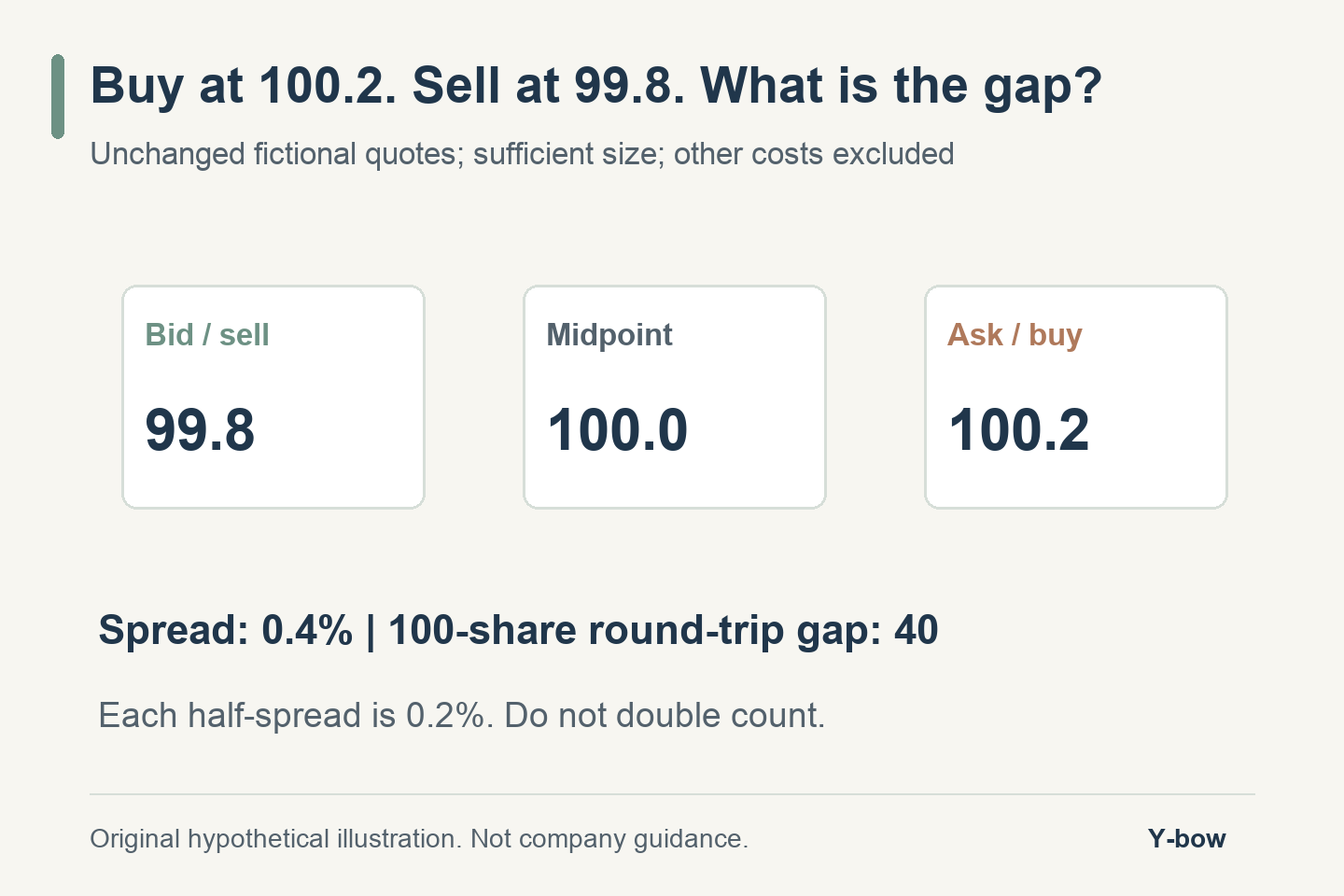
Take fictional quotes of 99.8 bid and 100.2 ask. Their midpoint is 100. The spread is 0.4, or 0.4% of the midpoint. If enough shares are available, buying 100 at the ask and immediately selling 100 at the unchanged bid loses 40 before commissions, tax or currency conversion.
Do not count the same cost twice
The purchase is 0.2% above the midpoint and the sale 0.2% below it. The quoted round-trip gap is 0.4%. Adding the full spread and the purchase’s half-spread as two separate costs for one buy would mix overlapping measures. The midpoint is a reference for analysis, not an execution price everyone is entitled to receive.
The SEC’s ETF bulletin discusses spreads and premiums or discounts as investor checks. A fund’s historical median spread helps with research, but it does not replace a live quote for today’s order.
広告
How a market order walks the book: a 100-share example
Assume the sell side contains 20 shares at 100.2, 30 at 100.5 and 50 at 101.0. With no other order changes, a market buy for 100 shares costs 20×100.2 + 30×100.5 + 50×101.0 = 10,069. The average fill is 100.69.
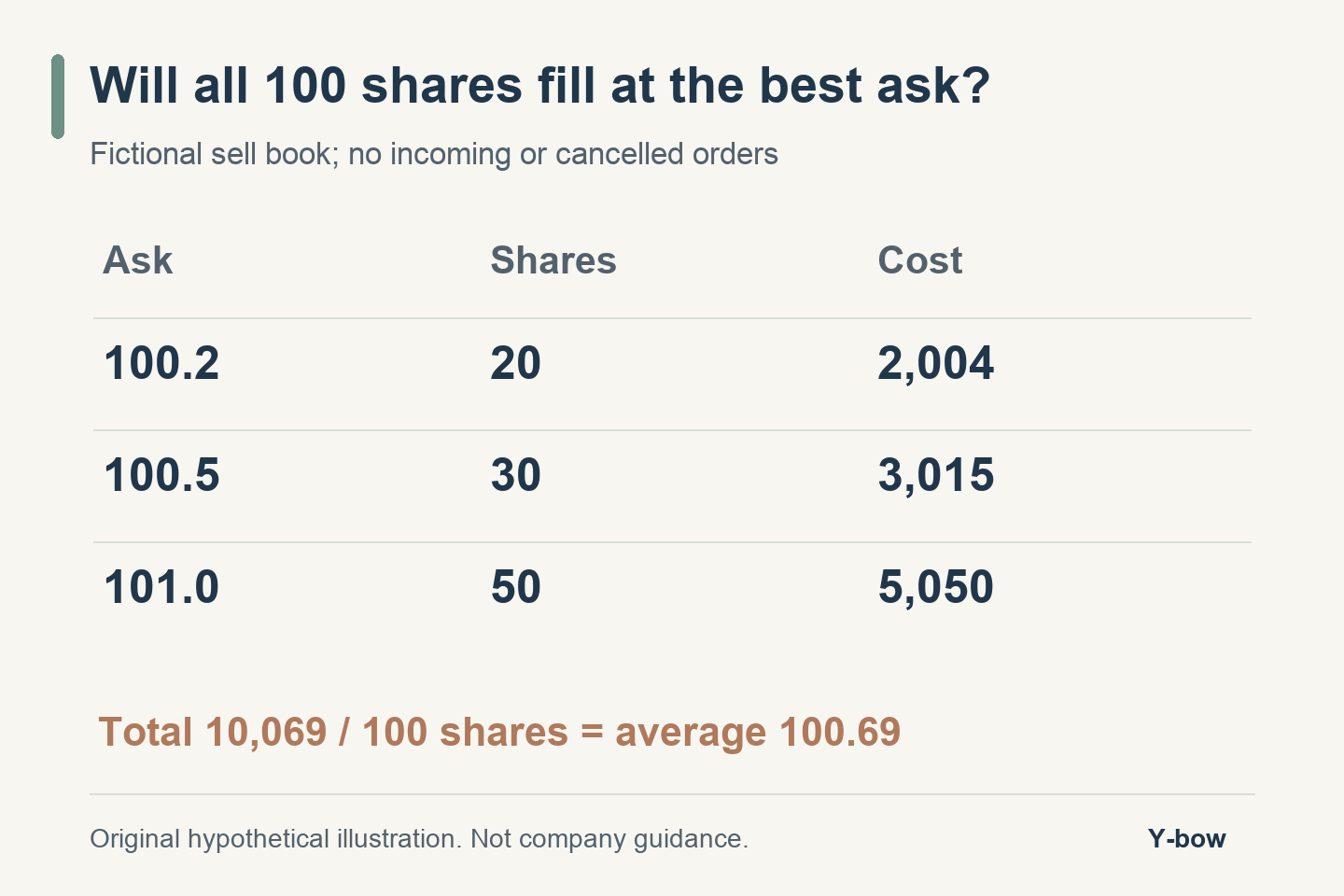
Buying every share at the initial best ask would have cost 10,020. The difference is 49. That is the effect of reaching additional price levels, separate from the initial quoted spread. A real order book changes constantly, so this arithmetic is not a promised execution result.
A marketable limit is different from waiting for a dip
With the same fictional book, a buy limit of 100.5 for 100 shares permits the first 50 shares but not the 50 offered at 101. The remaining quantity depends on the order’s time-in-force and other instructions. You preserve a ceiling while accepting that you may not obtain all the shares.
A buy limit near or above the prevailing ask can seek prompt execution while retaining a boundary. That is different from placing a low bid and hoping the market falls. Vanguard’s January 2026 execution discussion explains marketable limits. There is no universally appropriate fixed distance above the ask: conditions and your price tolerance matter.
ETF premium or discount to NAV: compare the clocks
A price above comparable NAV is a premium; below it is a discount. If an appropriately timed, same-currency NAV were 100 and the market price 102, the premium would be 2%. In practice, published NAV is usually a daily figure. A live market quote may be from a different time.
This matters for international ETFs. The ETF’s listing venue can be open while its underlying stock market is closed. New information and exchange-rate movements may reach the ETF price before they appear in the underlying assets’ last closing prices. An apparent premium to stale NAV is not automatically an exploitable 2% overvaluation.
Check the methodology and timestamp of indicative values too. Creation, redemption and arbitrage can encourage alignment; they do not promise an immediate return to zero premium during a halt or stressed market. Costs and the ability to trade the underlying basket matter.
広告
When should you trade an ETF? Focus on conditions, not a magic minute
Near the open, price discovery may still be under way. Some holdings may not yet have meaningful trading prices. Vanguard’s trading guidance discusses these conditions and the relationship to underlying markets. That is not a rule that waiting a fixed number of minutes guarantees a better price.
The relevant clock depends on the listing venue, assets and daylight-saving rules. A U.S.-listed domestic-equity ETF and a European or Japanese listing holding U.S. stocks do not face identical trading hours. Use the actual quote, spread and quantity for the instrument you intend to trade.
Low screen volume does not by itself prove an ETF is impossible to trade: underlying liquidity and market makers also matter. High volume does not make every large order harmless either. If your proposed trade is large relative to displayed quantity, consider asking your broker about execution support rather than repeatedly hitting the market.
A seven-point ETF order checklist
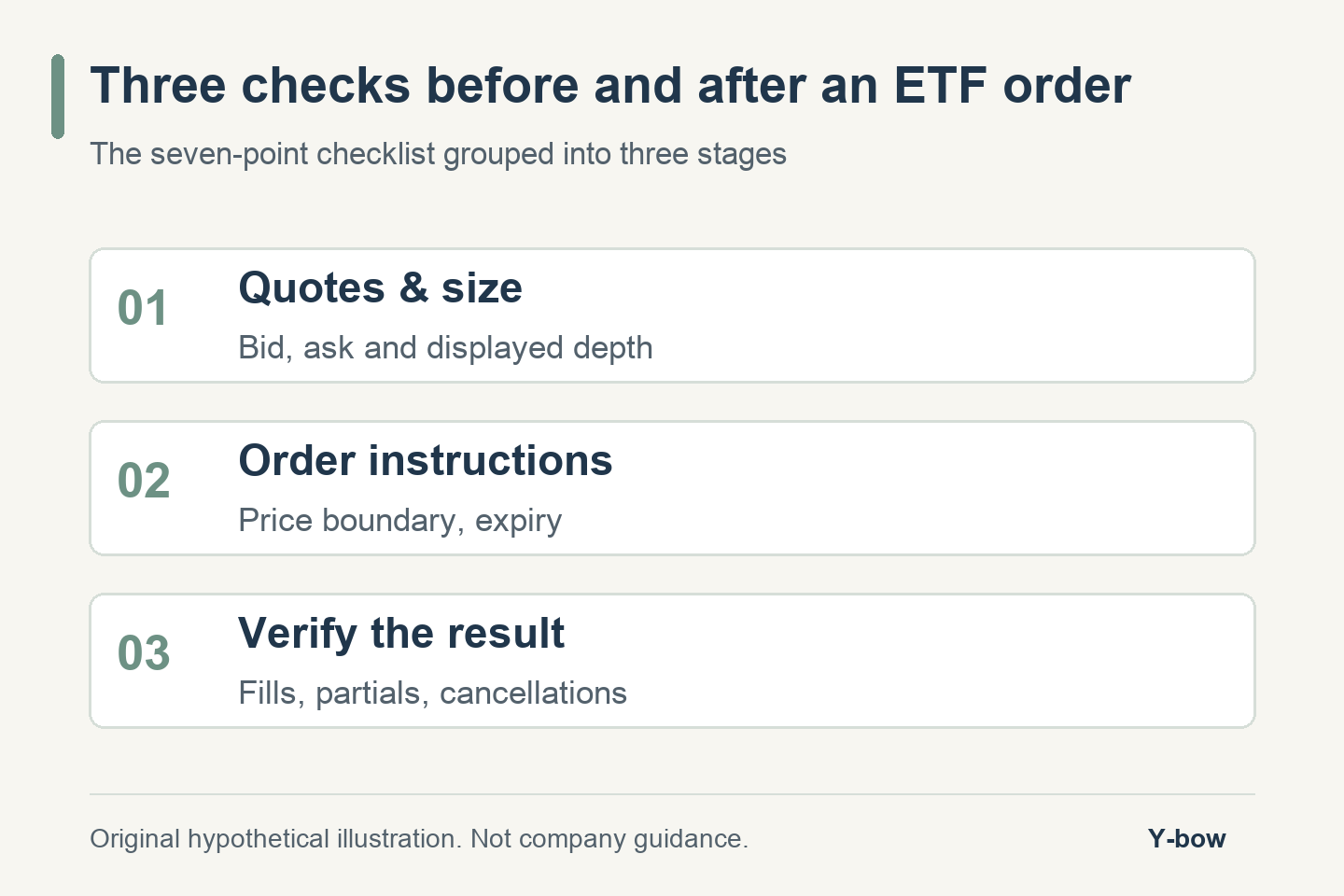
- Instrument: confirm ticker, exchange, currency and leverage.
- Quote: check live bid, ask and timestamp, not only the last trade.
- Size: compare your quantity with displayed depth.
- Boundary: choose a maximum buy or minimum sell price.
- Instructions: review time-in-force, partial fills and extended hours.
- Markets: check underlying trading, halts and major announcements.
- Outcome: verify fills, amendments and cancellations before sending another order.
A limit is not much help if anxiety makes you move it repeatedly without revisiting your plan. Decide when you will reassess. Conversely, someone with a genuine cash deadline may rationally value execution more than a small potential saving. The right trade-off depends on the purpose of the money, not only the fee schedule.
FAQ: why did my ETF limit order not fill?
Is yesterday’s close a safe limit?
It imposes a boundary, but yesterday’s price is not necessarily today’s fair value. The order may remain unfilled, or it may fill before another fall. Execution control and an investment decision are separate.
Does a stop order cap my loss?
Not necessarily. A stop that becomes a market order can execute beyond the trigger after a gap. A stop-limit can remain unfilled if the price passes through its limit. Confirm your broker’s exact rules.
Does this also apply to a mutual fund purchase?
A conventional mutual fund follows its applicable NAV pricing rules rather than the ETF order book. See our ETF vs mutual fund guide for that distinction.
Related reading and video: timing is not execution
Our English video Buy the Dip vs DCA examines the cost of waiting. It is not an order-entry tutorial. Understanding when you want exposure does not remove the need to control how you trade it.
The author’s note about urgent selling, limits and stops (Japanese) is another perspective. Check its free/paid boundaries. For fund selection rather than execution, see VOO, SPY and IVV trading costs.
Sources, calculations and updates
Checked October 20, 2026. Primary guidance: SEC ETF bulletin, Vanguard January 2026 execution discussion, Vanguard trading practices, and JPX’s Japanese ETF trading rules. All diagram prices are fictional. Spread percentage uses (ask−bid)/midpoint; a comparable premium uses price/NAV−1. The static book omits order changes, fees, tax and FX. Future reviews will check broker instructions, hours and disclosure changes. No execution outcome or return is guaranteed.




Comments