

You want to start investing. You open a fund list and find hundreds of choices: global equities, the S&P 500, the Nasdaq-100, dividends, individual stocks. The natural question is, “Which one is going to go up?”
After 17 years of investing, the first question I would ask is different: Which money can stay invested when the market falls? I cannot know next year's winning fund. I can separate next month's bills from long-term savings, choose a contribution I can maintain and understand what I am buying.
This guide gives you a first-month plan. Dollar figures are illustrations, not amounts every household should save. The same arithmetic works in pounds, euros or another currency. The account rules and products available to you will depend on where you live.
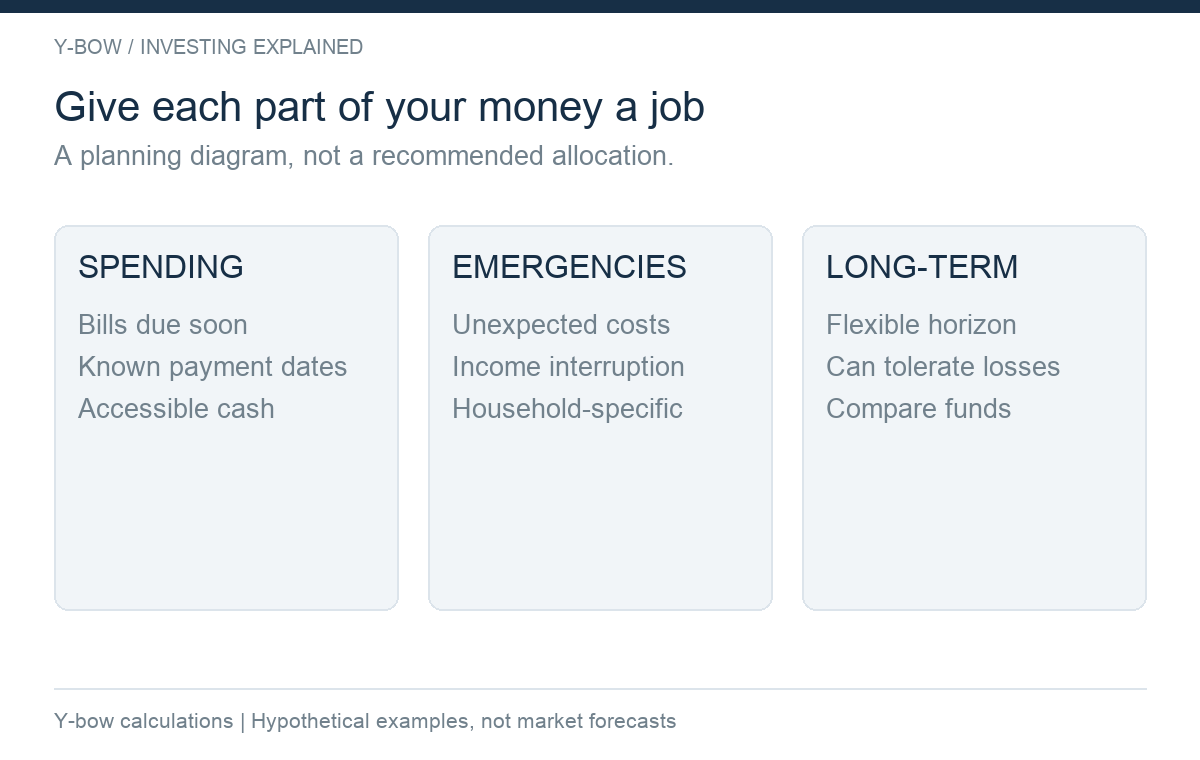
Before opening a brokerage account, give your money three jobs
A tuition bill due next year cannot wait indefinitely for a stock market recovery. Nor can a broken refrigerator or a period without income. Write down the amount and payment date of known expenses before deciding how much is available to invest.
| Money's job | Example | Question to answer |
|---|---|---|
| Planned spending | Rent, annual insurance, next year's tuition | Is the money available on the payment date? |
| Emergency reserve | Repairs or a temporary income interruption | Can I access it without selling stocks? |
| Long-term investment | Money without a near-term spending commitment | Can I tolerate a substantial fall? |
Do not count the same cash twice. If you have $6,000 but $2,000 is reserved for an approaching bill, your emergency reserve is not $6,000. With essential spending of $2,000 a month, the remaining $4,000 represents two months of those expenses. That is a description of this example, not a recommended reserve.
The CFPB's emergency-fund guide explains why the appropriate amount depends on the household. Employment, dependants, insurance and the reliability of income matter more than someone else's account balance.
How much should a beginner invest each month?
Start with a budget you can repeat during an ordinary month. A contribution that depends on every bonus arriving, nothing breaking and no family expense changing is fragile. Keep room to adjust after you have used the account and seen a few price changes.
For example, $100 a month is $1,200 of annual contributions; $250 is $3,000. Neither figure includes investment gains. Those deposits give you something useful to measure: did the contribution leave enough money for the rest of the month?
Costs deserve attention even on a small account. A $5 charge on a $100 purchase consumes 5% of the purchase amount. A platform advertising commission-free orders may still have currency conversion charges, spreads or account fees. Read the fee schedule for the account you will actually use.
If your starting amount feels small, see what small investments can and cannot accomplish. The aim of your first purchase is not to catch up with a stranger's portfolio.
Choose the investment exposure before the fund wrapper
“ETF or mutual fund?” is a useful question, but it comes after “What does this fund own?” A diversified global stock fund, a single-country fund and a semiconductor fund can all be ETFs. Their labels do not make their risks alike.
Read the benchmark, main holdings, geographical scope and ongoing costs. Then compare how orders are priced and executed. An ETF trades on an exchange; a conventional open-end mutual fund generally transacts at the next calculated net asset value, subject to its dealing rules. The SEC's fund guide explains those differences.
Two funds can also own many of the same companies. Buying a broad U.S. fund and a large technology-focused fund does not necessarily add much diversification. List the overlapping holdings before calling the combination balanced.
Use the right account for your country
An investment product and a tax-advantaged account are separate decisions. The account determines eligibility, contribution and withdrawal rules; the investment determines the exposure you hold inside it. A tax advantage does not protect the investment from a falling market.
Before opening an account, check your residence, permitted investments, access restrictions, charges and withdrawal conditions. Do not assume that an American retirement account, a British ISA or a Japanese NISA is available to you because an English-language article discusses it. Likewise, an exchange listing does not mean your broker can sell that product to you.
Check the provider against your local regulator's register. Keep the official fee schedule and product document, rather than relying on a promotional comparison page alone. Opening an account does not oblige you to place an order that day.
Turn an investment loss into a cash amount
A 20% decline can sound manageable until you attach it to money you worked to save. A $5,000 position falling 20% becomes $4,000; falling 40% leaves $3,000. Losses can be larger. These are stress scenarios, not forecasts or maximum losses.
Ask what you would do if that happened while an unexpected bill arrived. “I would stay calm” is not a funding plan. Your answer needs to identify cash, income, a spending adjustment or a smaller initial investment.
The SEC's asset-allocation guide links investment choices to time horizon and tolerance for loss. A longer horizon creates more time; it does not create a guaranteed recovery date.
Automate purchases, but understand what automation does
Regular contributions can reduce the number of decisions you make. They do not guarantee a profit. Suppose you invest $100 at a unit price of $100 and another $100 at $50. You own three units, costing $200 in total. At a price of $50, those units are worth $150. Your average purchase price fell, yet you still have a loss.
Record the contribution date, amount and review date. Check that transfers completed and that charges match the schedule. If income changes, adjusting or pausing a contribution can be sensible; continuing an unaffordable transfer is not a test of discipline.
Do not borrow someone else's portfolio
My main recurring investments are an unhedged leveraged Nasdaq-100 fund and FANG+ exposure. That is a statement about my own choices, not a starting portfolio for a beginner. Experience, available assets and the ability to absorb a loss differ between households.
Start by being able to explain a product's main risk without mentioning its past return. If you cannot explain the daily reset of a leveraged fund, leave the purchase until you can. A popular product can still be the wrong first holding for your circumstances.
A realistic first-month investing checklist
| When | Task | Evidence that you finished |
|---|---|---|
| Week 1 | List bills, reserves and goals | Separate amounts and payment dates |
| Week 2 | Compare a few understandable funds and accounts | Benchmark, fees and eligibility written down |
| Week 3 | Review a small first order, if appropriate | Correct product, account, amount and order terms |
| Week 4 | Check the transfer and household budget | No missed bill; a scheduled review date |
You do not have to complete every step in four weeks. If the budget or product is still unclear, take longer. A successful first month can be one in which you avoid a rushed purchase and establish a contribution you understand.
Sources checked October 15, 2026. Numerical examples and the diagram are original Y-bow illustrations, before tax and investment costs unless stated. This article provides general education, not a personal investment recommendation.










Comments