

A fund with a price of $10 is not necessarily cheaper than one priced at $100. A lower unit price may simply mean the same assets are divided into more units. It does not tell you whether the underlying investments are attractively valued.
That misunderstanding often starts with three terms: net asset value, units and redemption. Once their relationship is clear, a fund statement becomes easier to read—and a distribution that lowers the displayed price becomes less mysterious.
What is mutual fund NAV?
Net asset value, or NAV, is the value of a fund’s assets minus its liabilities. NAV per share or unit divides that amount by the number of shares or units outstanding.
Suppose a fund owns securities worth $1,000,000 and has liabilities of $10,000. Its net assets are $990,000. If 99,000 units are outstanding, NAV per unit is $10. The unit is a proportional claim on the fund, subject to the product’s terms—not a separate promise that the fund will repay $10 regardless of market conditions.
| Calculation | Example |
|---|---|
| Assets | $1,000,000 |
| Minus liabilities | $10,000 |
| Net assets | $990,000 |
| Units outstanding | 99,000 |
| NAV per unit | $10 |
The SEC distinguishes open-end mutual funds, ETFs and other fund structures. Ordinary open-end mutual funds generally transact at a calculated NAV, while ETF shares trade during the day at market prices that may differ from NAV. Source: SEC fund characteristics.
More fund assets do not necessarily mean a higher unit value
Imagine a simpler fund with net assets of $20,000, divided into 2,000 units at $10 each. A new investor contributes $100 at that NAV, with no fee or market movement. The fund issues ten units.
Afterward, the fund has $20,100 and 2,010 units. NAV remains $10: 20,100 ÷ 2,010. Existing investors have not earned a return merely because another investor subscribed.
The reverse works similarly. A redemption at NAV reduces both net assets and the units outstanding. Large redemptions can still affect trading costs, liquidity and remaining investors, depending on the assets and fund rules. The simple arithmetic does not say those real-world effects are absent.
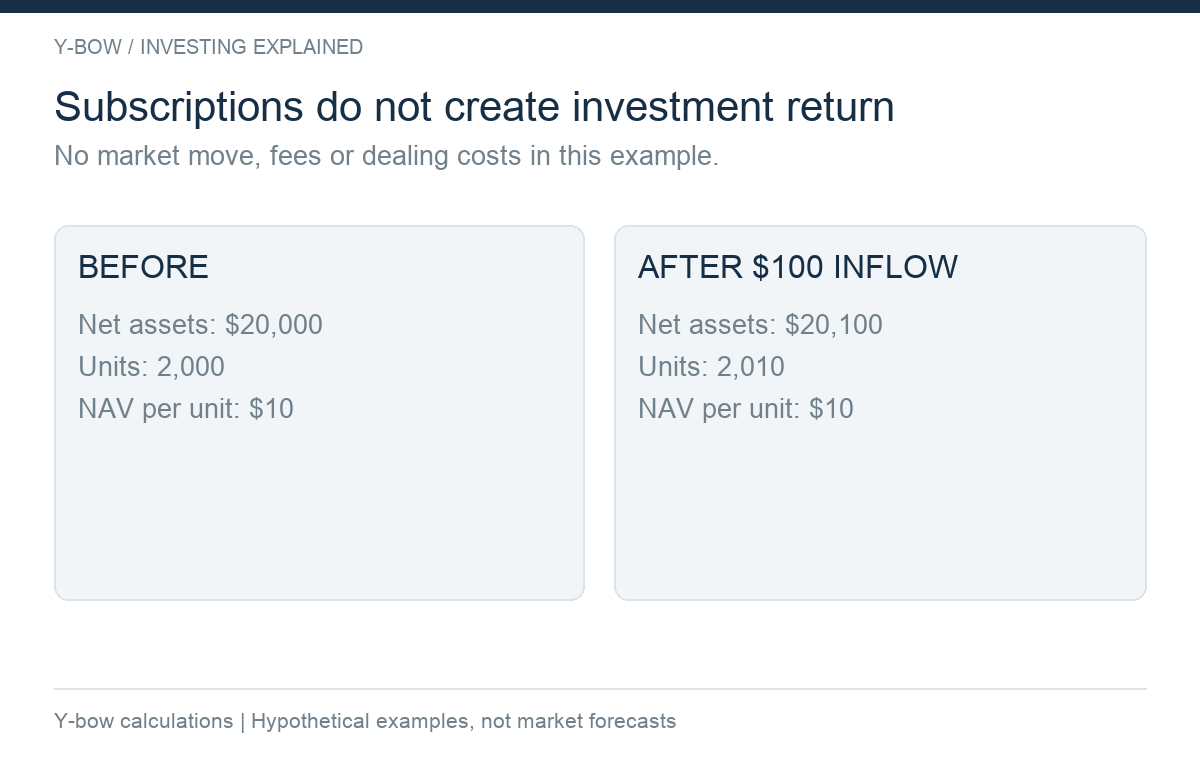
When evaluating a growing fund, distinguish investor inflows from investment performance. Total assets can rise because of subscriptions even if each unit loses value. A unit price can rise while total assets fall if redemptions outweigh market gains.
Why a distribution can lower NAV without an equivalent economic loss
Suppose you own 100 units at $10, worth $1,000. The fund distributes $0.50 per unit. Ignoring market moves, taxes and costs, NAV falls to $9.50 because $50 left the fund and went to you.
You now have fund units worth $950 plus $50 cash. Before tax, the combined amount is still $1,000. Looking only at the price chart would miss the cash distribution.
| Item | Before distribution | After distribution |
|---|---|---|
| Units owned | 100 | 100 |
| NAV per unit | $10.00 | $9.50 |
| Value of units | $1,000 | $950 |
| Distribution cash | $0 | $50 |
| Combined amount | $1,000 | $1,000 |
If distributions are reinvested, the investor receives additional units instead of keeping the cash. Taxes and reinvestment timing can change the outcome. A high distribution rate is not automatically a high investment return: distributions can have different sources, including returned capital under some products and tax systems.
Redemption: selling fund units is different from a fund closing
In English-language fund documents, redemption commonly means returning shares or units to an open-end fund for payment under its rules. It does not necessarily mean the whole fund is being terminated.
This distinction matters when translating Japanese material. A Japanese investor’s cancellation or sale of fund units and the fund’s final maturity or liquidation are different events. The exact terminology and procedure depend on the product and jurisdiction.
For an ordinary open-end mutual fund, the price generally depends on the next applicable valuation after an order is accepted under the fund’s rules. An order cutoff, settlement period, currency conversion or redemption fee may apply. Do not assume the price shown when you click is a guaranteed executable price.
An ETF investor usually sells shares on an exchange to another market participant. Authorized participants have a separate creation-and-redemption mechanism with the fund. A retail exchange sale and the fund’s institutional redemption process are not the same transaction. Source: SEC ETF guide.
A low NAV is not evidence that a fund is a bargain
Fund A could have $100 million in net assets and ten million units, giving $10 NAV. Fund B could hold the same portfolio with one million units, giving $100 NAV. A $1,000 investment buys 100 units of A or ten units of B. Before costs and other differences, the percentage exposure is equivalent.
What matters is the underlying portfolio, not how finely it is divided. Compare holdings, benchmark, valuation measures, concentration, strategy, leverage and costs. A falling NAV can reflect losses rather than a bargain; a high NAV can reflect accumulated gains rather than an expensive portfolio.
Also read the quotation convention. Some Japanese funds display a reference amount per 10,000 units rather than per one unit. Comparing those raw numbers with a U.S. fund’s per-share NAV would mix units.
Fees, share classes and the return that reaches the investor
Two share classes can hold the same underlying portfolio but charge different expenses or sales fees. The gross market return is therefore not necessarily the return received by both investors. Read the fee table and any conditions attached to waivers. Source: SEC fee bulletin.
A meaningful comparison identifies the same period, currency and treatment of distributions. If your account contains deposits and withdrawals, the return on the fund and the growth of your account balance can differ. A bigger account is not proof that the investment performed better if you simply contributed more.
A five-item fund statement check
Read the number of units, the quotation basis, NAV, distributions and fees together. Then reconcile opening value, contributions, withdrawals, distributions and market changes with the closing balance.
If something appears to have vanished after a distribution or redemption, follow the cash before concluding that the fund lost it. If a low unit price appears attractive, inspect the assets before calling it cheap.
For the next step, see a practical first-month investing plan and how average returns differ from compounded returns.
Information checked October 15, 2026. Examples are original simplified calculations. Fund dealing, taxes and investor protections vary by product and country.








Comments