
Electricity and water remain necessary during a recession. That helps explain why utilities are often described as defensive businesses. It does not make utility shares a substitute for cash or guarantee that a utilities ETF will outperform in a downturn.
VPU, XLU and JXI offer different ways to take utilities exposure. The useful comparison starts with geography and index scope, then asks how the businesses finance growth and earn returns.
Three funds, three scopes
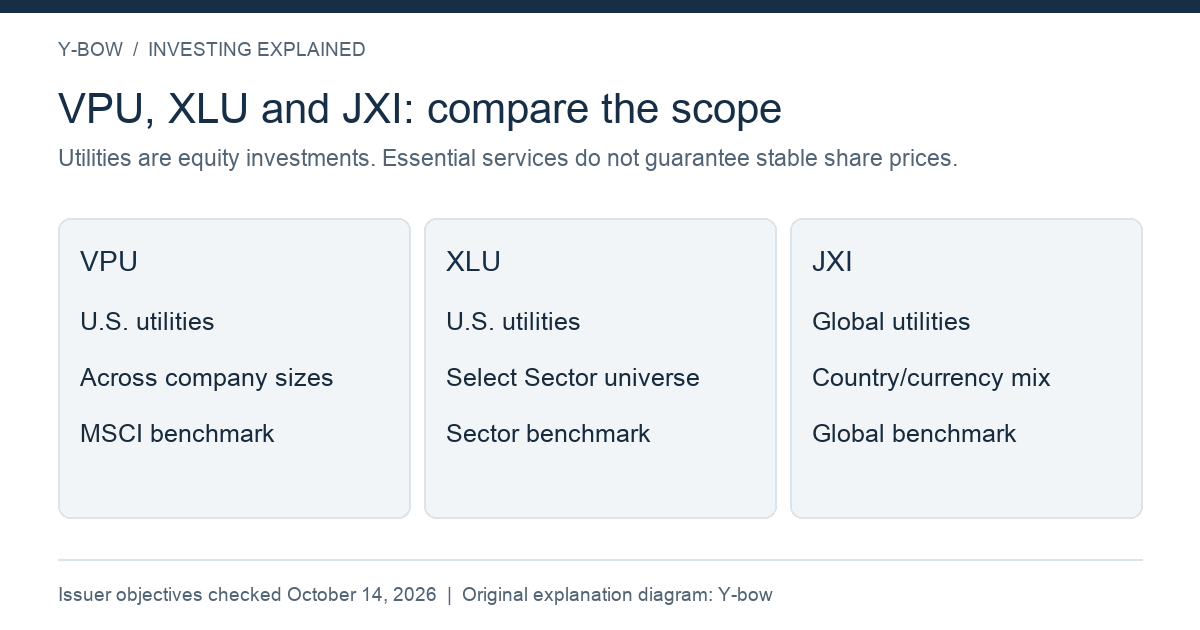
VPU follows the MSCI US Investable Market Utilities 25/50 Index, covering U.S. utilities across company sizes. XLU follows the Utilities Select Sector Index. JXI targets global utilities equities. These summaries come from the issuers: Vanguard VPU, State Street XLU, and iShares JXI.
| Fund | Geographic frame | Starting point for comparison |
|---|---|---|
| VPU | United States | Breadth across U.S. company sizes |
| XLU | U.S. Select Sector universe | Large-company sector exposure |
| JXI | Global | Country, currency and regulatory mix |
Read each current factsheet for actual holdings, weights, expense ratios and yield definitions. A fund marketed as global can still have substantial exposure to one country. A U.S.-listed fund's trading currency does not describe every underlying economic exposure.
Why financing costs matter
Utility businesses can require large investments in infrastructure. Higher demand is useful only if the company can finance and operate that infrastructure at an acceptable return. Debt costs, regulation and the timing of customer-price adjustments all matter.
Here is a simplified example. A business has $100 million of operating profit before interest and $500 million of debt. At a 4% average interest cost, interest is $20 million, leaving $80 million before tax and other items. At 6%, it is $30 million, leaving $70 million—a 12.5% decline in the remainder despite unchanged operating profit.
This is not a forecast for a utility company. Existing fixed-rate debt does not instantly reprice when market rates move. The example highlights why maturities, refinancing schedules and regulated returns belong in the analysis.
A dividend is not a bond coupon
Utilities may pay dividends, but the amount is not guaranteed and the share price can fall. Compare cash generation, investment needs and the financing of distributions. A large yield caused by a falling price can be a warning as well as an opportunity.
Distinguish trailing distributions, an annualized recent payment and a standardized yield measure. They need not give the same answer. To judge historical investment results, use total returns that account for distributions, not just a price chart or yield label.
Global exposure adds different risks, not no risks
JXI can diversify the country exposure of a U.S.-only utilities allocation, but countries have different regulatory structures, financing environments and currency movements. This is an analytical trade-off, not an automatic improvement.
For an investor spending in a particular currency, calculate what a foreign-currency move would mean for the overall portfolio. Local-currency share prices can rise while the value measured in the investor's spending currency falls.
Are utilities an AI or data-center investment?
Greater electricity demand is a plausible business driver, but it is not enough to establish an investment return. Ask which companies have the relevant assets, which contracts or regulatory arrangements determine revenue, what capital expenditure is required, and what the current valuation already expects.
The risk is moving from a real demand trend to a promise of shareholder gains without analyzing the middle steps. A utilities ETF can contain businesses with little direct exposure to the specific development motivating the purchase.
A repeatable comparison checklist
Align the dates and distribution treatment when comparing returns. Check top holdings and portfolio overlap. Record expenses, trading spreads, country weights and the date of the data. Decide whether the fund is intended as a long-term sector allocation or a short-term view.
A defensive business model can still produce volatile shares. If a financial goal requires stability of principal, compare the utilities allocation with cash and appropriate lower-risk alternatives rather than relying on the label.
Continue with portfolio diversification and ETF overlap. The Japanese utilities companion covers the original discussion.
Fund scopes checked October 14, 2026. Financing example and diagrams: Y-bow, hypothetical and simplified. Availability, taxes and account rules vary by country.





Comments