

A memory-company buyback is not an automatic stock-price accelerator. It can introduce a corporate buyer, reduce the share count, distribute cash out of the business and change the shares that index funds are expected to hold. Those mechanisms operate on different schedules and should be analyzed separately.
SK hynix’s 2026 repurchase-and-cancellation program provides a useful case study. Comparing it with Micron’s 2018–2019 execution, Samsung Electronics’ completed purchases and Micron’s newly expanded authorization reveals why a large headline amount is only the beginning of the analysis.
Research cutoff: October 12, 2026. We directly inspected KRX/KIND execution records and reconciled 34 daily observations with SK hynix’s cumulative total. Plans, completed transactions, reported market reactions and illustrative calculations are distinguished throughout. Future completion dates and index flows are not presented as established facts.
Authorization, execution and cancellation are different events
An authorization establishes capacity or a policy; execution shows what the company actually purchased. Cancellation, retention as treasury stock and distribution to employees have different implications for the subsequent share count. A company can spend substantial cash buying stock without permanently removing all of those shares from circulation.
| Case | Plan or authorization | Verified execution | Intended treatment |
|---|---|---|---|
| SK hynix, 2026 | Approximately KRW 40tn; scheduled August 20–November 19 | 20.45m shares and KRW 35.73tn through October 12 | Full cancellation after acquisition |
| Micron, announced 2018 | Up to USD 10bn; discretionary purchases from FY2019 | USD 2.66bn in FY2019 | Recorded as treasury stock |
| Samsung, announced 2024 | KRW 10tn acquired in stages | Acquisition completed by September 2025; initial KRW 3tn tranche cancelled in February | Do not assume every acquired share was immediately cancelled |
| Samsung, August 2026 | KRW 15tn; originally scheduled August 24–November 21 | 56,856,305 common shares acquired August 24–October 6 | Treasury stock for employee compensation |
| Micron, October 2026 expansion | USD 35.16bn total authorization; purchases from December 9 subject to conditions | No future execution under the expanded capacity can yet be observed | No obligation or expiration date |
Sources: SK hynix’s announcement, KRX/KIND records, Micron FY2019 results, Samsung’s shareholder letter, its August 2026 resolution and RNS execution disclosure, and Micron’s FY2026 Form 10-K. Different currencies and periods make the amounts unsuitable for direct ranking.
SK hynix’s 2026 buyback: what the exchange records show
The daily bid declined from 650,000 to 400,000 shares
The announced plan was to acquire and cancel approximately KRW 40tn of shares. The initially indicated 24.07m shares—about 3.3% of issued shares—was calculated using a reference stock price. It should not be interpreted as a fixed share quantity independent of execution prices.
KRX/KIND shows 34 execution days from August 20 through October 12. Applied and executed quantities matched on every observation. Most early purchases were 650,000 shares; later September purchases were commonly 600,000; October 2 was 500,000; the observed execution days from October 6 onward were 400,000.
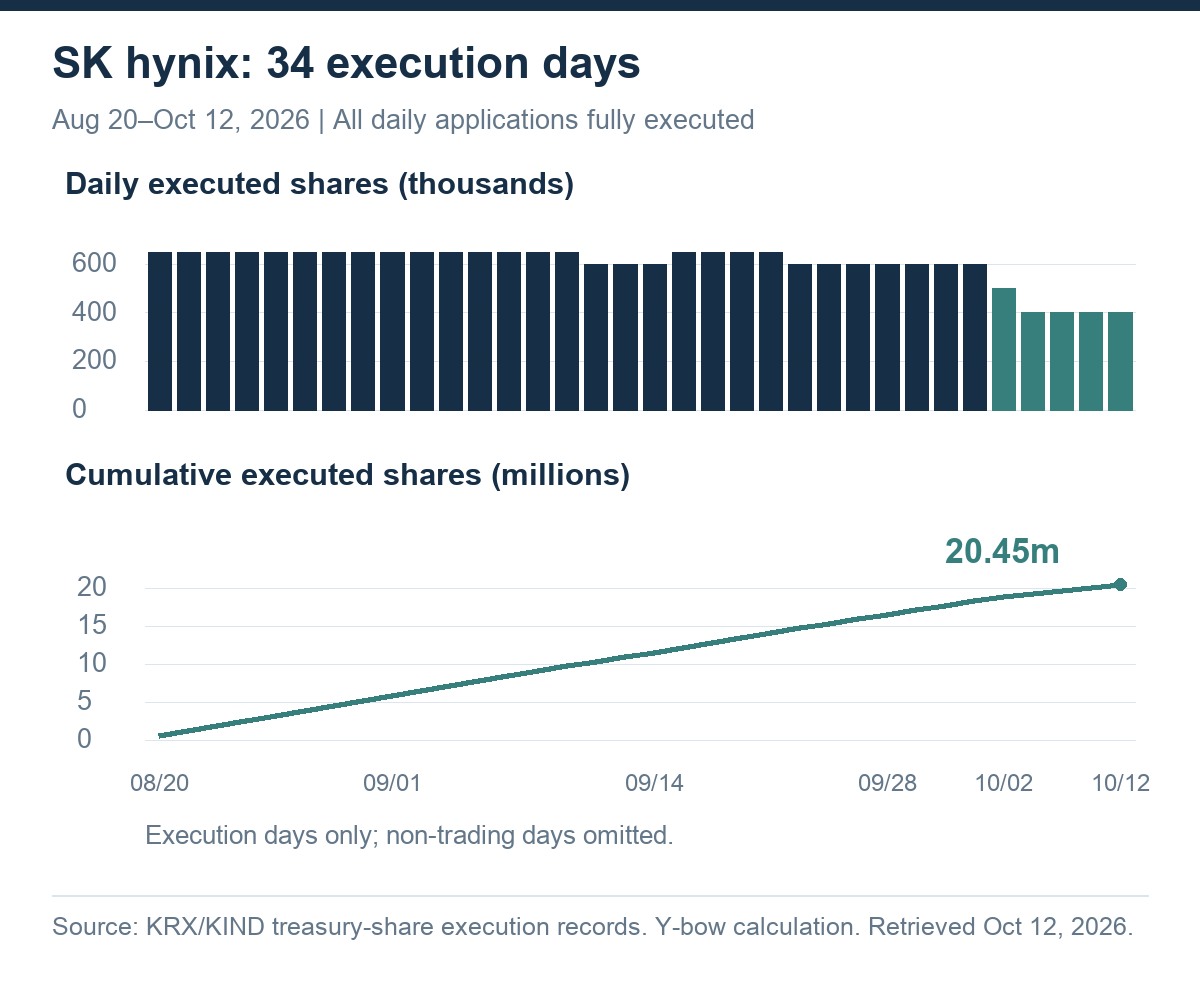
Moving from 650,000 to 400,000 shares reduces the daily quantity by about 38.5%. It does not establish an identical reduction in price support. Market volume, available sellers, prices and execution timing also matter. The records establish the transactions, not the reason management changed its applications.
Share progress and budget progress give different answers
The exchange’s cumulative record shows 20,450,000 shares and KRW 35,729,554,409,000. The daily share total reconciles exactly with the cumulative field. Dividing cumulative expenditure by shares gives a calculated average of approximately KRW 1,747,166 per share. That is not the latest day’s execution price.
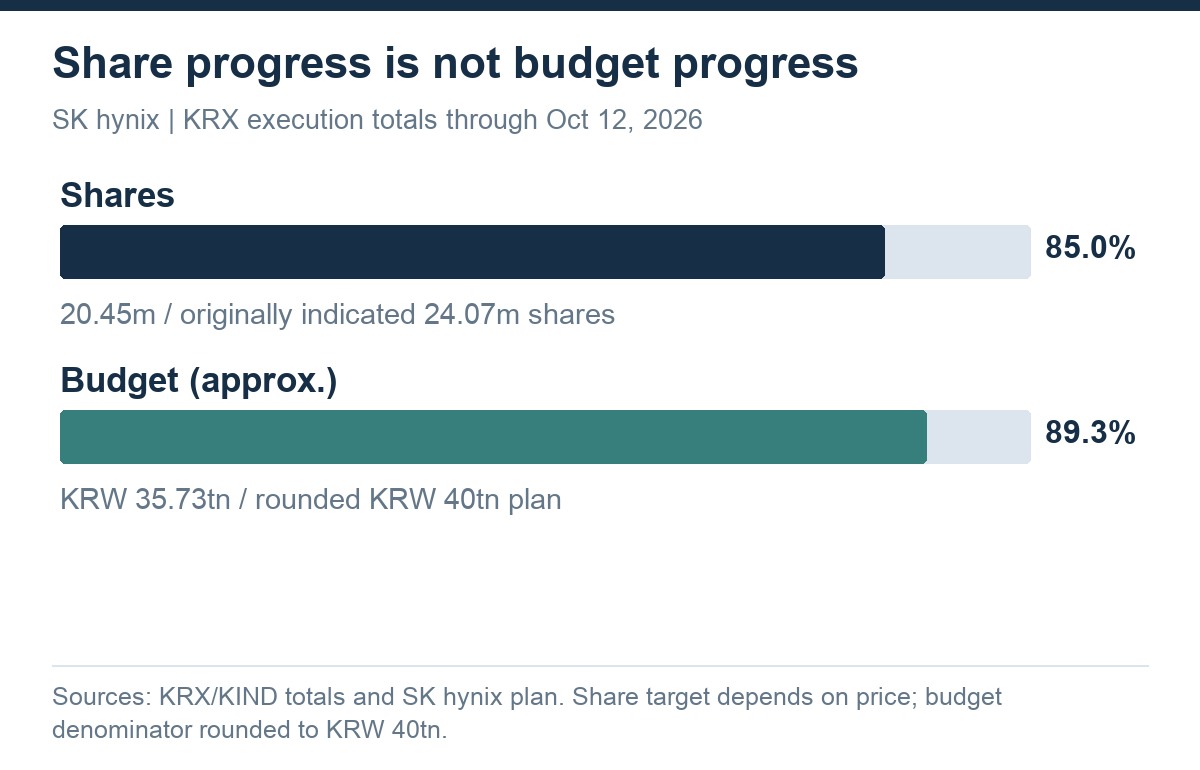
Subtracting acquired shares from the initial indication leaves 3.62m shares. At an assumed 400,000 shares per execution day, that is roughly 9.1 trading days, or about ten whole trading days. But the rounded budget leaves approximately KRW 4.27tn; at the cumulative average price, that would purchase only about 2.44m shares. The difference illustrates why a price-dependent share indication and a cash budget are not interchangeable.
October completion is a plausible scenario, not a verified outcome as of the cutoff. Track remaining expenditure, daily applications, execution prices and the final acquisition report. Do not assume purchases continue unchanged until the scheduled deadline or that the company must increase its budget to reach the initial share indication.
To reproduce the exchange lookup, select SK하이닉스, code 000660, and the relevant dates in KRX/KIND’s treasury-share acquisition/disposal screen. The declaration and execution tabs provide different information.
Market reception: a strong reaction is not a causal estimate
On August 20, 2026, SK hynix closed at KRW 1.69m, up 12.73%, while KOSPI rose 5.89%. Yonhap’s closing report also describes a broad rebound after the previous session’s sell-off and easing U.S. bond-yield concerns. The buyback announcement was one important part of a day with several drivers.
Samsung’s 2024 plan was announced after the November 15 market close. On the next trading day, November 18, Samsung gained 5.98% and KOSPI gained 2.16%, according to Yonhap. The same report describes different company-specific news affecting SK hynix. A semiconductor-sector label does not make every stock react identically.
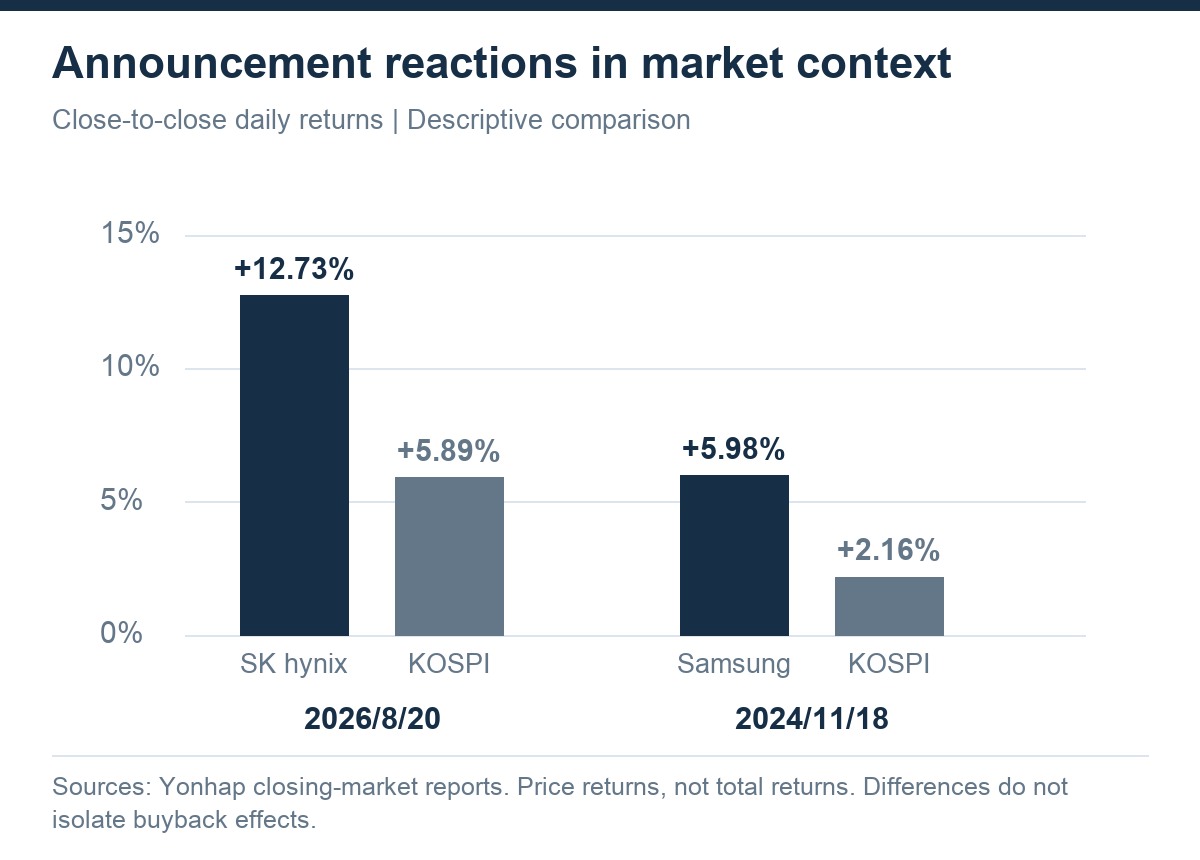
A credible event study would identify announcement timing, define a window, choose an appropriate benchmark and account for simultaneous earnings or product news. The counterfactual price without a buyback cannot be observed directly. A one-day rally should therefore not be treated as proof that execution or the post-buyback period will be successful.
Our framework separates the announcement signal, the execution-period bid and post-completion durability. Management’s valuation judgment can affect confidence before purchases begin. Actual orders matter during execution. Afterward, other investors and operating expectations must carry more of the demand.
Micron in 2018–2019: repurchases did not eliminate the memory cycle
Micron’s May 21, 2018 announcement authorized up to USD 10bn of discretionary repurchases from fiscal 2019. Capacity to repurchase was not an obligation to exhaust the authorization.
Actual execution was substantial: FY2019 Q1, ending November 29, 2018, included approximately 42m shares for USD 1.80bn. Full-year FY2019 execution reached USD 2.66bn. The fiscal-year label is not the calendar year: placing FY2019 Q1 transactions in January–March 2019 would misdate the purchases.
Meanwhile, annual revenue declined from USD 30.39bn to USD 23.41bn, and Q4 GAAP gross margin fell from 61.0% to 28.6%. Those figures describe operating performance, not a buyback-adjusted stock return.
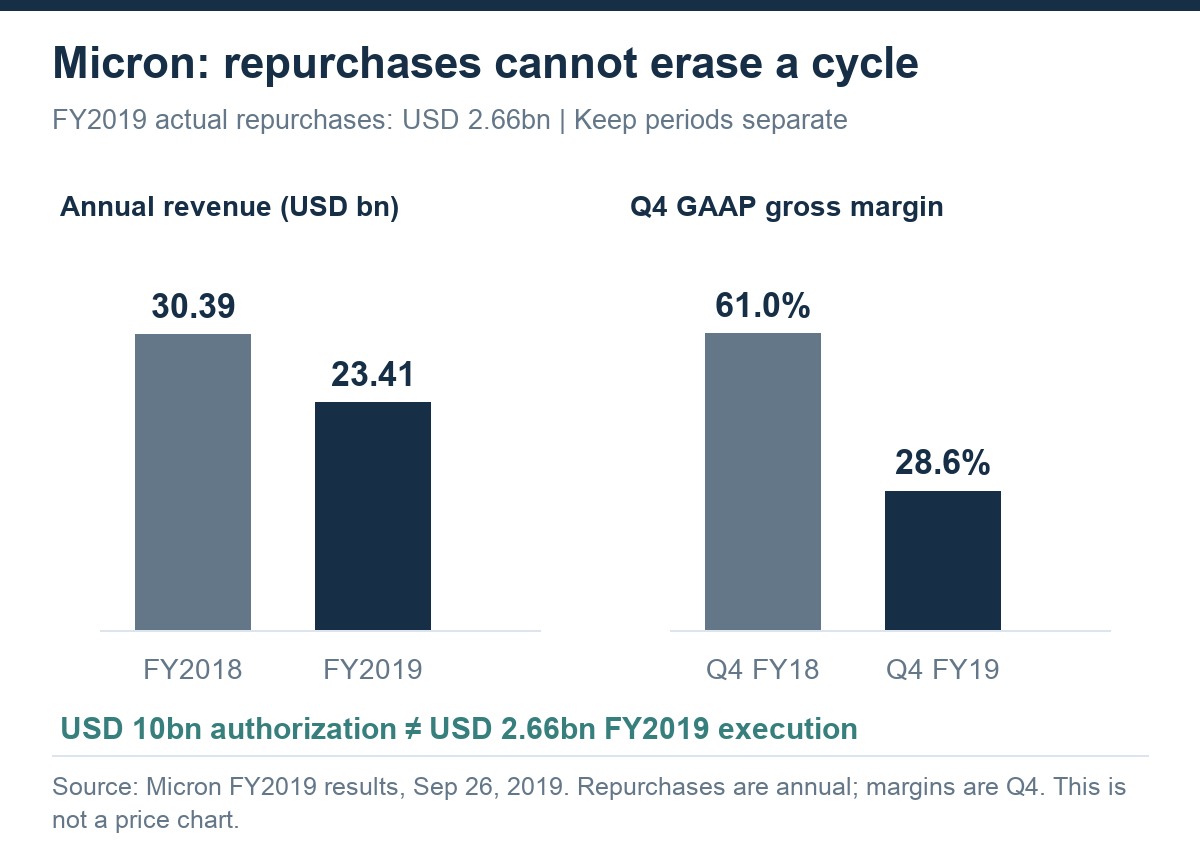
This does not prove that the purchases destroyed value. Buying below long-term intrinsic value can benefit remaining shareholders. It demonstrates the narrower point that repurchases cannot stop falling memory prices, weaker volumes or manufacturing pressure. Evaluate the price paid and the balance-sheet capacity that survives a downturn.
A low P/E during unusually strong memory earnings can also mislead. If peak profits later normalize, the same share price has a different valuation. Capital returns occur inside the operating cycle; they do not remove the cycle.
Samsung: cancellation versus employee-stock compensation
The first 2024 tranche reached acquisition and cancellation
The November 2024 plan called for KRW 10tn of phased purchases, with full cancellation of the first KRW 3tn. Samsung’s business report records completion of that first tranche on February 13, 2025 and cancellation on February 20: 50,144,628 common shares and 6,912,036 preferred shares.
Samsung’s shareholder letter subsequently reported that all KRW 10tn of acquisitions were completed by September 2025. That is not equivalent to saying every acquired share was cancelled. The letter separates already cancelled stock, employee-compensation reserves and further cancellation decisions.
The 2026 KRW 15tn program had a different purpose
Samsung’s August 21, 2026 resolution specified treasury stock for employee and executive compensation. Its October 12 RNS results disclosure reports 56,856,305 common shares acquired from August 24 to October 6, at an average KRW 263,823, for approximately KRW 15tn.
The initial indication was 53,285,968 shares, based on the resolution-day close of KRW 281,500. The final quantity was larger because execution prices differed. The results disclosure also contains an updated order quantity; distinguish that from the initial indication and final acquisition.
The average acquisition price was about 6.3% below the resolution-day close. That calculation is not a 6.3% start-to-finish stock return: a transaction-weighted average is not the closing price on the completion date.
Compensation-related purchases still create a corporate bid, but later employee distributions can bring treasury shares back into circulation. Examine net share-count changes rather than treating the gross purchases as permanent cancellation. Talent retention is a separate business objective, also worth evaluating.
Higher EPS is not automatically higher intrinsic value
In a simplified model, earnings of 100 divided by 100 eligible shares produce EPS of 1. If earnings remain unchanged and shares fall to 96.7, EPS becomes roughly 1.0341, an increase of 3.41%. This is denominator arithmetic, not operating growth.
Reported EPS uses weighted-average shares and dilution rules. Treasury shares may already be excluded. Cancelling shares previously bought into treasury does not necessarily deliver the same EPS effect a second time.
Cash also leaves the company. Suppose fair equity value, including cash, is 1,100 with 100 shares, or 11 per share. Repurchasing 3.3 shares at fair value costs 36.3, leaving 1,063.7 divided by 96.7 shares: still 11. In this deliberately simplified, tax- and cost-free model, buying at fair value does not create free money.
The substantive questions are price versus intrinsic value and opportunity cost. Could the cash earn more through capacity, research, debt reduction or a downturn buffer? Memory technology requires investment. Judge repurchases alongside the cash and competitive position left behind.
Can lower free float create an index-flow headwind?
The corporate buyer and the benchmark target are different mechanisms
Float-adjusted capitalization-weighted benchmarks use a concept equivalent to price multiplied by index shares and a float factor. See S&P DJI’s Index Mathematics Methodology and the MSCI methodology hub.
If repurchases reduce investable shares and the benchmark updates, a tracking fund may need fewer shares, all else equal. This can introduce rebalancing sales while the company is buying. It does not imply automatic deletion from the index, same-day selling or a predetermined cash outflow.
A 3.3% issued-share reduction need not equal a 3.3% float change
Our illustrative company has 100 issued shares and 70 free-float shares. Repurchasing 3.3 from the float leaves 66.7 float shares and, after cancellation, 96.7 issued shares. At an unchanged price, float-adjusted capitalization falls 66.7/70−1, approximately 4.71%.
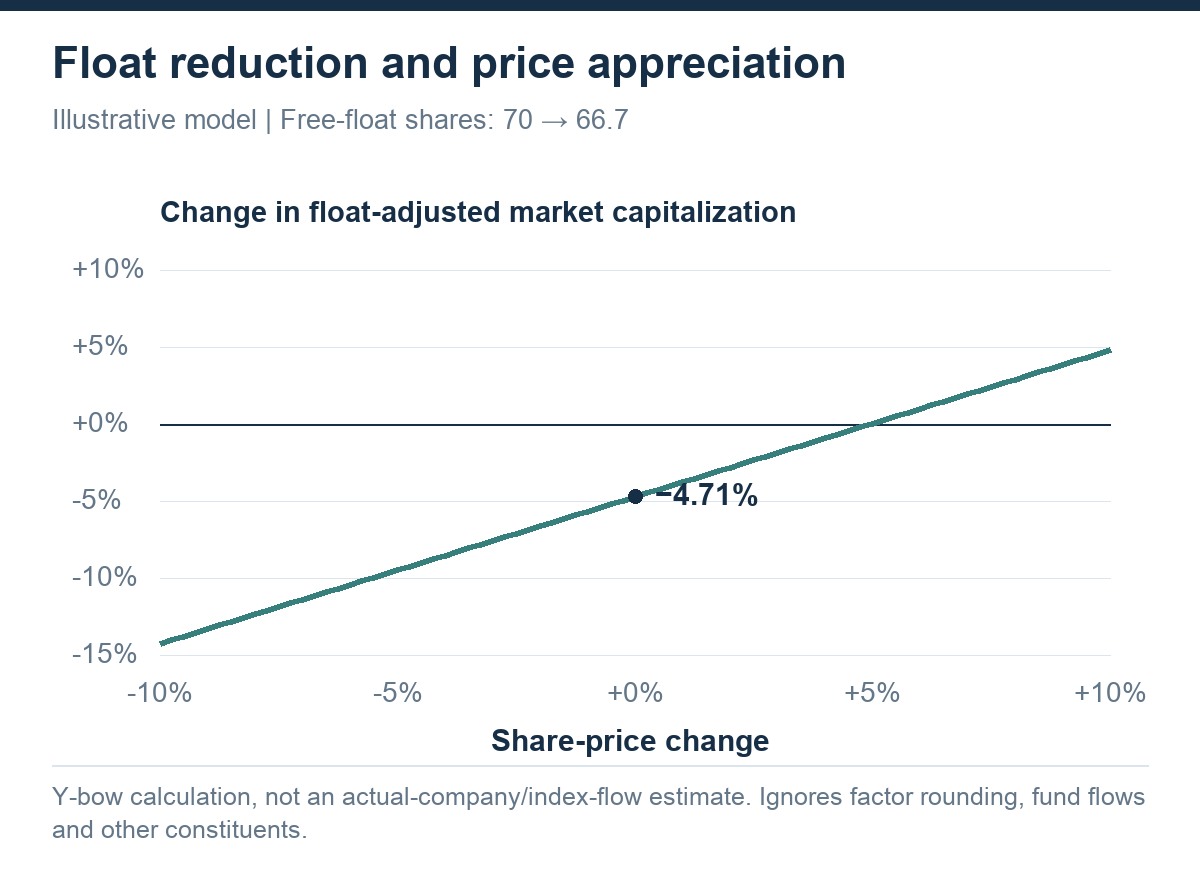
With 5% price appreciation, the same company’s float-adjusted capitalization is approximately 0.05% higher; with 10%, it is approximately 4.81% higher. Actual weight also depends on the other constituents and benchmark constraints. Float reduction alone cannot establish a decline in index weight.
Acquisition, cancellation and index implementation have separate dates
Section 2.4 of MSCI’s February 2026 Corporate Events Methodology distinguishes progressively executed open-market buybacks, implemented through regular reviews, from tender offers. Do not borrow tender-offer thresholds for open-market purchases. Float-factor rounding rules can also change.
Already excluded treasury stock should not be subtracted from the float again on cancellation. Conversely, employee distributions can change investability again. Index-divisor adjustments that preserve index continuity are also distinct from fund transactions.
Corporate purchases and index-holder sales can be opposite sides of the same transaction; treating their gross amounts as entirely independent flows can double-count the mechanism. We have not verified a specific SK hynix index-implementation date or passive-sale amount. Those require confirmed provider notices, before-and-after index shares and factors, and relevant tracking assets.
Micron’s December 9, 2026 capacity is not a dated purchase order
Micron’s FY2026 Form 10-K reports an October 8 expansion to USD 35.16bn in total authorization, with purchases from December 9 under its CHIPS direct-funding agreements. The authorization has no expiration and does not obligate execution.
CHIPS conditions distinguish permitted dilution-offset or otherwise approved transactions from purchases subject to financial conditions. This is not simply “a total ban ends and unrestricted purchases begin.” FY2026 already included USD 650m of acquisitions under the old program, versus none in FY2025.
Monitor execution, capital expenditure, grant conditions, dividends and stock-based dilution—not authorization alone. A larger ceiling expands discretion; it does not establish how quickly cash will be deployed. The current source is Item 5 and Notes 12 and 15 of the FY2026 Form 10-K.
A checklist for the post-buyback period
- Reconcile execution: original and revised plans, actual expenditure, shares, average price and completion notices.
- Measure net shares: include new issuance, employee compensation, treasury distributions and cancellation.
- Separate missing buying from new selling: the corporate bid ending is not an equivalent new sell order.
- Track the business: DRAM, NAND and HBM pricing, volumes, mix, margins and customers’ capital expenditure.
- Check resilience: cash remaining after necessary investment and capacity to withstand a downturn.
- Verify index events: use confirmed changes rather than invented passive-flow dates or amounts.
Completion may be anticipated before the final purchase. Additional capital-return announcements or earnings news can coincide with it. Other memory stocks need their own analysis: a NAND-focused producer and an HBM leader have different operating exposures. An SK hynix buy order does not directly purchase Kioxia or Micron shares.
Frequently asked questions
Does a buyback guarantee a rising stock?
No. Demand and confidence can improve, but neither removes adverse earnings revisions, weaker memory pricing, interest-rate pressure or selling by other investors. Paying too much can also be poor capital allocation.
Does higher EPS prove better operations?
No. Separate total-profit growth from denominator reduction and examine weighted-average diluted shares. Margins, operating cash flow and investment provide additional context.
Does lower float make every buyback bearish?
No. Potential benchmark adjustments are one force among price appreciation, valuation, timing and liquidity. Permanent cancellation and later employee distribution are different designs.
Can leveraged ETFs turn the buyback into a predictable return?
No. First check holdings, weights and listing exposures. Daily leverage adds path-dependent compounding. Our daily-leverage explanation and backtesting guide explain why a company event cannot establish a leveraged-fund outcome.
Our interpretation: a buyback is an investment decision by the company
The durable question is what management gives up and what remaining shareholders gain. SK hynix’s cancellation program, Samsung’s compensation-related purchases and Micron’s discretionary authorization all fit under the same headline, yet have different economic designs.
Assess execution price, net shares, business investment, balance-sheet resilience and confirmed index treatment. For the wider distinction between structural demand and cyclical profits, read our semiconductor-supercycle analysis.
Sources checked October 12, 2026. Charts and interpretation are original Y-bow work. This is an educational analysis, not a recommendation to trade or a forecast of guaranteed appreciation. Future completion, cancellation and index announcements should be added as new evidence, separately from the record documented here.


Comments
List of comments (1)
[…] Our memory-company buyback analysis explored the opposite direction: removing float can reduce benchmark holdings. Here, changes in previously fixed ownership may eventually increase index capacity. Following the shares makes both mechanisms easier t […]