

The company is buying more GPUs. Its customers want more capacity. Earnings are rising. Why, then, is so little cash left after investment? That is a reasonable question when you own AI-related shares. “It is all growth spending” may be true, but it is not a complete answer.
A GPU’s physical life, its accounting useful life and the time needed to earn back its cost are different clocks. This guide separates them. The aim is to make the next earnings report easier to read, rather than to predict the next move in an AI stock.
Follow the equipment from purchase to service, depreciation and eventual replacement. Ask what cash remains after paying for the capacity needed to keep the business competitive. Neither a large capex budget nor a long depreciation schedule settles that question.
AI capex vs depreciation: why earnings and cash move differently
Equipment spending and the expense recognized in the income statement do not necessarily happen together. A capitalized asset is generally expensed over its estimated useful life. The SEC’s financial statement guide is a useful introduction to the relationship between earnings and cash flow.
Consider hypothetical equipment costing 60 units, paid in cash at the beginning of the year, with no residual value and straight-line depreciation. A six-year life gives annual depreciation of 10. A three-year life gives 20. The initial cash payment is 60 in both cases. The annual expense differs by 10, although neither the equipment nor the cash paid has changed.
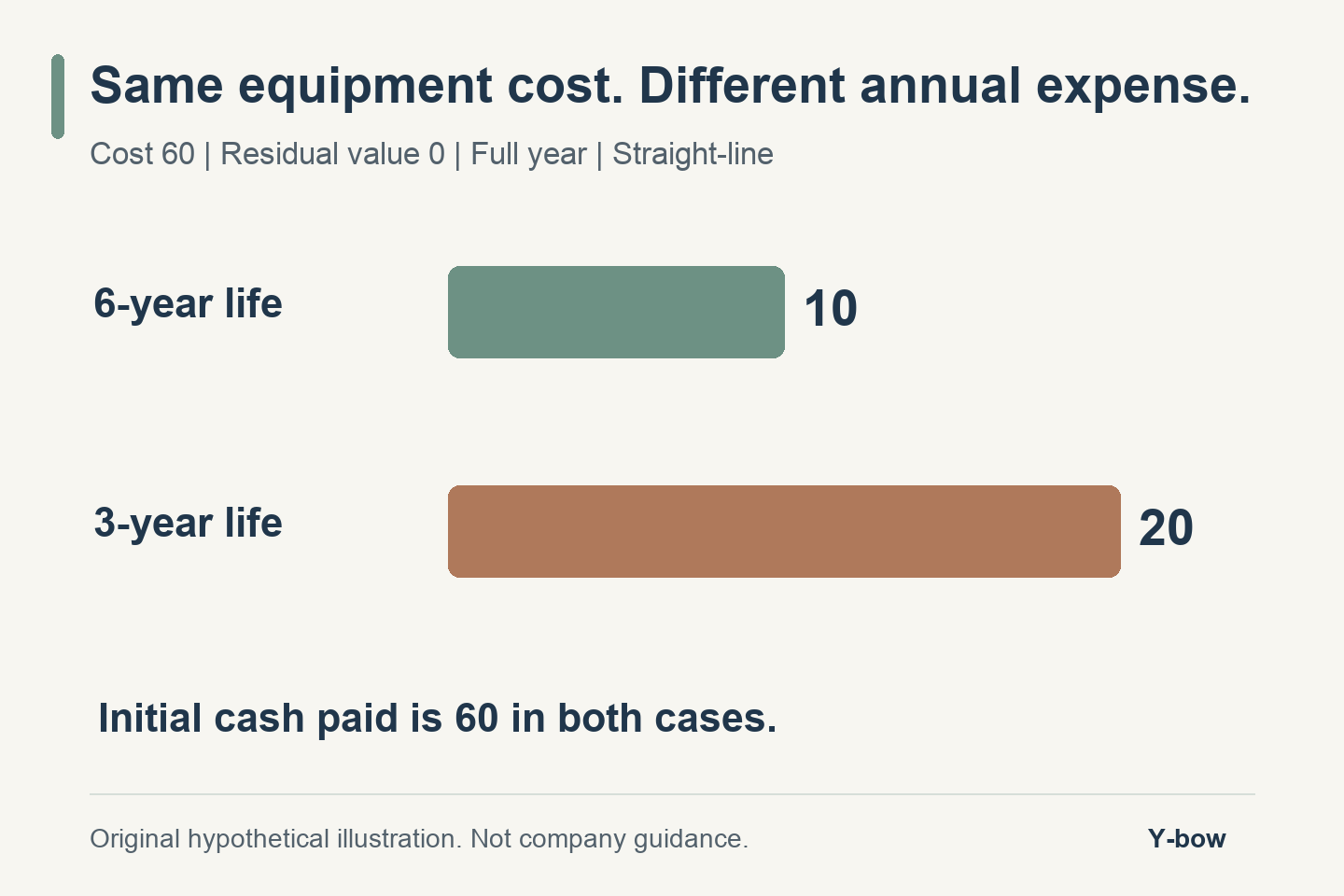
This compares two estimates made at initial recognition. A later change in an existing asset’s estimated life needs to consider its remaining carrying amount, residual value and remaining life. It is not necessarily a fresh division of the original price by a new number of years.
Noncash does not mean free
Under the indirect cash-flow method, depreciation is added back to earnings because the expense is not a current cash payment. That does not cancel the earlier purchase or the next replacement. Looking only at the add-back can make a capital-intensive business seem less demanding than it is. Looking only at capex can make a worthwhile expansion seem like a failure. You need both sides.
How long do GPUs last? Four questions behind one headline
| Clock | Question | Evidence to seek |
|---|---|---|
| Physical life | Can it still operate? | Maintenance and reliability |
| Accounting life | Over what period is cost allocated? | Accounting policy and estimate changes |
| Economic life | Can it still earn an adequate margin? | Utilization, pricing and operating costs |
| Payback | When is the investment recovered? | Initial cost and subsequent cash flows |
A new chip does not automatically make an older one worthless. An older system may find another workload. But being usable is not the same as being profitable after power, maintenance and staffing. Nor should the life of a building be assigned to every GPU inside it. Compare similar asset categories and service dates before comparing companies’ schedules.
広告
Amazon’s useful-life change: a real disclosure, not a universal GPU expiry date
Amazon’s 2025 Form 10-K, Note 1 says it shortened the estimated useful lives of a subset of servers and networking equipment from six to five years, effective January 2025. It cited faster technological development, particularly AI and machine learning, and disclosed $1.4 billion of additional depreciation and amortization expense for 2025.
The important words are “a subset.” This is not a five-year expiry date for Amazon’s whole estate or the world’s GPUs. It is also a historical accounting effect, not the purchase cost of those assets or a forecast for the latest quarter. An estimate change deserves investigation; its existence alone is not evidence of fraud.
A practical follow-up is to separate a change in expense allocation from a change in cash spending. Then ask whether the equipment’s actual use and replacement pattern support the new estimate. A longer accounting life cannot, by itself, make an unprofitable workload profitable.
A worked free-cash-flow example: positive profit, negative cash after capex
Take a fictional year with revenue of 50, cash operating costs of 25 and depreciation of 10. Ignore tax, interest and working-capital movements. Operating profit is 15. Adding depreciation back produces operating cash flow of 25. If cash capex is 40, free cash flow under the definition used here is 25 minus 40, or negative 15.
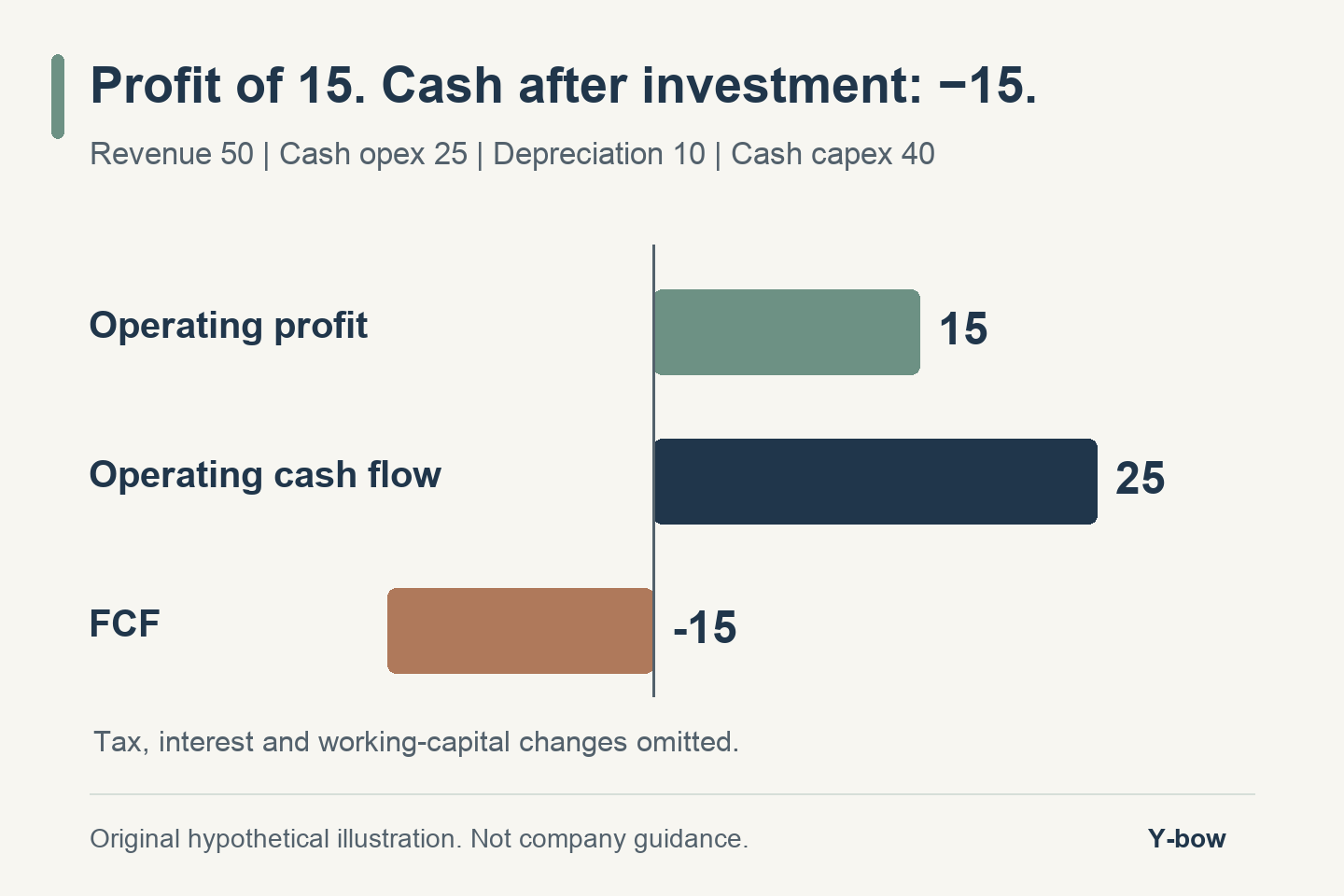
There is no contradiction between these three figures. The question is what the new assets will earn, how long the company can fund the build-out and what happens if revenue arrives late. Look at available cash, debt maturities, lease payments and committed future spending. A company’s adjusted FCF may use a different definition; reconcile it before making comparisons.
Be careful with “excluding growth capex”
Separating maintenance from expansion can be useful. Guessing the split can also make the answer say whatever you want. A single project may both replace old equipment and add capacity. Start with the full cash outlay when the split is unavailable. Present any alternative estimate separately, with an explicit assumption and a sensitivity range.
Even if an asset has a six-year accounting life, replacing it after three years to remain competitive requires cash. Conversely, cheaper replacements or profitable secondary workloads can improve economics. Neither outcome follows automatically from the depreciation label.
広告
Utilization is not revenue: multiply the assumptions
Suppose available annual compute time is 1,000 units, utilization is 60% and revenue per used unit is 2. Revenue is 1,200. If utilization rises to 80% but price falls to 1.5, revenue is still 1,200. This is a unit-consistency exercise, not an actual cloud tariff or a prediction.
Power, staffing, maintenance and replacement come next. If a contract supports the revenue, check its term, minimum usage, payment terms, customer credit and cancellation rights. Backlog is not collected cash. Also distinguish the chip supplier’s sale from the cloud operator’s return on the equipment: one can book revenue well before the other proves payback.
For the physical side of the investment, see our guides to data center electricity demand and the HBM, DRAM and NAND industry map. These explain constraints and suppliers; they do not replace the cash-flow calculation.
A seven-point checklist for the next AI earnings report
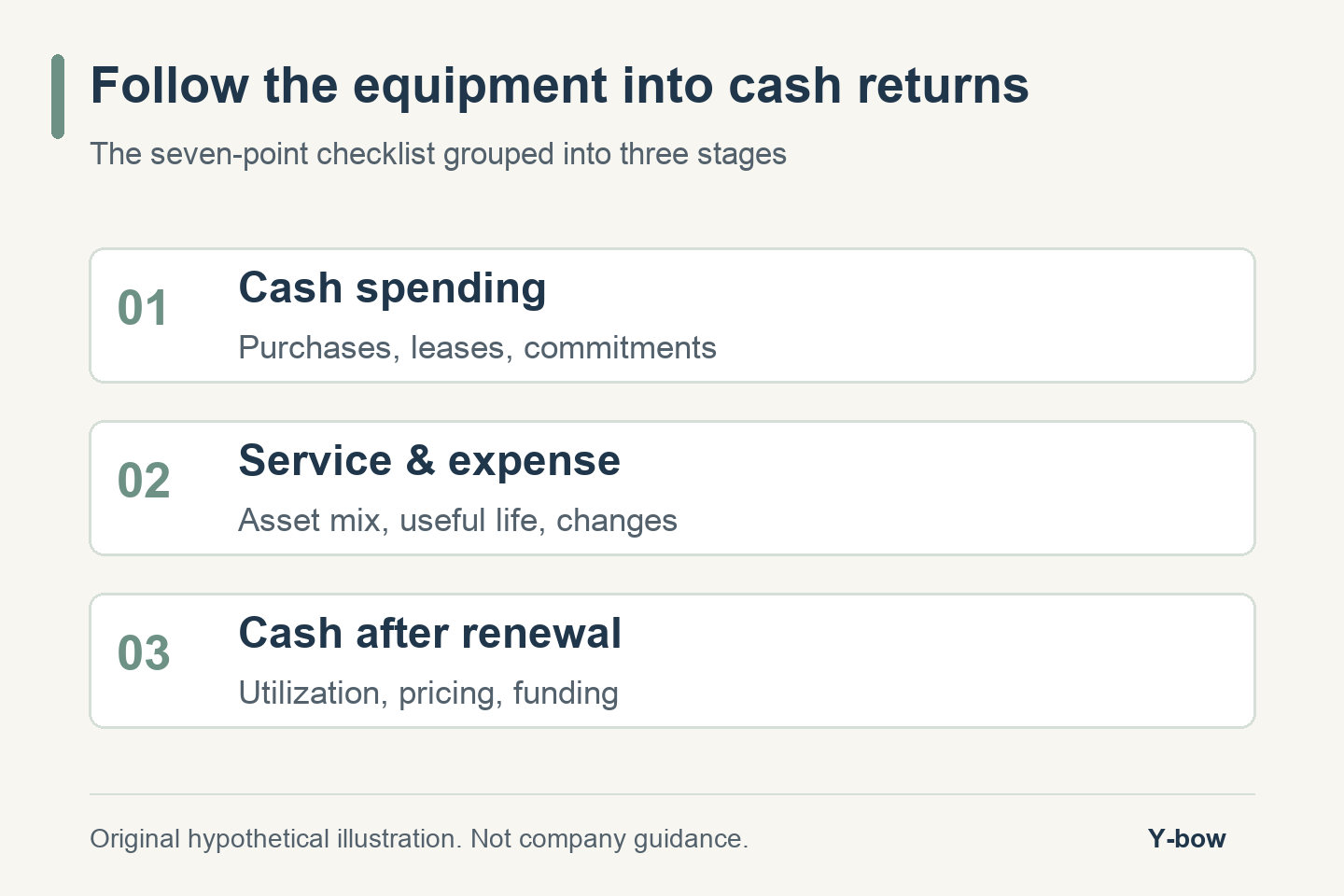
- Assets: separate buildings, servers and networks.
- Spending: distinguish cash purchases, leases, prepayments and commitments.
- Timing: determine whether capacity is being built, installed or earning revenue.
- Accounting: read useful lives, residual values and estimate changes.
- Workloads: compare utilization with realized pricing and operating costs.
- Funding: include replacement needs, debt and lease obligations.
- Evidence: compare profit with operating cash flow and cash after investment.
Missing disclosure is not a clean bill of health. Leave an unanswered question in the worksheet, then revisit it at the next filing. This makes the framework useful after today’s AI headlines have faded.
FAQ: does higher depreciation make an AI stock a sell?
Is a long useful life an earnings warning?
It lowers annual depreciation in a like-for-like initial estimate, but asset mix and actual use matter. Read the explanation and test it against subsequent evidence. Do not compare a whole building with a GPU fleet.
Is negative FCF always bad?
No. A fundable investment that earns an adequate return can justify temporary negative cash after capex. The difficult part is testing the return and funding, including a delay scenario, rather than assuming them.
Where can I learn the technical background?
Our English video Why GPUs Need HBM explains memory bandwidth. It is related technical background, not a video about depreciation accounting.
For a further discussion of who earns money along the AI spending chain, see the author’s related note article (Japanese). Check the free and paid sections at the destination; no paid material is reproduced here.
Sources, calculations and future updates
Checked October 20, 2026. Primary sources: Amazon’s 2025 Form 10-K, Note 1, and the SEC financial statement guide. All diagram numbers are original hypothetical examples. Straight-line depreciation assumes zero residual value; FCF here means operating cash flow minus cash capex. The cash bridge omits tax, interest and working-capital changes. Future updates will check estimate changes, service dates, replacement needs and cash conversion. This is an analysis framework, not a security recommendation.








Comments