
A contract for difference, or CFD, provides exposure to a price change without purchasing the underlying asset in the usual way. The result is settled under the contract with a provider. It can support long or short positions, but neither leverage nor a “zero commission” label makes it a low-cost substitute for owning an ETF.
Availability and retail protections differ by country. This explanation is about the mechanics, not a recommendation to open an account or a claim that the same rules apply worldwide.
Position value and margin are different numbers
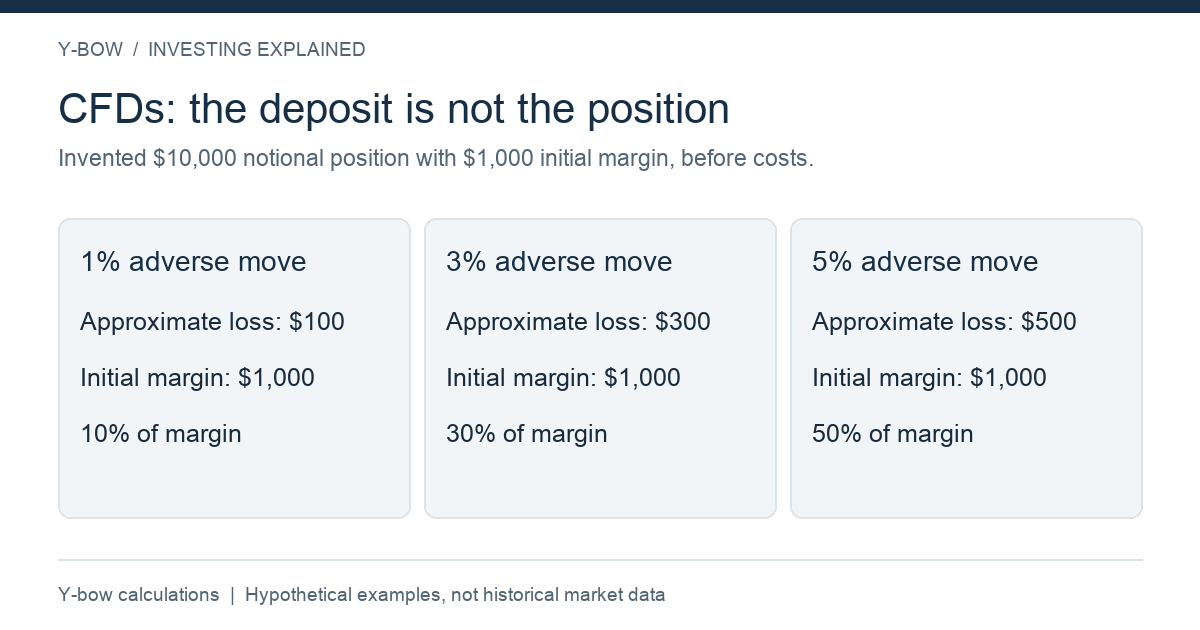
Suppose an invented CFD position has a notional value of $10,000 and requires $1,000 initial margin. That is 10 times exposure relative to the posted margin. A 3% unfavorable price move creates an approximate $300 loss before costs: 3% of the position value, or 30% of that initial margin.
| Underlying move against the position | Approximate loss on $10,000 notional | Share of $1,000 initial margin |
|---|---|---|
| 1% | $100 | 10% |
| 3% | $300 | 30% |
| 5% | $500 | 50% |
These are mathematical illustrations. They do not imply that 10x leverage is available or suitable in your jurisdiction, or that a position can necessarily remain open until the last row.
Why a margin close-out matters
A provider may close positions when the account no longer meets its margin requirements. The exact mechanism depends on regulations, account terms and the positions held. A market gap can make the outcome different from the price you expected.
Posting more collateral can postpone a close-out, but it does not turn a losing position into a safer investment. It increases money at risk unless the exposure itself changes. A stop-loss order can help define a plan but generally should not be assumed to guarantee an execution price.
The UK FCA imposes specific protections for covered retail CFD accounts, including leverage restrictions, margin close-out rules and negative-balance protection. Read the current FCA handbook section rather than applying a UK rule to every offshore provider or professional account.
Zero commission is not zero cost
Compare the bid–ask spread, financing or overnight charges, currency conversion, adjustments and any guaranteed-stop charge where offered. Costs can depend on the instrument and whether the position is long or short.
For an invented $10,000 position, a 0.1% spread-equivalent cost is $10. A hypothetical annual financing charge of 8%, applied simply for 30/365 of a year, is about $65.75. Actual providers can use different rates, conventions and adjustments. These are not quoted fees.
That example explains why a short trading instrument can become expensive to hold. A share price chart alone does not show the costs debited from a CFD account.
CFD, ordinary ETF and leveraged ETF: different structures
| Structure | Main implementation issue |
|---|---|
| Ordinary ETF | Fund holdings, trading costs and market exposure |
| Daily leveraged ETF | Daily target, compounding, financing and fund costs |
| CFD | Contract terms, margin, provider exposure and position costs |
A CFD does not normally make you the direct owner of the underlying share with the same shareholder rights. A daily leveraged ETF does not ordinarily require the holder of fully paid shares to post additional CFD-style margin, although the ETF itself can lose substantial value. Read the actual terms instead of transferring one product's protection assumptions to another.
A sensible comparison starts before the trading screen
Identify the purpose of the exposure, the maximum affordable loss and the planned holding period. Calculate loss against the notional position, not just the deposit. Verify provider authorization with the relevant local regulator and understand which legal entity holds the account.
For many long-term investors, ordinary fund structures are a more useful starting comparison than the maximum leverage available. Our daily leveraged ETF explanation covers a different mechanism. This article adapts the Japanese CFD introduction without carrying over Japan-specific account recommendations.
Sources and review date
Reviewed October 14, 2026 using the FCA's current linked handbook and its CFD restriction policy statement. Numbers are original hypothetical examples before other costs. Retail eligibility, leverage limits and negative-balance rules are jurisdiction-specific.






Comments