
Many bond ETFs do not give each investor a date on which the original purchase amount is returned. Discovering an ETF with a maturity year can therefore sound like a solution with guaranteed principal. A defined date and a guaranteed dollar repayment are different promises.
What “defined maturity” means for an ETF
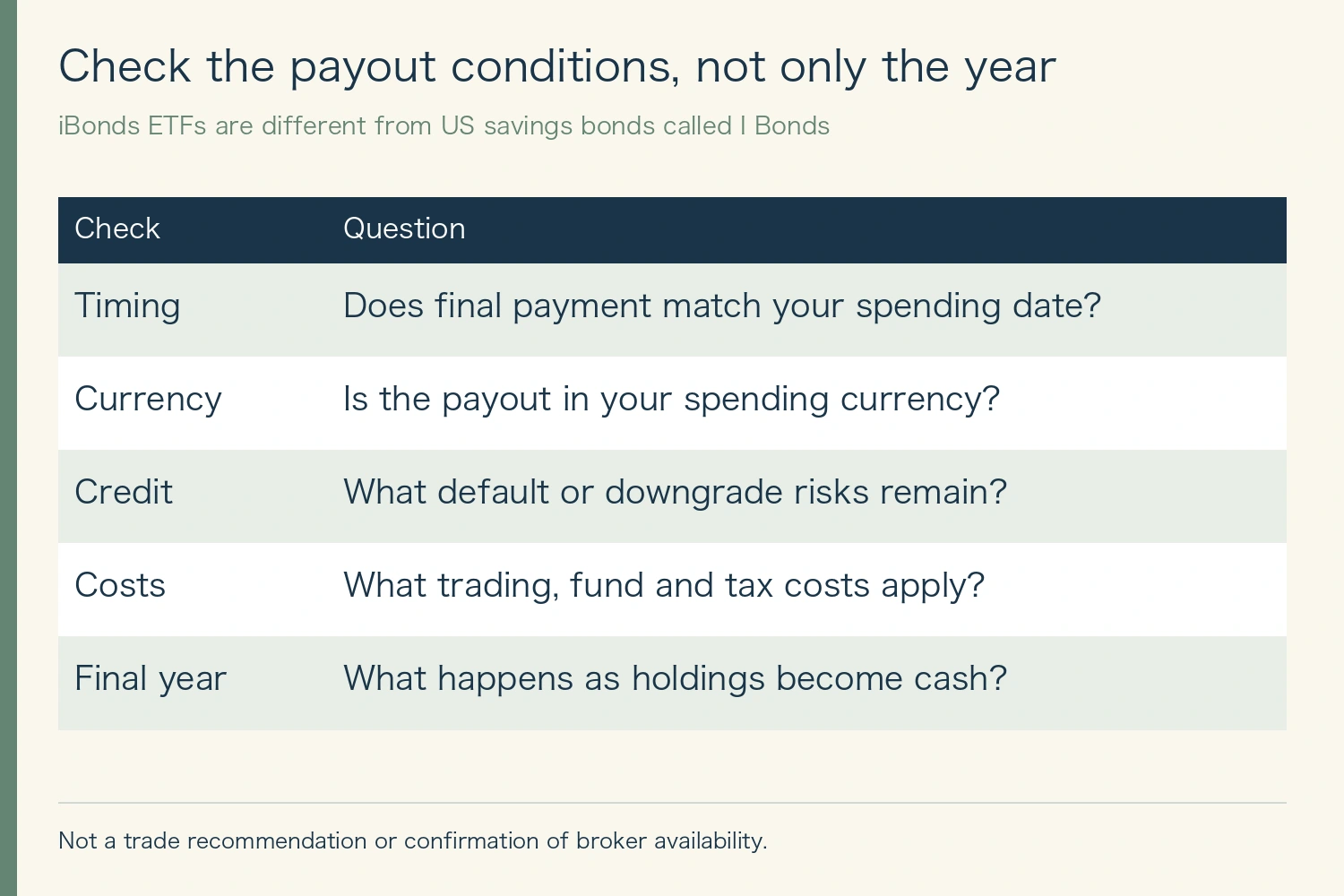
The iBonds discussed here are iShares ETFs, not US Series I savings bonds commonly called I Bonds. They are also different from retirement target-date funds that change stock and bond allocations over time.
The iShares investor guide describes funds grouping bonds around a specified maturity year. A conventional bond ETF may replace holdings to maintain a maturity band or exposure. A defined-maturity fund instead approaches its target year as the underlying portfolio ages.
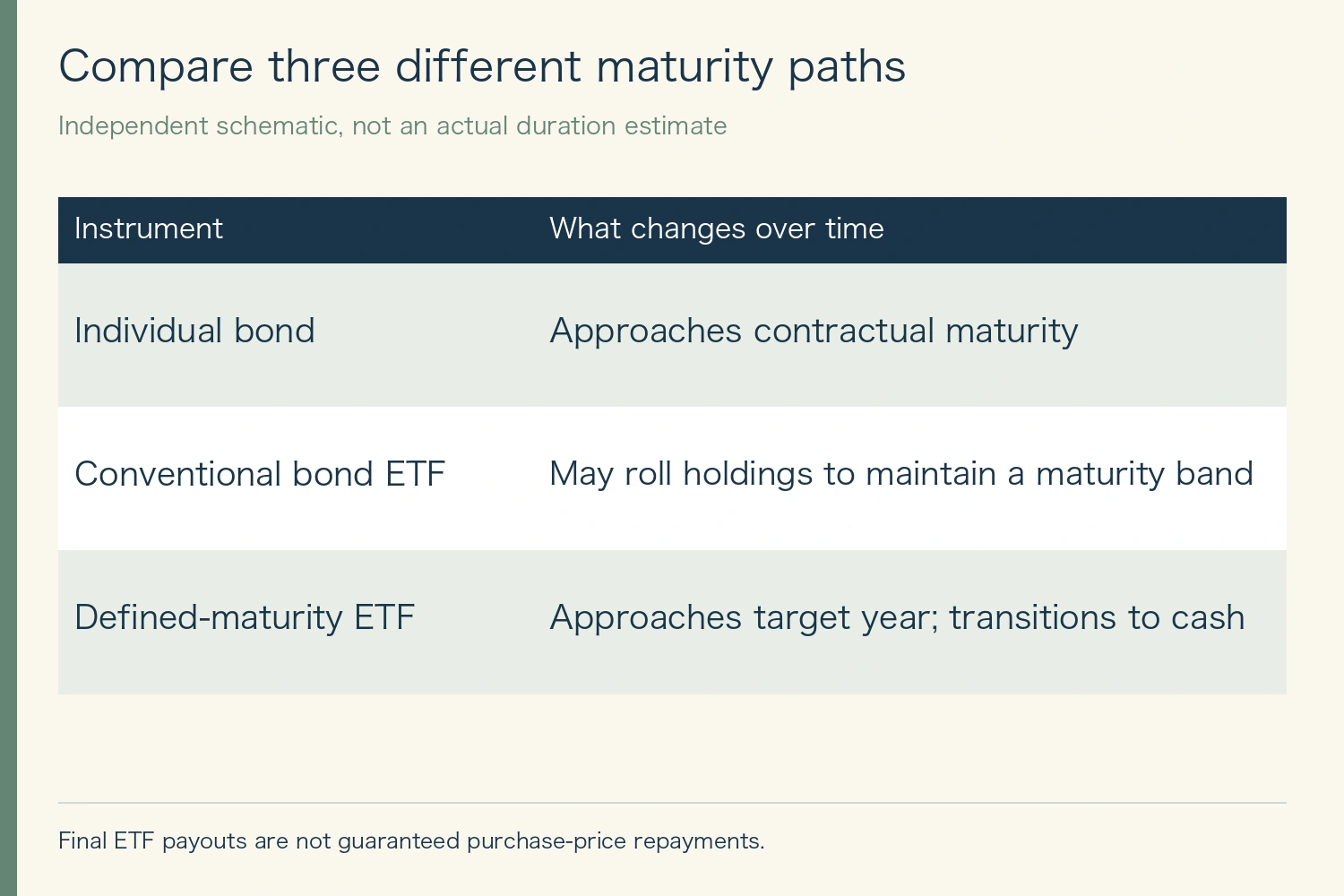
An individual bond’s contractual payments depend on its issuer meeting its obligations. An ETF’s final payment depends on the remaining fund assets and liabilities. Even an individual bond bought above par does not necessarily repay the purchase price at maturity. Define whether “principal” means face value, market purchase price or total outlay after transaction costs before making comparisons.
The final year includes a transition toward cash
As underlying bonds mature, their proceeds can become cash or short-term investments. The fund does not necessarily retain the original bond portfolio’s yield characteristics throughout every month of its final year. Reinvestment conditions during that transition matter.
The official IBTG page, for the 2026 term Treasury ETF, is one dated example of the structure. Do not infer a final trading date, payment date or account procedure from the year in a name. Verify the particular fund’s current notices and documentation.
← Swipe to view the full table →
| Instrument | Date or maturity concept | Payment caution |
|---|---|---|
| Conventional bond ETF | May maintain a maturity band | No personal date for purchase-price repayment |
| Individual bond | Contractual maturity | Issuer performance matters; par differs from price |
| Defined-maturity ETF | Target year and cash transition | Final payout is not a purchase-price guarantee |
| US I Bonds | Savings-bond terms | Different from iShares iBonds ETFs |
Product existence is not confirmation that a reader can buy it through a specific broker. Account access, jurisdiction, taxes and currency conditions vary. This explanation does not confirm Japanese brokerage availability or treat any resident’s tax treatment as universal. The purpose of the example is to understand the mechanism before comparing actual choices.
Advertisement
A final payout below purchase price can still accompany a gain
Use an independent toy example: purchase price USD100, transaction cost USD1 and total outlay USD101. Assume interim distributions of USD5 and a final payout of USD98. Ignore taxes and reinvestment.
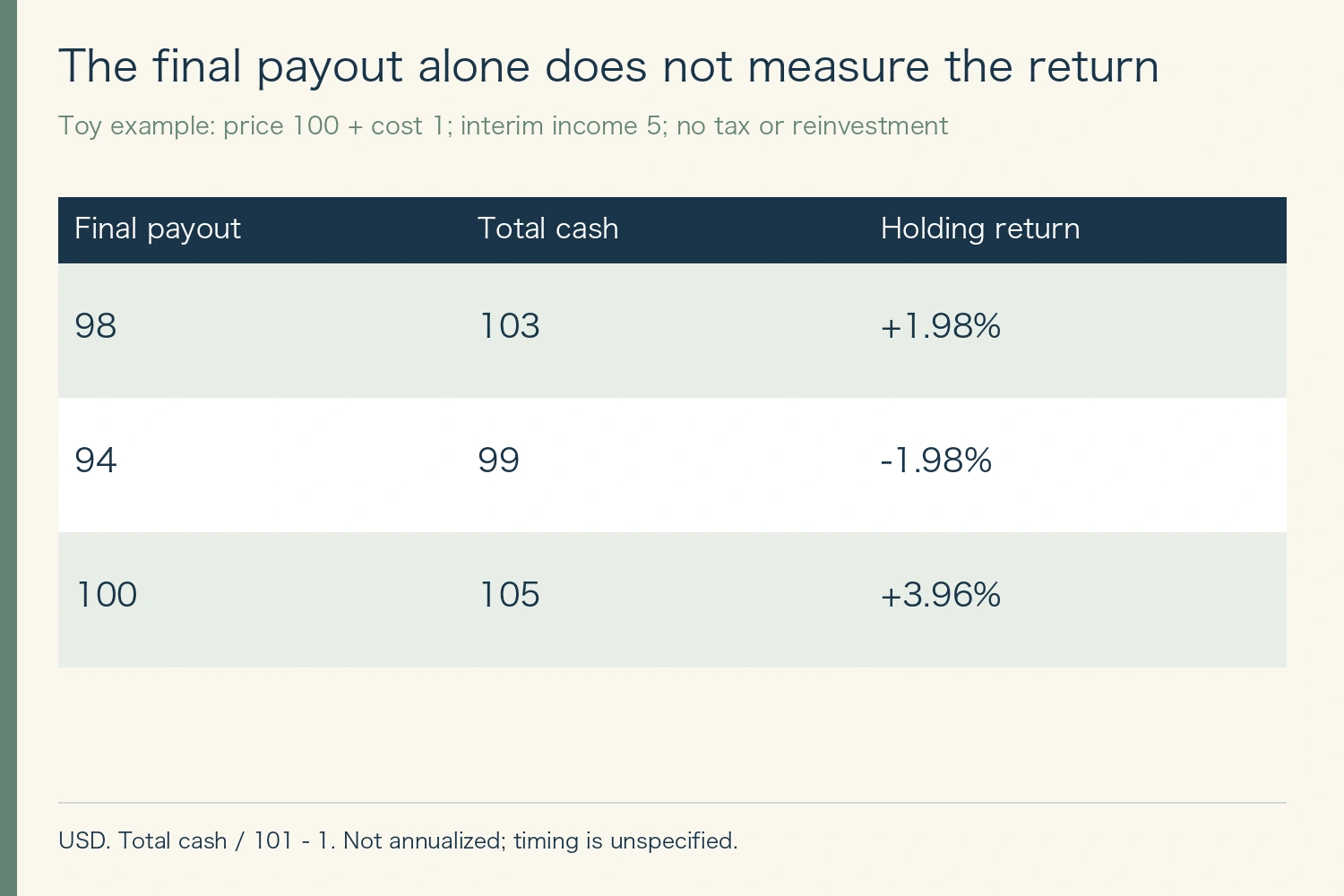
Total receipts are 5 + 98 = USD103. The simple holding-period return is 103 / 101 − 1, approximately 1.98%. Looking only at the USD98 final payout misses the interim income. If the final payout is USD94 instead, receipts are USD99 and the return is about −1.98%. At a final payout of USD100, total receipts of USD105 imply about 3.96%.
None of these are actual fund results or forecasts. They are not annualized either: the holding period and payment dates have not been specified. An annualized or internal-rate-of-return calculation needs dated cash flows. The lesson is narrower: the final distribution, distribution yield and total investment result are not interchangeable quantities.
What risks remain even when a maturity year is defined?
Check default and downgrade exposure, fund expenses, trading costs, market-price differences from NAV and conditions for selling before termination. Interest-rate sensitivity can change as maturity approaches, but a target year does not remove price variation throughout the holding period.
Cash transition introduces reinvestment conditions. Amounts received as bonds mature may not keep earning the yield observed when the original portfolio was purchased. Issuer yield estimates have definitions and exclusions; read those rather than treating one displayed percentage as a guaranteed receipt.
Currency can dominate a small positive dollar result for a non-dollar investor. In a deliberately simplified example, a 2% dollar gain combined with a 10% decline of the dollar against the spending currency gives 1.02 × 0.90 − 1 = −8.2%, assuming everything is converted only at the end. If interim distributions are converted on different dates, calculate their actual cash flows separately. Do not apply one terminal exchange rate to a different real payment pattern.
A ladder aligns dates; it does not guarantee amounts
Combining different maturity years can help organize a schedule of future receipts. That schedule still has to match the timing, currency and amount of actual spending. A list of years is not a guarantee that every future liability is funded.
For example, a spring expense cannot be met by a final payment expected late in the same calendar year unless other liquidity is available. Rolling a completed rung into a later fund also depends on the rates and transaction conditions then available. A ladder is not a promise of an unchanged return from year to year.
Compare conventional bond funds, individual bonds, cash and defined-maturity ETFs against the same spending need. The relevant distinctions include credit exposure, cash-flow timing, liquidity and implementation costs. Our invented payment example is an explanation, not a model allocation or a recommendation to purchase a particular fund.
Advertisement
Common questions about maturity and principal
Will USD100 invested come back as USD100 at termination?
Not necessarily. Purchase price and final distribution are different quantities. Include costs and interim distributions when evaluating the overall result.
Can a displayed yield be locked until the ETF matures?
Do not treat it as a guarantee. Read the methodology and exclusions, including expenses, credit losses, changing cash balances and the price actually paid.
Is a defined-maturity ETF always safer than a conventional bond ETF?
No universal ranking follows from the label. Purpose, holding period, currency and credit exposure can differ. Start with the cash needed at a particular time, then compare the actual instruments and their conditions.
Related guides, sources and update policy
Our Treasury ETF guide covers maturity bands and duration. The SGOV distribution guide separates an ex-dividend price move from total return.
Sources checked November 6, 2026: the iShares investor guide and official IBTG material. Payment and currency scenarios are original hypothetical calculations, not actual results or forecasts. Holding-period returns are not labeled annual yields. The cover and three figures are original. Review live examples and final-distribution notices as target years approach.
This is general educational information. Evaluate an investment against your own objectives and the applicable product conditions.









Comments