
A currency-hedged fund can have a low expense ratio and still perform differently from an unhedged version. There may be no separate invoice labeled “hedging cost.” The effect usually appears inside the fund’s valuation and returns.
Where the effect appears in a fund
A currency hedge seeks to reduce exchange-rate exposure relative to a chosen base currency. Define that currency first. A Japanese investor saving for yen spending and a dollar-based investor holding overseas assets do not face the same conversion exposure.
Asset Management One’s educational FAQ explains the indirect burden through fund assets rather than a direct charge to the unitholder. In practice, forward valuations and settlements affect NAV. Management fees compensate fund management; forward pricing and investment gains or losses are not simply the same fee under a second name.
It is also too crude to imagine a universal, fixed daily cash deduction. Hedge ratios, reset periods, contract values and implementation vary. If a published NAV return already incorporates hedging, subtracting the same estimated effect from that return again double-counts it. Distinguish the components before comparing two funds.
How interest differentials enter a forward rate
Building on the mechanism described by PIMCO, use our own one-year example: spot exchange rate S = JPY150 per USD, yen interest rate 1% and dollar rate 4%. Assume comparable credit, simple annual rates and no basis, spreads or taxes. These are invented inputs, not current market quotes.
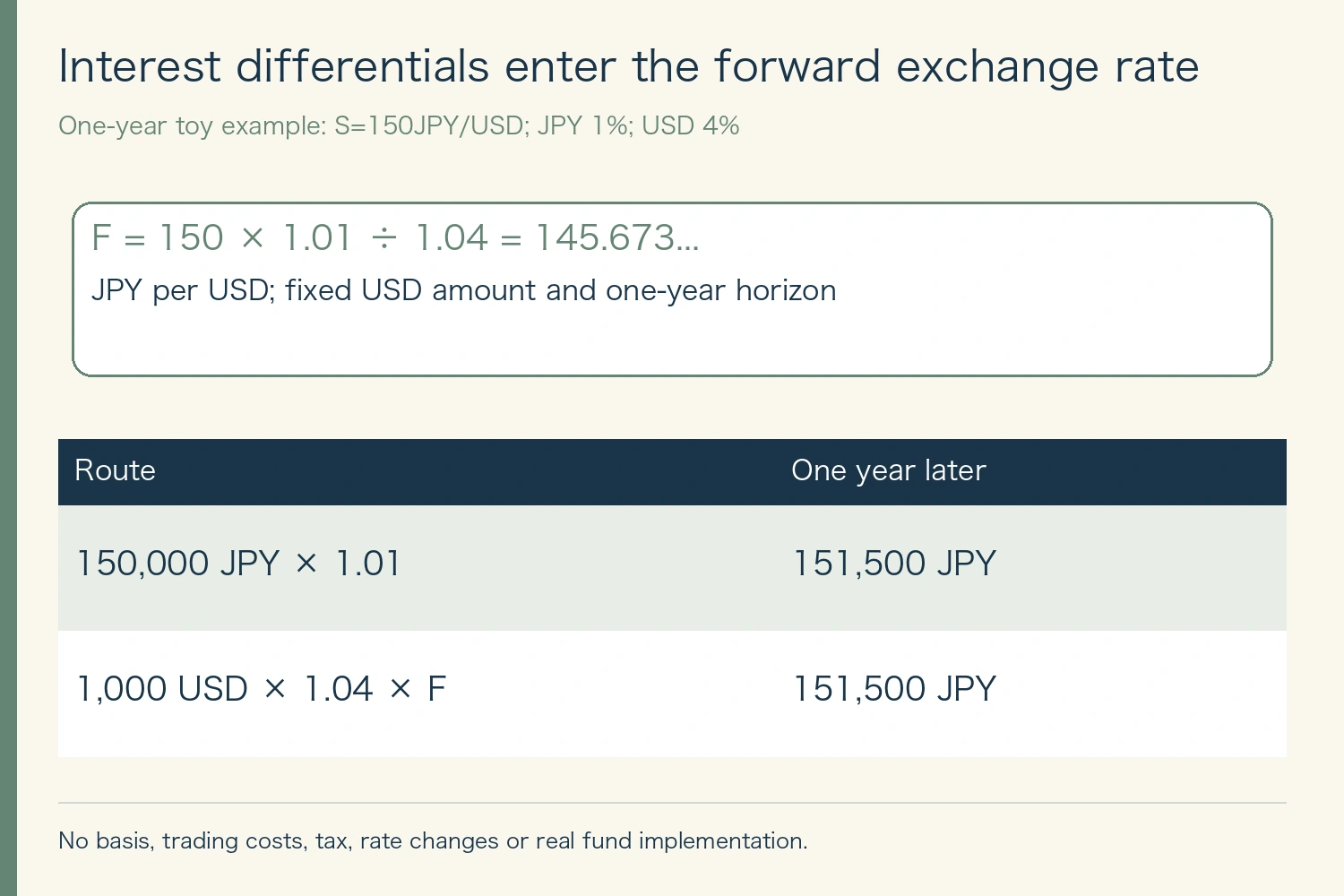
The theoretical forward rate is F = 150 × 1.01 / 1.04 = approximately JPY145.673 per USD. Investing JPY150,000 at 1% produces JPY151,500. Converting it to USD1,000, earning 4%, then converting the entire USD1,040 at F produces the same yen amount.
The ratio F/S − 1 is about −2.885%, not exactly 1% − 4% = −3%. This is a no-arbitrage teaching model. It does not let an investor collect the higher dollar interest rate while freely locking conversion back at today’s spot rate. Clearly state the quote direction: the formula uses yen per dollar, not dollars per yen.
Advertisement
Hedged and unhedged outcomes under three exchange rates
Keep the same fixed USD1,040 maturity amount. Without a hedge, convert it at the eventual spot rate. Rates of JPY135, 150 and 165 per dollar produce JPY140,400, 156,000 and 171,600. The fully pre-agreed forward conversion produces JPY151,500 in this idealized example.
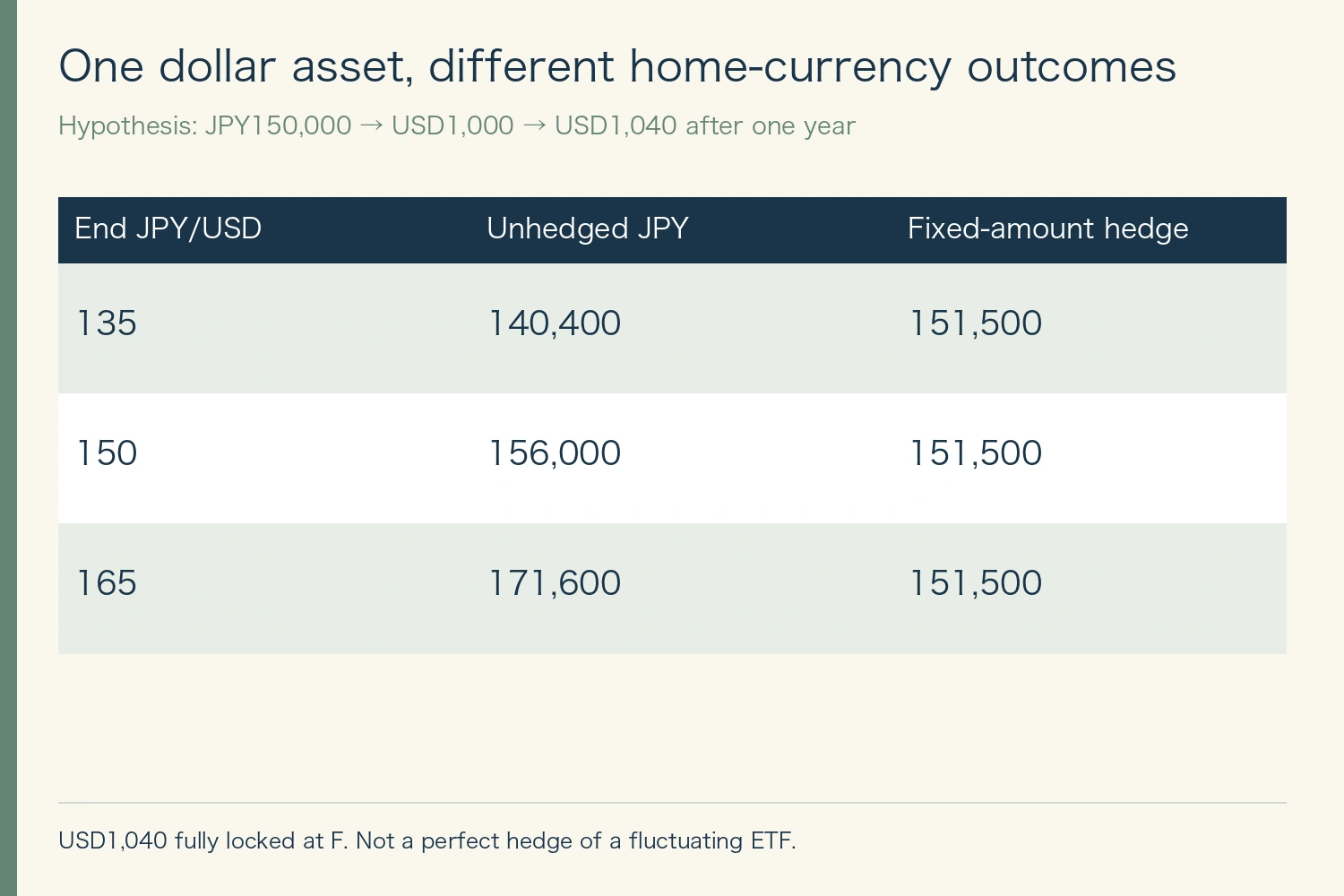
The table does not predict which spot rate occurs. It shows the exchange-rate upside and downside forgone by locking a conversion. Selecting the winning strategy after observing the exchange rate is not evidence that the rate could have been forecast beforehand.
Crucially, the entire foreign-currency receipt is known here. An equity ETF’s future market value is not. Funds may reset hedge amounts periodically, so asset-price changes and timing can leave residual currency exposure. Do not turn a fixed-amount deposit example into a promise that every currency-hedged ETF has a fixed home-currency value.
Why hedge carry is not always a cost
Reverse the interest relationship and the same-direction theoretical forward carry can become positive. Pictet’s currency-hedging discussion emphasizes that the decision and return depend on the investor’s currency and rate environment. Hedging does not inherently impose one permanent negative percentage.
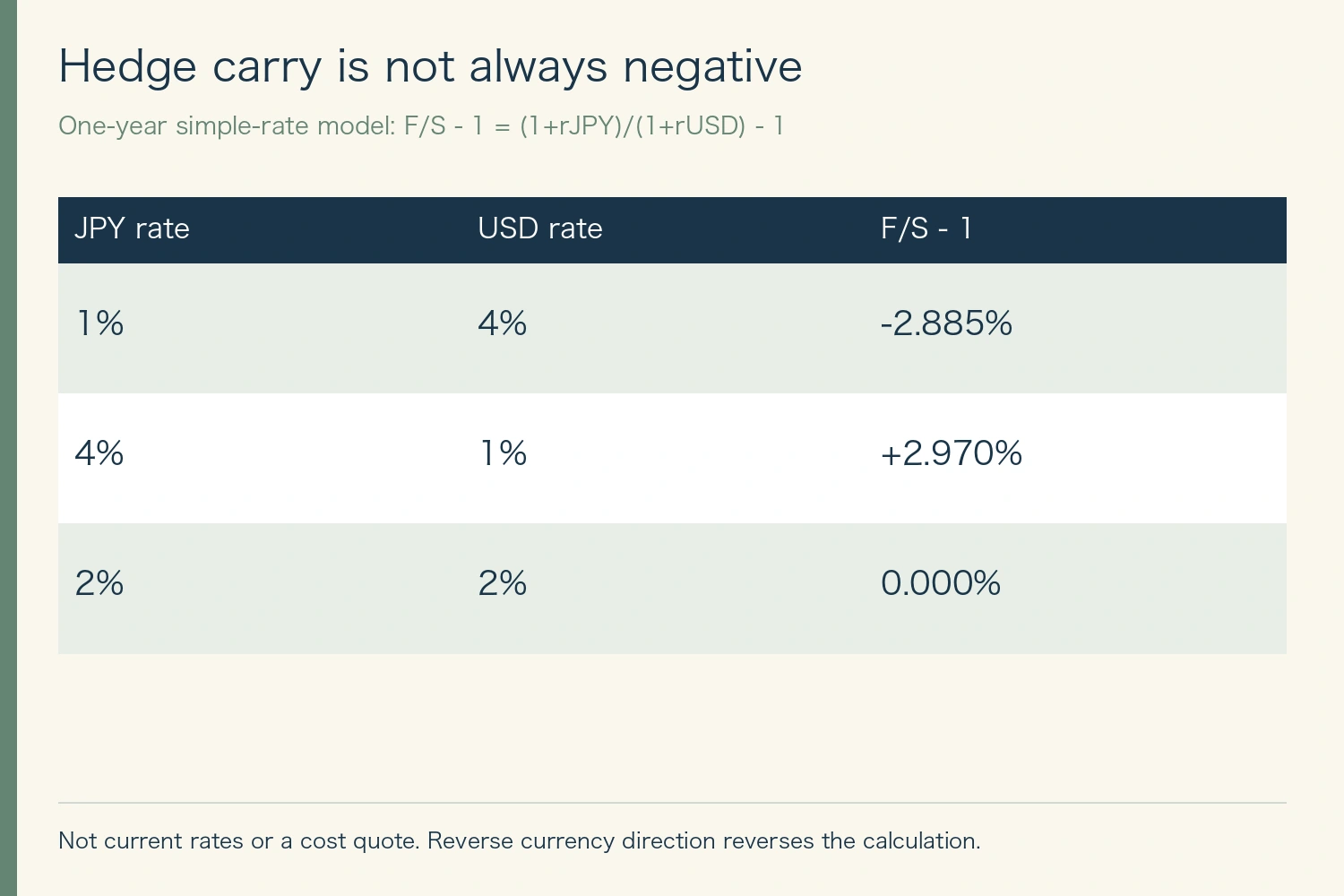
Actual prices can reflect cross-currency basis, supply and demand, spreads and contract terms. Hedge frequency and the amount covered matter too. Two central-bank policy rates are therefore not enough to reconstruct a fund’s realized hedging result.
Read the direction of an English-language comparison carefully. Hedging a foreign asset into dollars is not the same transaction as selling dollars forward into yen. Reversing the currency quote or the investor’s base currency requires changing the calculation, not retaining the same sign and relabeling the axes.
A practical reading checklist for fund documents
Start with the prospectus: what exposure is hedged, by what policy, and to what extent? Then examine the reporting period, NAV return, distribution treatment and any hedge-related commentary in reports. Not every provider discloses one separately measurable cost line using a common definition.
← Swipe to view the full table →
| Check | Align these conditions |
|---|---|
| Currencies | Investor base currency and asset currency |
| Assets | Underlying exposure, index and portfolio |
| Dates | Start, end and forward-contract horizon |
| Return | Distributions, reinvestment and fee treatment |
| Disclosure | Approximate carry vs reported contribution |
When comparing share classes or funds, align the underlying investments, dates, reinvestment convention, currency and fee treatment. A tracking difference from an index is not automatically pure hedging cost. Sampling, asset selection, implementation and timing can also contribute.
Keep an interest-differential approximation separate from the actual reported result. That preserves a useful rough estimate without giving it false precision. Finally, currency hedging does not remove the asset’s own downside. It can reduce one source of variation while leaving market, credit and implementation risks intact.
Advertisement
Common questions about currency-hedged funds
Is all hedge carry included in the expense ratio?
No. A management-expense disclosure and investment gains or losses from forward contracts are different concepts. Check the fund’s documentation and avoid deducting an already incorporated effect twice.
Can the current policy-rate gap lock next year’s cost?
No. Forward maturity, pricing date, market basis, transaction conditions and changing hedge amounts all matter. Our example intentionally fixes inputs to explain a mechanism.
Should every worried investor choose a hedged class?
The relevant spending currency, horizon, asset and tolerance for variation differ. The article provides a comparison method, not a universal allocation or trading instruction.
Related guides, sources and update policy
For another source of variation, see our Treasury ETF duration guide. Hedging the currency does not remove the underlying bond portfolio’s sensitivity to interest rates.
Sources checked November 6, 2026: public PIMCO, Asset Management One, Pictet and Daiwa educational material. Examples assume a one-year fixed currency amount with simple interest and omit real implementation costs. They are not quoted hedge costs or fund returns. The cover and three figures are original; update document-reading guidance when disclosures change.
- アセットマネジメントOne 資産形成FAQ
- 大和アセットマネジメント 為替ヘッジの解説
- Pictet Demystifying currency hedging, December 2022
- PIMCO ヘッジコストとフォワードレートの決まり方
This is general educational information. Evaluate an investment against your own objectives and the applicable product conditions.






Comments