

A startup announces a billion-dollar valuation. Headlines call it a unicorn, and the next question arrives quickly: could this be the next great public-market investment?
Sometimes a private company becomes a major listed business. But a financing valuation, an IPO price and an investor's eventual cash proceeds are three different measurements. Putting them in one league table can make very different assets look directly comparable.
This guide explains what the numbers mean, how dilution works and why an exciting private company is not automatically a future Nasdaq-100 holding.
What is a unicorn company?
In common venture-capital usage, a unicorn is a privately held startup valued at $1 billion or more. It is a useful label for scale, not a guarantee of profitability, liquidity or investment quality. There is no need to add a universal “under ten years old” requirement to make sense of the valuation.
Nor should a private financing figure be called a continuously observable stock-market capitalization. There may be no public market, no daily bid for your shares and different rights attached to different classes of stock.
The SEC's private-placement bulletin highlights limited disclosure, restricted resale and the possibility of losing the whole investment. A prestigious company name does not remove those features of a particular offering.
A dated example: Stripe's employee tender offers
Stripe announced an employee liquidity transaction at a $91.5 billion valuation on February 27, 2025. On February 24, 2026, it announced agreements for another employee tender offer at a $159 billion valuation.
The second number is about 73.8% higher, by simple calculation. That does not mean every investor could buy at the first price, sell at the second or receive identical share rights. A tender transaction supplies information about a defined deal, not an unrestricted market quote.
| Announcement | Stated valuation | What the figure describes |
|---|---|---|
| February 27, 2025 | $91.5 billion | Employee liquidity tender offer |
| February 24, 2026 | $159 billion | New agreements for employee liquidity |
These are dated examples, not a current ranking of the world's largest private companies. A useful comparison needs the transaction date and type alongside the valuation.
Pre-money and post-money valuation: follow the new shares
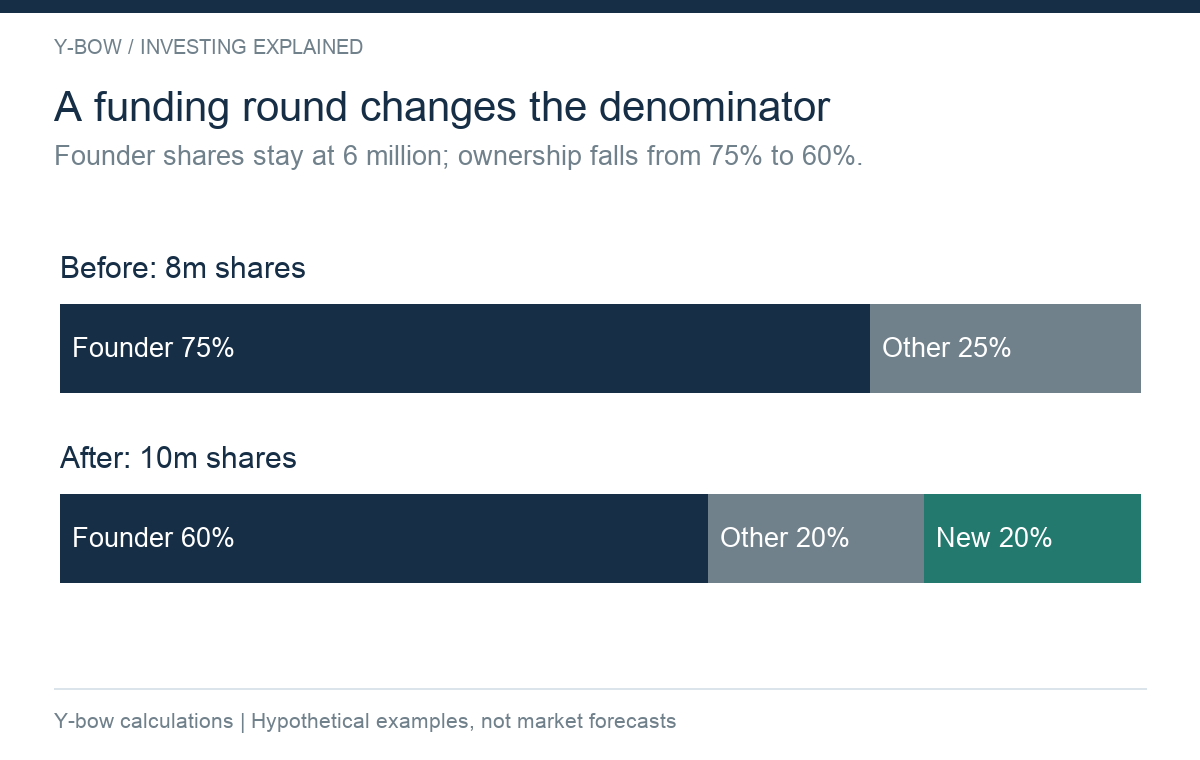
Suppose a startup has 8 million shares and is valued at $8 million before a financing. An investor puts $2 million into the company at $1 per new share. The company issues 2 million shares, leaving 10 million outstanding and a $10 million post-money valuation.
A founder with 6 million shares owned 75% before the round and owns 60% afterwards. Their share count did not fall. Their percentage fell because the denominator increased.
| Holder | Before financing | After financing |
|---|---|---|
| Founder | 6 million shares; 75% | 6 million shares; 60% |
| Other existing holders | 2 million; 25% | 2 million; 20% |
| New investor | None | 2 million; 20% |
| Total | 8 million; 100% | 10 million; 100% |
At the financing price, the founder's stake is notionally $6 million both before and immediately after the round. The company received the $2 million; the founder did not. This deliberately simple example excludes option pools, convertibles and differences between share classes.
Why the headline valuation may overstate ordinary shareholders' proceeds
A financing can give new investors preferences that founders and employees do not have. To see why terms matter, imagine a company selling for $6 million after an investor put in $2 million for 20%, with a simple 1x non-participating liquidation preference.
Under those assumed terms, the investor compares taking $2 million under the preference with converting to common and taking 20% of $6 million, or $1.2 million. The preference is worth more. The remaining $4 million goes to the other holders under the assumed structure, not $4.8 million.
Real documents can be more complicated. Multiple preference layers, participation, debt, option exercise prices and transaction costs alter the waterfall. The point of the example is to read the rights, not to claim every startup uses this arrangement.
An IPO creates a market; it does not guarantee a profitable exit
An IPO may include newly issued shares, existing holders' sales or both. Only the primary issuance raises money for the company. Selling shareholders receive proceeds from their own secondary shares, subject to the transaction terms and costs.
The opening exchange price may differ from the offer price. Lock-ups, limited allocation and eligibility restrictions may prevent an individual investor from trading the same way as the headline example. The SEC's IPO guide explains why registration should not be mistaken for an assessment of investment merit.
For an employee, subtract the exercise cost and consider taxes before treating a quoted stake as spendable money. A company can have a high valuation while an employee has neither a buyer nor the cash required to exercise options.
Is a unicorn automatically a Nasdaq-100 candidate?
No. Private status must change first, and the listing venue and index eligibility rules then matter. The Nasdaq-100 is not a collection of every large technology company around the world. It concerns eligible large non-financial companies listed on Nasdaq.
Nasdaq changed its methodology effective May 1, 2026, following a formal consultation. That is another reason to check the current rules rather than repeat an old assumption about when a successful IPO will enter the index.
For a watchlist, keep separate columns for private valuation date, proposed or completed listing, exchange, share structure and index eligibility. Write “not confirmed” when a step has not happened. A large private valuation cannot substitute for the missing steps.
What to check before paying for pre-IPO access
First establish what you are buying: direct shares, an interest in a vehicle, a contract or an intermediary's economic exposure. Then ask which class, what fees, which transfer restrictions and what information you will receive. A reference to a famous company is not evidence that the seller owns transferable shares.
Read how the investment can be sold and who determines any reported value. If the expected exit is “the IPO,” ask what happens if there is no IPO during your planned holding period. If no realistic answer exists, do not treat a projected listing date as a repayment date.
For the ownership arithmetic behind these questions, see founder equity, dilution and paper wealth. There is a lot to learn from private companies without assuming every reader needs to invest in one.
Sources checked October 15, 2026. The cap table and preference examples are original hypothetical Y-bow illustrations, not Stripe's capitalization or legal terms. No future IPO, index inclusion or return is assumed.










Comments