
A technology company announces a power agreement measured in gigawatts. That sounds like electricity secured. Yet the facility may still be waiting for a connection, and the agreement may settle prices rather than deliver power from that generator to that site.
What kind of PPA is being announced?
PPA stands for power purchase agreement. Long-term arrangements can specify prices, volumes and periods, but the label alone does not establish one universal delivery structure. Nor does a headline expressed in GW disclose how much electricity reaches a particular load at a particular time.
The US EPA’s procurement overview distinguishes physical and financial arrangements. A physical PPA can involve market and delivery intermediaries; it does not necessarily mean a dedicated wire directly connecting the plant to the buyer.
← Swipe to view the full table →
| Structure | Main question | What still needs checking |
|---|---|---|
| Physical PPA | Electricity purchase and delivery terms | Grid, retail, connection and supply terms |
| Virtual PPA | Settlement against a reference price | Facility electricity is purchased separately |
| Environmental attributes | Ownership, transfer and retirement | Contract and jurisdiction-specific rules |
Separate three items: electricity, financial settlement and environmental attributes. Identify the contracting parties and the obligations for each. This article primarily uses US sources. REC terminology and market rules should not be treated as identical to certificate, retail and grid arrangements in every other jurisdiction.
Virtual PPAs separate the financial and physical routes
The EPA’s Financial PPA explanation describes a generator selling output into the market while the contracting parties settle a price difference. The buyer purchases electricity separately for its facility rather than receiving direct delivery under that financial contract.
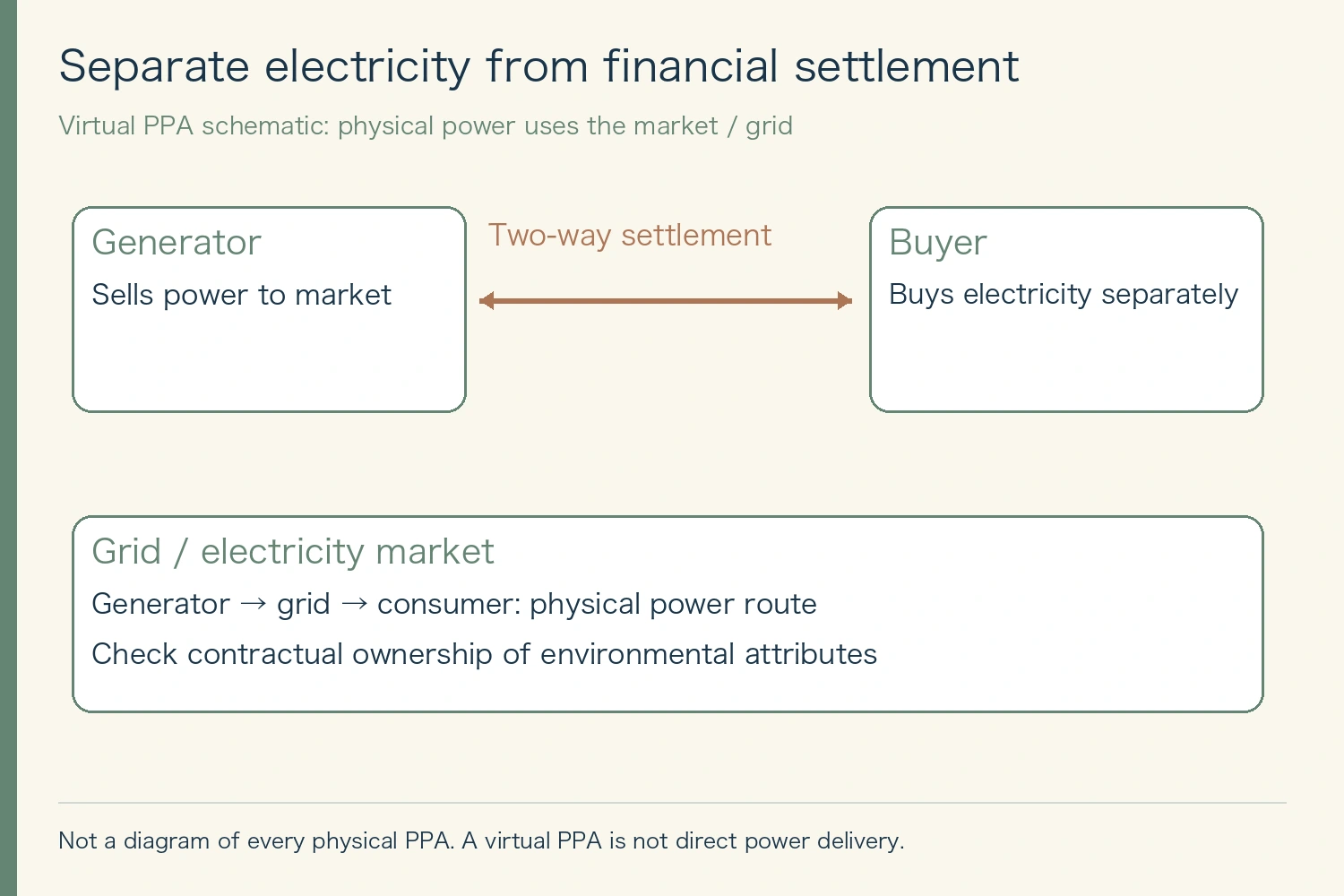
Environmental attributes require their own ownership check. A contract’s handling of renewable energy certificates determines who can use or retire those attributes. Do not assume that any financial relationship with a renewable generator automatically transfers every environmental claim.
This distinction does not make the arrangement pointless. Long-term revenue arrangements may support project financing. It does mean that a price or attributes contract does not automatically provide a buyer’s transformer, connection capacity, delivery rights or operating reliability. Keep those questions visible rather than letting the contract’s size answer all of them.
Advertisement
Matching energy totals is not matching every hour
MW measures power; MWh measures energy over time. In an independent toy example, a constant 100MW facility uses 2,400MWh over 24 hours. A generator producing 200MW during only 12 daytime hours also produces 2,400MWh.
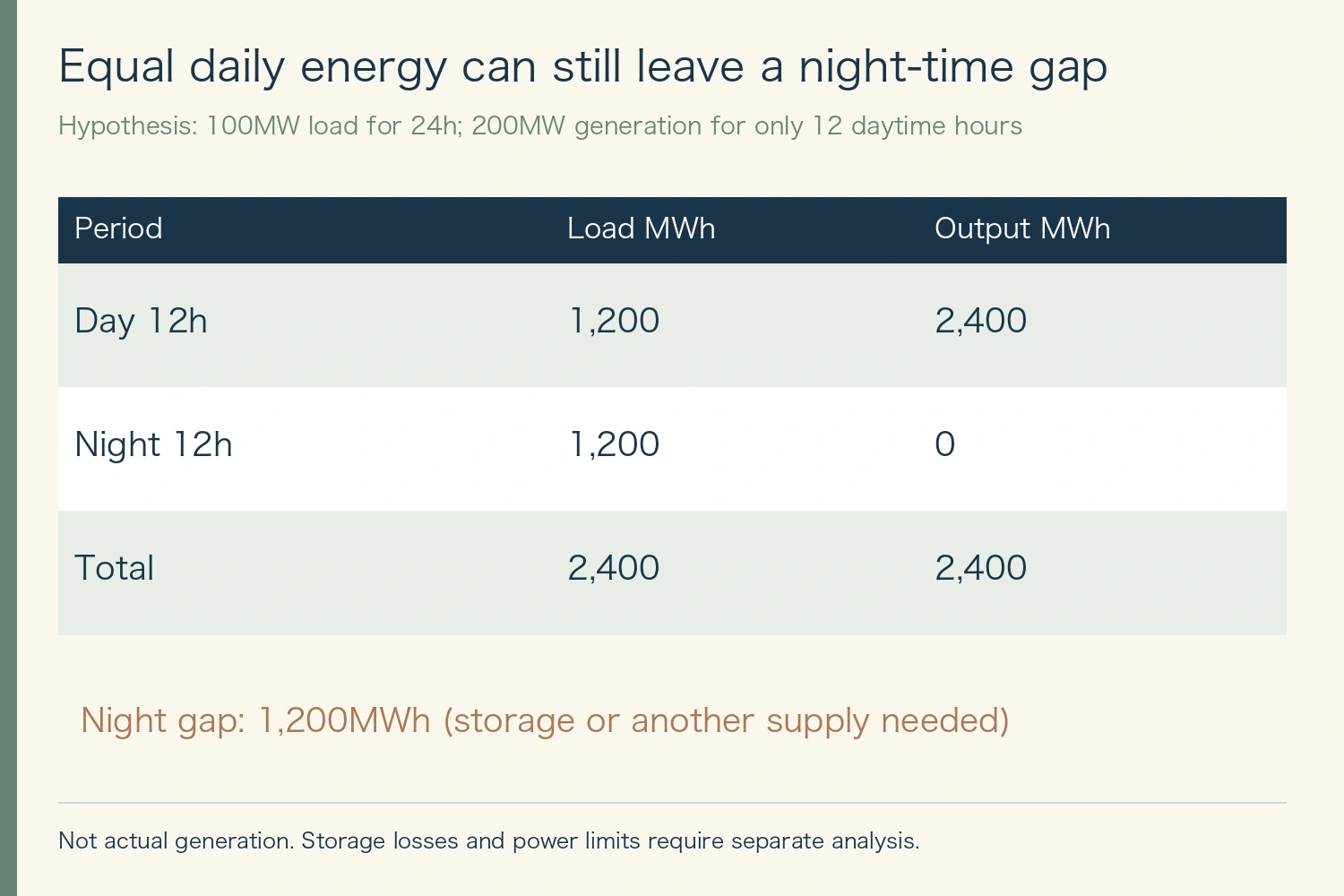
The totals match, but the night has a 1,200MWh gap. Moving surplus daytime output into that period requires storage or another source, with power limits, energy capacity and losses assessed separately. Matching an annual quantity of renewable generation is not the same condition as having adequate supply in the right place during every hour.
This deliberately simplified pattern is not measured solar output or a real data center load. It illustrates a denominator problem. Also check whether a facility’s quoted MW refers to IT equipment or the entire site. Applying an efficiency adjustment twice—or not at all—can distort even a straightforward energy calculation.
A positive settlement is not the entire electricity bill
Assume a strike price of USD60/MWh and a settlement volume of 1,000MWh. When the contract’s market price is USD40/MWh, the buyer pays USD20,000. At USD80/MWh, the buyer receives USD20,000. These are our hypothetical inputs, not terms taken from a disclosed company contract.
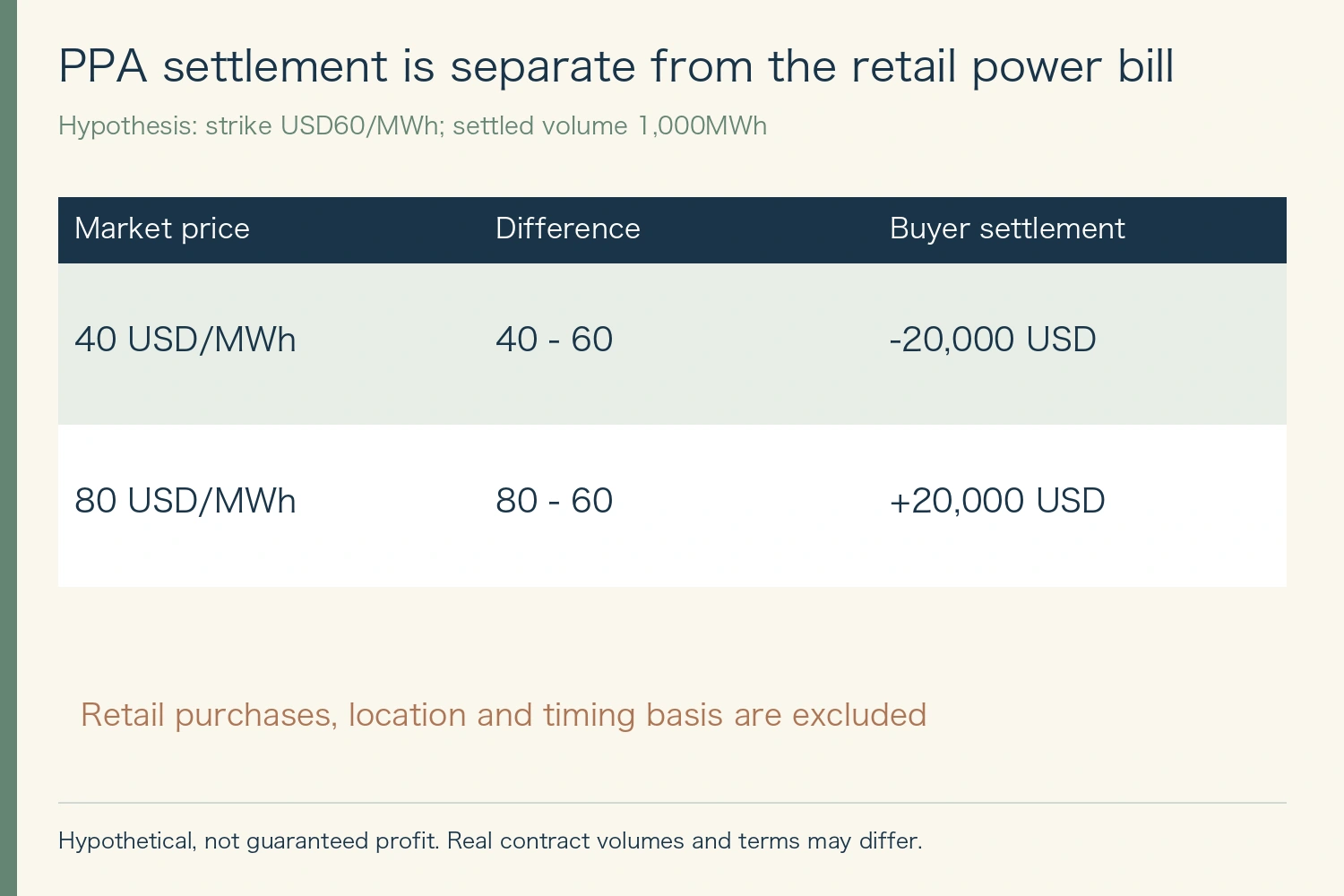
The table isolates settlement. It excludes the retail electricity purchased for the facility. A different location, time profile, retail tariff or volume can prevent the two cash flows from offsetting perfectly. A higher reference price can produce a receipt under the PPA while other costs or exposures still change.
Real contracts can define reference prices, volumes and conditions differently. State whose cash flow the sign represents: a buyer’s payment is not the same sign as a generator’s receipt. This small discipline avoids turning a hedging mechanism into a claim of guaranteed profit or a universally fixed electricity bill.
What must happen before the facility can operate?
The IEA’s 2026 energy-and-AI analysis discusses electricity and grid-connection constraints. For a project reader, the practical question is not merely whether an agreement exists, but when the site can receive power and under which conditions.
← Swipe to view the full table →
| Item | What to verify |
|---|---|
| Start date | Contract commencement vs site energization |
| Location | Generator, buyer and reference market |
| Connection | Capacity, substation and conditional supply |
| Time | Annual energy vs hourly delivery |
| Costs | Retail bill, basis exposure and extra equipment |
An operating generator does not prove that a buyer’s connection, substation or permits are complete. A conditional or flexible connection may not offer unrestricted capacity at every time. Onsite generation and backup plans also need equipment, fuel, maintenance and the relevant approvals.
For investors, contracted GW cannot be translated directly into a supplier’s revenue, margin or cash generation. Start dates, cost allocation, pricing, counterparty ability to pay and the buyer’s eventual utilization all matter. “AI will require electricity” is a useful starting observation, not a completed investment case for every energy company.
Advertisement
Common questions about data center power contracts
Does a PPA prevent an outage?
The label alone provides no such guarantee. Physical equipment, grid conditions, contractual limits and backup arrangements need separate evaluation.
Is 100% renewable procurement the same as 24/7 renewable supply?
Not necessarily. Matching a reporting-period energy total differs from matching each hour’s load. Attribute accounting also depends on the contract and applicable rules.
Is a larger agreement always better?
No. Location, timing, price, obligations and fit with actual demand can matter more than the headline volume. The examples here explain mechanisms; they do not rank companies or recommend power stocks.
Related guides, sources and update policy
Our data center electricity guide covers demand, units and efficiency. This article focuses on contractual structures and physical delivery rather than repeating a general demand forecast.
Sources checked November 6, 2026: public EPA and IEA material. Energy profiles and settlements are original hypothetical calculations, not actual output, forecasts or reproductions of a company contract. The cover and three figures are independently produced. Recheck dated examples and jurisdiction-specific rules when they change.
- DOE Power Purchase Agreements Overview
- US EPA Financial PPA
- US EPA Green Power Supply Options
- IEA Key Questions on Energy and AI (2026), executive summary
This is general educational information. Evaluate an investment against your own objectives and the applicable product conditions.








Comments