
FNGU can look like a straightforward way to increase exposure to the FANG+ theme. But “three times the index” does not describe the entire security. Before comparing charts, establish whether you own a fund interest or an unsecured claim against an issuer—and which specific security the ticker identifies.
Checked October 25, 2026. This article concerns the current US-listed MicroSectors FANG+ 3x Leveraged ETNs, CUSIP 063679385. It does not predict issuer distress or an upcoming call.
FNGU’s ETN structure: a claim on Bank of Montreal
The SEC’s ETN bulletin describes ETNs as unsecured debt obligations of financial institutions. The current BMO supplement likewise identifies these notes as unsecured obligations.
With an ETF, the investor owns an interest in a fund that holds assets, potentially including derivatives. With an ETN, the investor holds a security promising a contractually determined payment linked to a reference index. Owning the note does not make you a shareholder of the index companies.
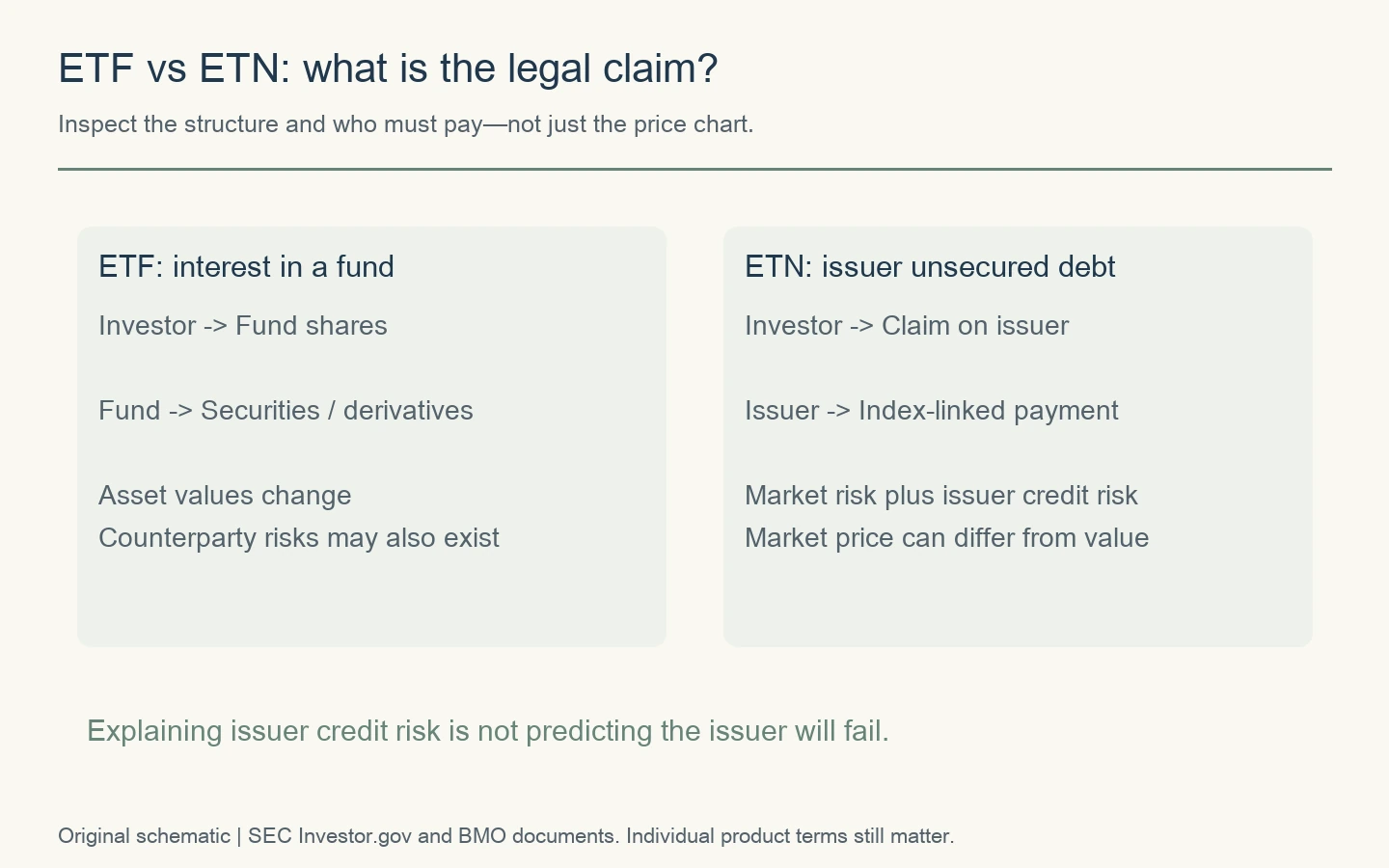
Issuer credit is therefore an additional consideration: an index gain is not enough if the issuer cannot meet its payment obligations. Recognizing that contract risk is not alleging that BMO is in financial difficulty. ETFs using derivatives can also have counterparty exposure; the legal structures should be compared accurately rather than reduced to slogans.
Daily 3x is only one layer of the return
The current product page describes leveraged participation in the NYSE FANG+ Index, compounded daily. A multi-month index return is not simply multiplied by three. Investor fees, financing charges and daily leverage mechanics affect the note’s indicative value.
Keep three quantities distinct: the index level, the note’s indicative value and the market price you actually pay or receive. The supplement distinguishes the investor fee from financing charges. A prominent annual fee is not necessarily an all-in measure of holding costs.
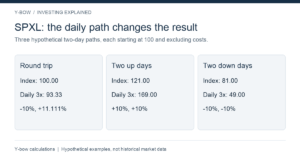
The daily-reset mathematics is related to the issue explained in our daily-leverage guide. That similarity does not make an ETF and an ETN the same legal product. Do not transfer an ETF’s operational assumptions to FNGU without reading the note terms.
The 2025 FNGU, FNGA and FNGB timeline
The old security’s February 19, 2025 addendum, filed with the SEC set a March 3 effective date for renaming the old FNGU to FNGA. The old security’s CUSIP was 063679534.
BMO’s May 1 notice announced exercise of the issuer call for FNGA. It scheduled a May 2–8 measurement period and expected May 15 settlement, subject to the contractual disruption provisions. We treat that as an announcement and schedule, not independent proof of the final settlement payment.
A separate, newly issued security used CUSIP 063679385 and initially traded as FNGB. Its June 2 addendum set June 24 for changing that ticker to FNGU. The current BMO page identifies this newer CUSIP.
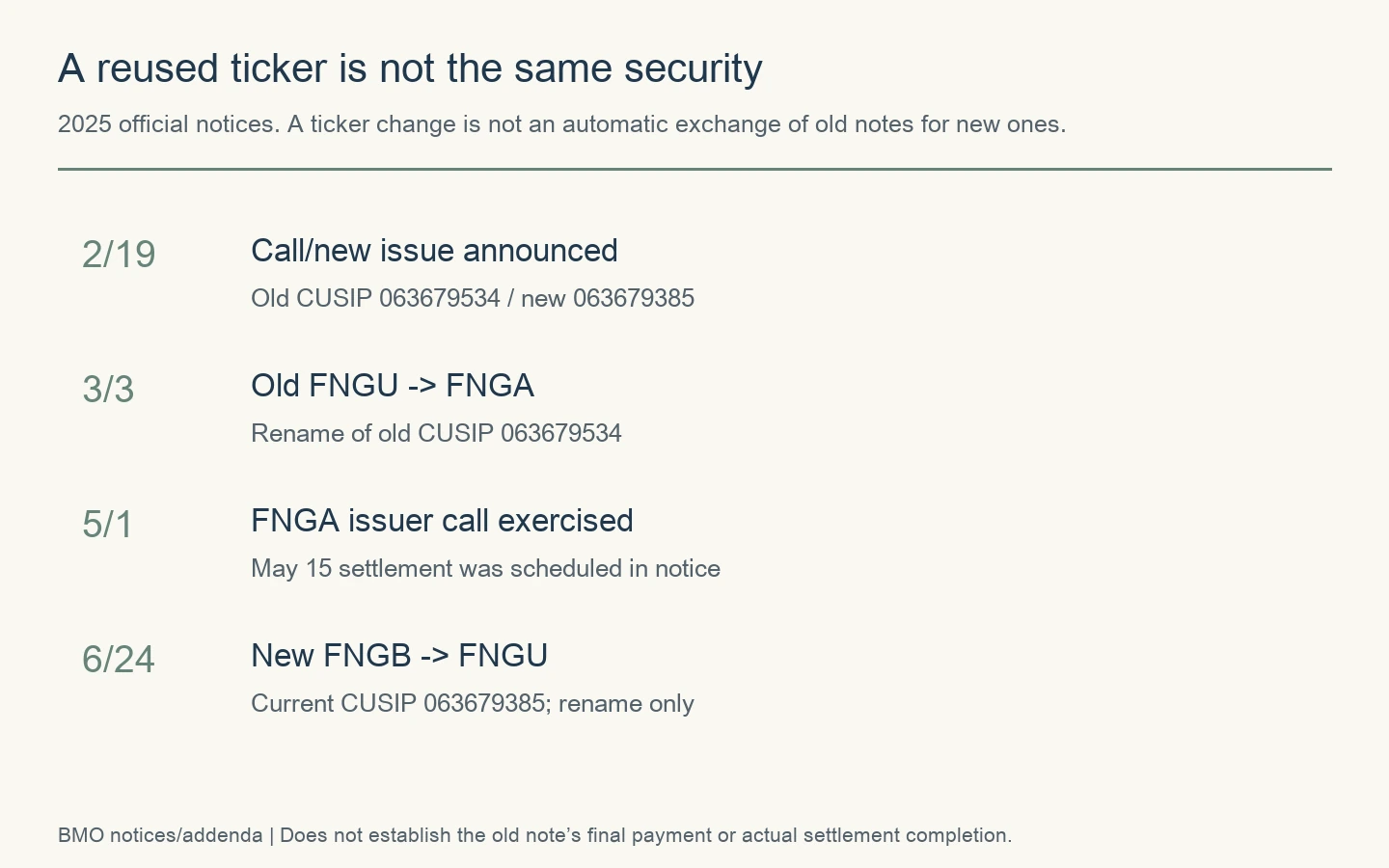
Renaming FNGB to FNGU did not automatically exchange an old FNGA holding for a new note. The CUSIP distinguishes the two securities despite the reused ticker. A chart vendor may handle that corporate-action history in a particular way; understand the treatment before using its line as your investment return.
Initial announcements can also be superseded by subsequent documents. Read the current supplement and addenda rather than freezing the first launch story as the final schedule. BMO’s original announcement discussed increased costs associated with supporting the old note’s leverage. That is a documented reason for that event, not a prediction that every ETN will be called for the same reason.
Advertisement
An indicative-value gain can coexist with an investor loss
Consider invented numbers. Indicative value is 100, but you buy at a market price of 110. Indicative value later rises to 105. If the premium disappears and you sell at 105, your return is (105 − 110) / 110 = −4.545%, before trading costs and tax.
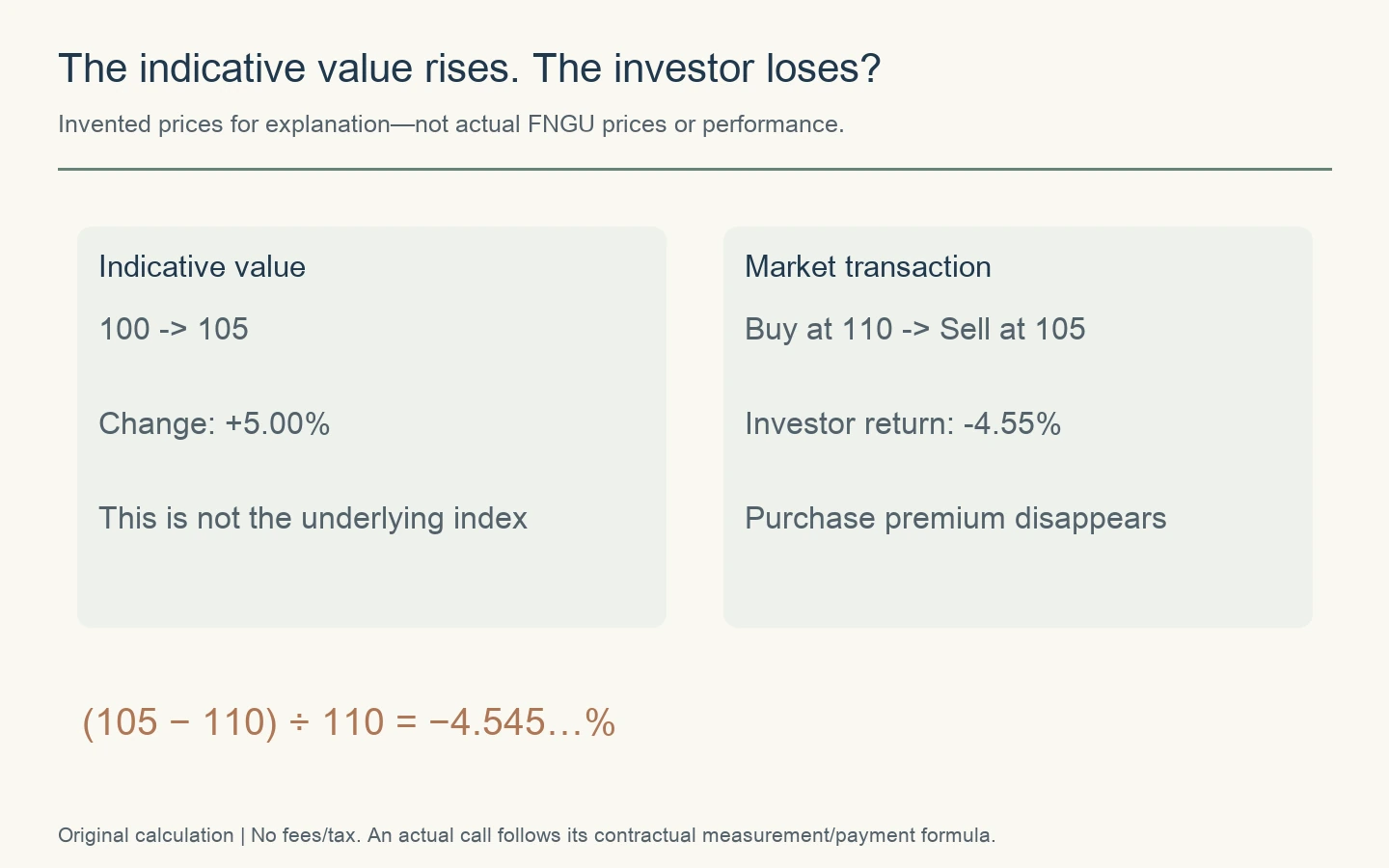
The indicative value gained 5%; the transaction lost money. BMO warns that a market-price premium can disappear and that secondary-market prices can diverge from indicative values. Being right about a theme does not protect an investor from overpaying for the note.
A discount is not automatically a bargain either. Thin liquidity, issuer concerns, market conditions or differently timed data may explain it. Compare the executable bid/ask with a contemporaneous indicative value. A stale last trade is not necessarily the price at which you can exit.
Maturity is not a promise that the note cannot be called
The current security has a scheduled February 17, 2045 maturity. Its terms also give BMO an issuer call right. Contractual notice, measurement and settlement provisions determine what happens if that right is exercised.
A call payment is not a refund of your purchase price. The applicable measurement-period formula matters; the amount may differ from your cost, the market price or the value observed when a notice appeared. Once the called note is settled, it does not continue participating in subsequent index gains.
This is why issuer call risk should not be collapsed into issuer default risk. A contractual early redemption can interrupt an intended holding period without an issuer failure. Conversely, an intended long holding period does not remove credit risk while the note is outstanding.
Selling on exchange is not requesting issuer redemption
A normal exchange sale relies on a buyer and a market price. A holder-initiated redemption asks the issuer to act under different contractual procedures, including size, notice, valuation and fee requirements.
The current supplement generally specifies a 25,000-note minimum for holder redemption, subject to stated exceptions and possible aggregation by an intermediary. That does not mean a smaller holder is prohibited from selling on exchange. Nor does it mean a small holder can freely demand immediate cash at indicative value.
| Item | What to establish |
|---|---|
| Security identity | Legal name, issuer, CUSIP and current ticker. |
| Entry and exit prices | Executable bid/ask and same-time indicative value. |
| Costs and leverage | Investor fee, financing charges and daily reset terms. |
| Issuer call | Notice, measurement period, payment formula and affected notes. |
| Holder redemption | Minimum size, deadlines, broker procedures and fees. |
| Tax and access | Rules for your residence and broker; do not assume ETF treatment. |
A familiar theme does not replace contract due diligence
The decision can be separated into manageable questions. Is the index exposure what you want? Can you tolerate daily leverage? Are the issuer and call terms acceptable? Is the market price reasonable relative to a timely indicative value? A favorable answer to the first does not answer the other three.
Our ETF liquidation guide explains a different process; it should not be treated as FNGU’s contract. For this note, return to the current issuer documents, even if an older article or saved ticker appears familiar.
Primary sources and update boundaries
The links above include the SEC-hosted old rename addendum, BMO’s launch and call notices, the current supplement/addendum, the current product page and the SEC’s ETN bulletin. The supplement’s updated FNGUIV identifier and current CUSIP take priority over stale FNGBIV wording remaining in one part of the product page.
The premium calculation is original hypothetical arithmetic. This article does not assert a verified final FNGA settlement amount or actual completion based only on the May notice. Future updates should start with the current CUSIP, then check new filings, charges and calls. Old-note terms must not silently become current-note terms.



Comments