

Education savings have a feature that many investment charts ignore: the bill has a date. A portfolio can have an excellent long-run average return and still fall short when tuition is due.
That changes the planning question. Instead of asking which asset might grow fastest, start with the payments, the currency and the amount the family cannot afford to lose near the deadline. Investments can then serve the plan rather than determine it.
Estimate education costs by payment year
Do not put every future expense into one distant lump sum. Tuition, accommodation, travel and living costs may begin at different dates. Scholarships, public support and family contributions are uncertain until their terms are known.
Record today’s estimated cost, the payment date and the currency. If a child may study abroad, a home-currency savings balance can change in value relative to the destination’s bills. A fund traded in dollars does not necessarily hedge the specific currency of those bills.
| Payment | Time until needed | Planning implication |
|---|---|---|
| Application and travel | Before enrollment | May need cash earlier than tuition |
| First-year tuition | Fixed enrollment date | Little flexibility if markets fall just before payment |
| Later tuition | Subsequent years | Each payment has its own shrinking time horizon |
| Living costs | Monthly or termly | Plan the cash flow, not just the total |
Inflation: a transparent starting calculation
Suppose a one-time education payment would cost $40,000 today and is due in ten years. At an assumed 3% annual cost increase, the future amount is about $53,757: 40,000 × 1.03^10.
The 3% is an invented planning assumption, not a forecast of tuition inflation. Costs differ by institution, country and currency, and can change in jumps rather than at a steady rate. Repeat the estimate with alternatives instead of treating one number as certain.
| Assumed annual cost increase | Estimated cost in ten years |
|---|---|
| 0% | $40,000 |
| 3% | $53,757 |
| 5% | $65,156 |
This range helps frame the savings problem. It does not tell you which investment will earn the amount required.
Contributions: what is under the family’s control?
With no starting balance, saving $400 at each month-end for 120 months contributes $48,000. Under a simplified constant monthly growth assumption, the future value is C × ((1 + r)^n − 1) ÷ r, where C is the monthly contribution and n is the number of months. At r = 0, use C × n.
For the next table, the annual rates are effective annual returns and the monthly rate is (1 + annual rate)^(1/12) − 1. Returns are assumed smooth, with no fees or taxes. Markets do not behave that way; the calculation isolates the assumptions.
| Assumed effective annual return | Value after ten years | Contributions included |
|---|---|---|
| 0% | $48,000 | $48,000 |
| 3% | About $55,779 | $48,000 |
| 5% | About $61,745 | $48,000 |
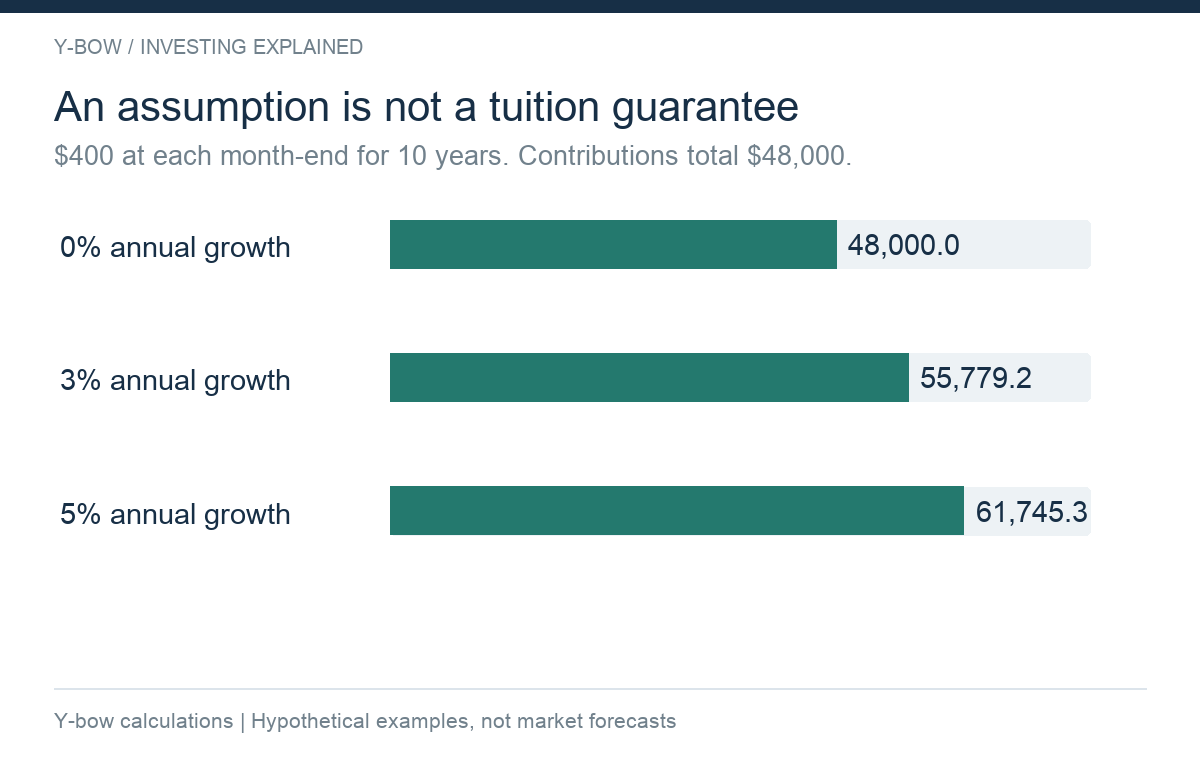
Do not select 5% simply because it closes a funding gap. An assumption does not become more likely because a household needs it. Increasing contributions, reducing the cost target or finding another funding source changes the plan in a way a spreadsheet return assumption cannot.
A late market decline can erase the apparent cushion
Take the smooth 5% example’s final value of roughly $61,745. A 30% decline immediately before the bill reduces an all-exposed portfolio to about $43,222. It no longer covers the illustrative $53,757 target.
If half the portfolio were exposed to that loss and the other half remained unchanged, the immediate portfolio loss would be 15%, leaving about $52,483. That still falls slightly short. These are simple stress tests, not predictions or a recommended allocation.
The lesson is that an expected surplus and a protected payment are different things. A family should decide how much shortfall it can cover from income or other assets before taking risk with money needed on a fixed date.
Reduce deadline risk with a payment schedule
Separate near-term payments from later ones. As a bill approaches, review how much of it should depend on market prices. This may involve cash or other assets matched to the payment’s timing and currency, subject to their own risks and local protections.
Bond funds are not automatically equivalent to cash: their market values can fall, including when interest rates rise. An individual bond held to maturity has different considerations, including credit risk, payment currency and the need to sell early. “Conservative” is not a guarantee that a bill will be fully funded.
The SEC’s allocation guide emphasizes that the time available to reach a goal affects the risk an investor can reasonably take. A college payment in a few years is different from a retirement account with decades before withdrawals. Source: SEC.
Education accounts: useful rules, different countries
In the United States, 529 plans are education-related savings arrangements with specific tax rules and conditions. Savings plans and prepaid tuition plans are not interchangeable. Investment options, fees, eligible expenses and state benefits require careful checking. Source: SEC introduction to 529 plans.
That does not make a U.S. account a universal solution for an international reader. Residency, cross-border taxation, account ownership and the destination institution can affect suitability. Use the relevant authority’s current rules rather than translating another country’s tax advantage into your own situation.
Also check what happens if the child chooses a different course, delays enrollment or does not pursue the expected education. Flexibility has value, but it must come from the actual account rules, not an assumption that all withdrawals are unrestricted.
Protect the rest of the household plan
Education is important, but so are emergency liquidity, debt obligations and the parents’ retirement. Using the same balance for all three goals overstates what the household has saved.
Do not use leverage to make a tuition target appear affordable. A loss can create the shortfall at exactly the wrong time, while borrowing costs can continue. See investing for busy parents for a contribution routine tied to household cash flow.
Review once a year—and when the plan changes
Update cost estimates, currency assumptions, expected support and payment dates. Compare the current balance with the next payments under adverse conditions, not just with a smooth growth line. Record which shortfalls could be funded from income and which would require changing the education plan.
A useful education portfolio is one that helps pay for the chosen education when the bills arrive. The highest historical return is a different objective.
Information checked October 15, 2026. All numerical examples are original hypothetical calculations, rounded for display. They exclude taxes and fees and do not recommend a specific account or asset allocation.









Comments