
A data center REIT announces a large AI lease. Does that mean more cash for shareholders this quarter? Not necessarily: rent may start later, construction needs funding, and the share count can change. Equinix and Digital Realty provide useful examples of how to trace those steps.
What the two businesses earn
Equinix reports colocation and interconnection, where customers house equipment and connect it to other networks. Digital Realty also serves colocation and interconnection customers, alongside large deployments and joint ventures. Both companies span more than one segment. Compare lease size, connection revenue and ownership economics rather than assigning the companies mutually exclusive labels.
Why signed leases take time to appear in revenue
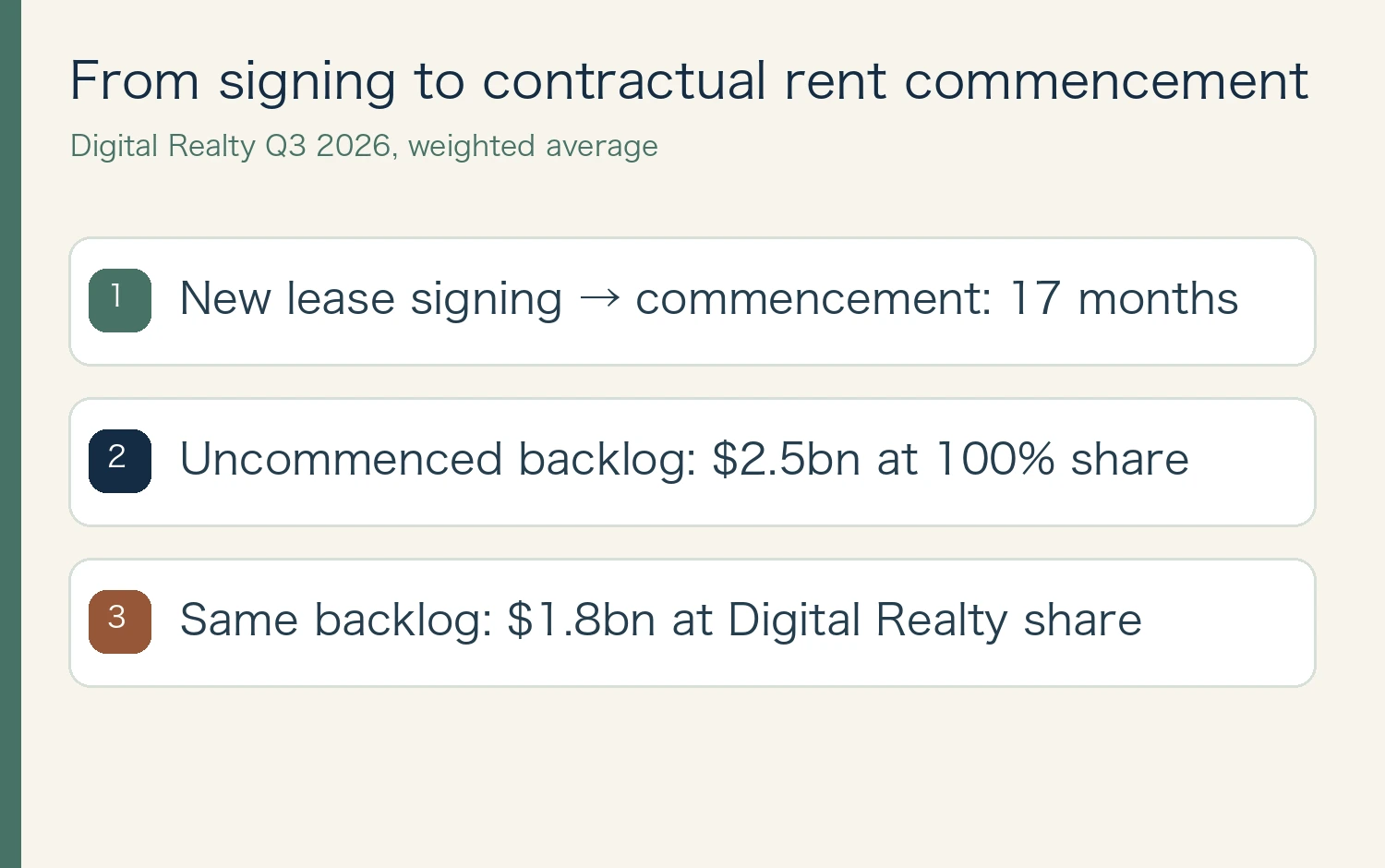
For Q3 2026, Digital Realty reported a 17-month weighted average from newly signed leases to contractual commencement. Its quarter-end signed-but-not-commenced backlog was $2.5 billion of annualized GAAP base rent at 100% ownership and $1.8 billion at Digital Realty's share. The two figures describe different ownership bases for the same backlog. The average is not a common start date for each lease. Check construction, power delivery, handover and the contract's commencement conditions.
Advertisement
Follow the bridge from GAAP earnings to FFO and AFFO
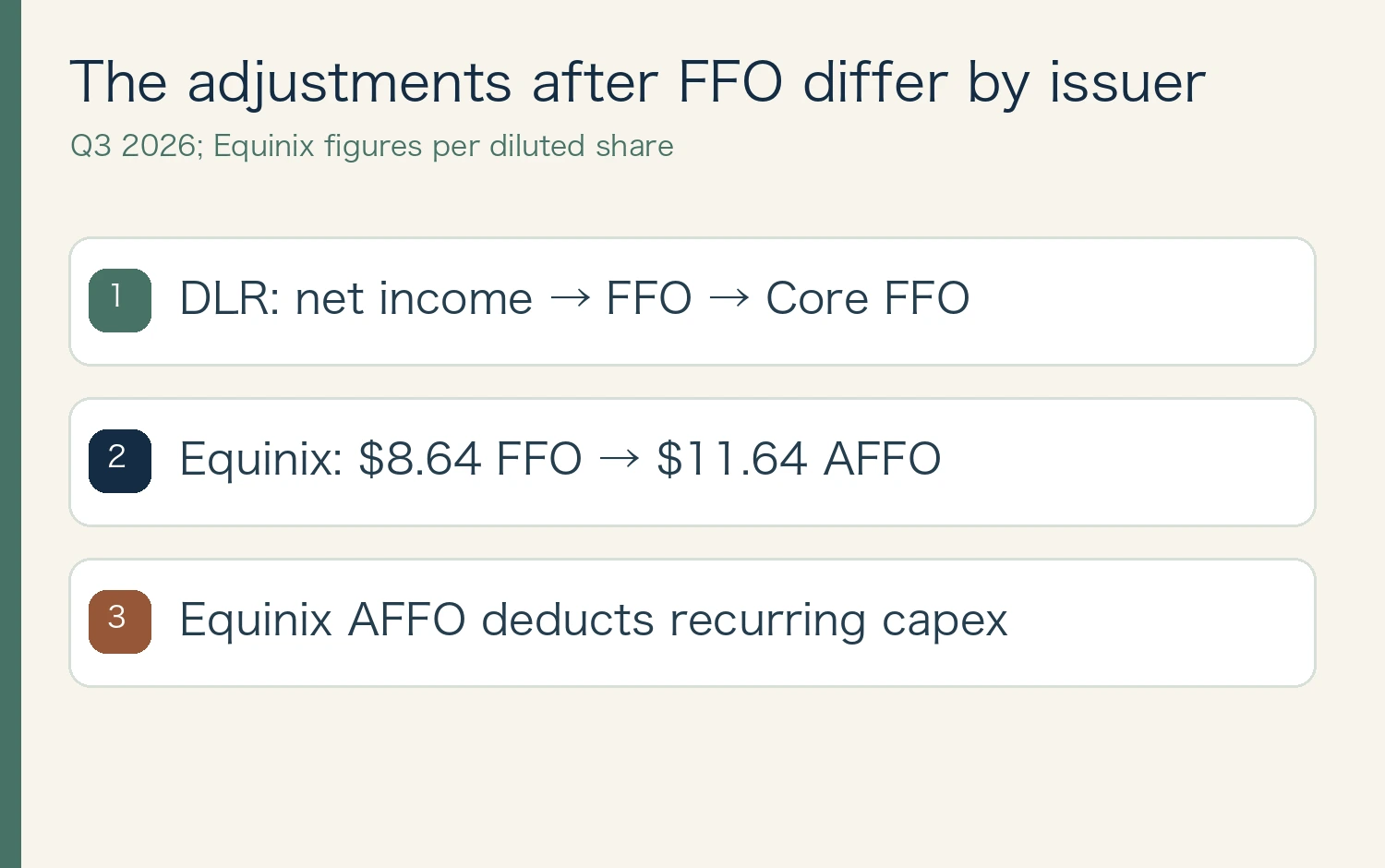
FFO starts from net income and adjusts for real-estate depreciation, disposition gains or losses and certain ownership effects. Digital Realty then applies its own adjustments to report Core FFO. Equinix bridges FFO to company-defined AFFO with several adjustments, including non-real-estate depreciation, straight-line accounting effects and a deduction for recurring capex. It reported Q3 diluted FFO of $8.64 and diluted AFFO of $11.64 per share. Read the adjustments behind the $3 difference before comparing with another issuer. An AFFO figure is not interchangeable with the cash-flow statement.
Stress-test rent timing and interest separately
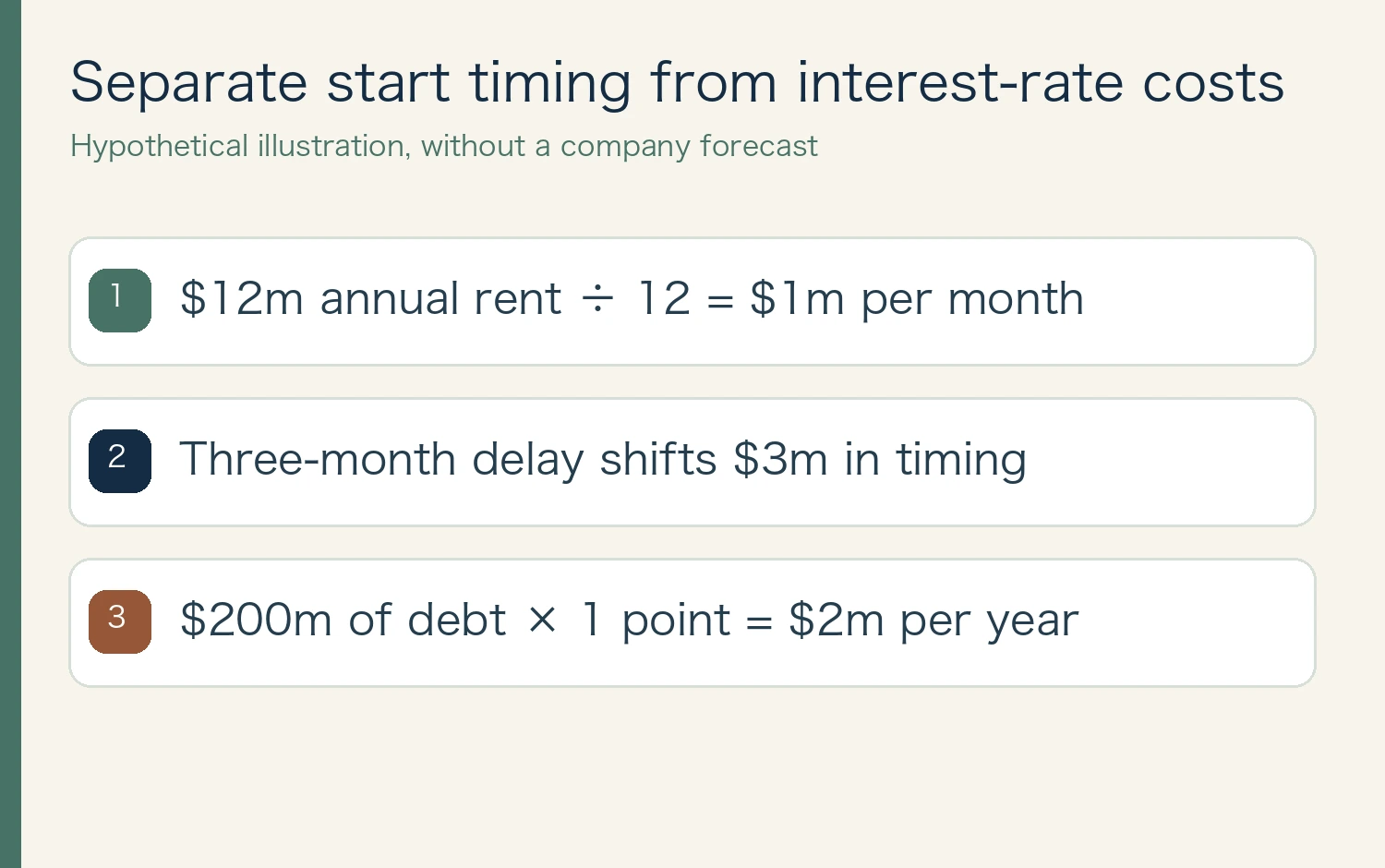
A hypothetical $12 million flat annual lease equals $1 million per month. A three-month start delay shifts $3 million out of the original observation window under those assumptions. A one-percentage-point rate increase on $200 million of floating-rate or refinanced debt adds $2 million a year at constant principal. One example measures timing, the other an annual cost. Neither includes concessions, taxes, collection or construction costs.
Advertisement
Reconcile cash after spending as a separate step
Operating cash flow can rise while new campuses absorb more cash before their rent starts. Recurring capex supports existing operations, while development capex expands capacity. Read each issuer’s classification and track joint-venture contributions and asset-sale proceeds separately in the cash statements. When equity funds expansion, compare companywide growth with the diluted per-share outcome.
A repeatable earnings checklist
Start with signed backlog and expected commencements, then read operating cash flow, recurring versus development capex, debt maturities and diluted shares. Compare the same period, currency and ownership basis. If recurring capex has already been deducted in AFFO, avoid deducting it twice. Separately budget the cash needed for development and acquisitions.
Swipe horizontally on a small screen.
| Item | What to verify |
|---|---|
| 1 | $12m annual rent ÷ 12 = $1m per month |
| 2 | Three-month delay shifts $3m in timing |
| 3 | $200m of debt × 1 point = $2m per year |
Frequently asked question
Does a higher AFFO guarantee a higher dividend?
Development spending, refinancing, liquidity and share count also matter. Align the period, share count and metric definitions when comparing payout and AFFO.
Company growth and growth per share can diverge
Take a hypothetical business whose adjusted earnings rise from 100 to 110. That is 10% growth. If its diluted share count rises from 100 to 120, however, earnings per share fall from 1 to about 0.917, a decline of roughly 8.3%. These are not either REIT’s reported results; they isolate the effect of the denominator.
This does not make every equity issue harmful. New capital may fund facilities that later produce rent and cash. But the timing, additional spending and financing costs need to be assessed alongside the new shares. Keep the present per-share result separate from the future investment case.
After reading a release, write three lines: leases signed, rent commenced and performance per diluted share. Power or construction delays can interrupt the first transition. Financing and dilution can change the second. The sequence is more informative than treating additional floor space as an immediate gain for every existing share.
Sources and review date
- Equinix Q3 2026 release and reconciliations
- Digital Realty Q3 2026 release and reconciliations
- Nareit AFFO glossary
Sources reviewed November 8, 2026. Original charts distinguish disclosed figures from illustrative assumptions.








Comments