

A record buyback sounds reassuring when you own a technology stock. Then you check the next filing and the share count has barely moved. Was the money wasted? Did employees receive the shares the company bought? And does growing adjusted EPS actually leave more value for you?
A buyback announcement is not the same as a reduction in your ownership denominator. Stock-based compensation, or SBC, is one reason. The useful response is not to condemn every equity award, but to reconcile shares, expense and cash before judging the program.
Authorization → actual spending → shares repurchased → net outstanding shares. Then add the compensation note and the basic/diluted EPS calculation. Each tells you something different.
Buybacks vs stock-based compensation: two directions of travel
Equity compensation includes different awards, such as restricted stock units and options. A grant, vesting, share delivery and expense recognition need not occur together. Likewise, authorizing a repurchase is permission to buy within stated conditions, not proof that the whole amount has been spent.
Consider a fictional company with 100 shares outstanding, excluding treasury shares. It repurchases 10 and issues 8 through compensation or other awards during the same period. With no other changes, it ends with 98 shares. Gross repurchases were 10; the net reduction was only 2.
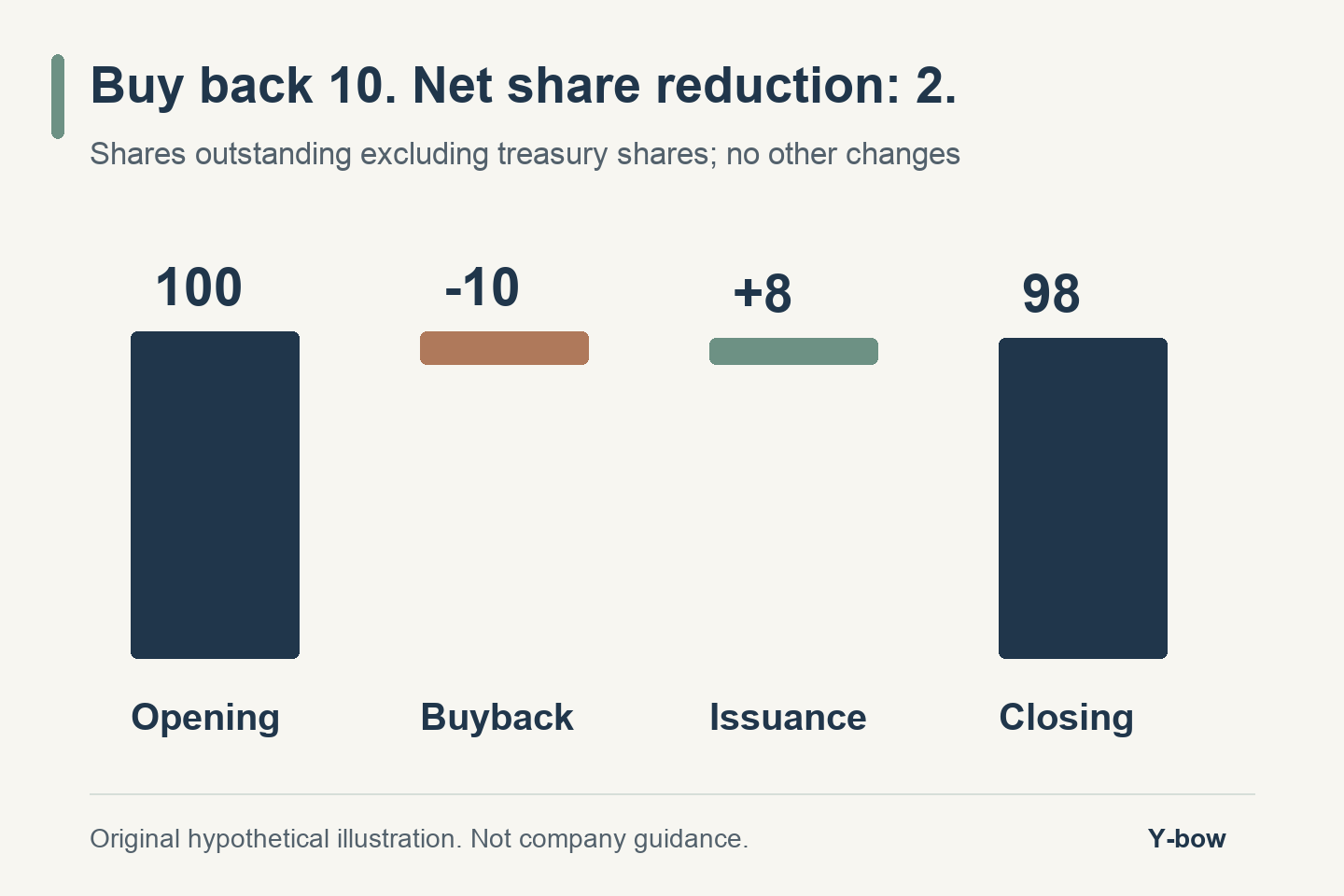
Real reconciliations include acquisitions, new capital, convertibles and shares withheld for employee taxes. Vested awards are not always identical to net new shares delivered. The diagram is a conceptual bridge, not a shortcut that lets you add every number in an award table.
Noncash compensation is still compensation
SBC can be recognized in operating expenses and added back as a noncash adjustment in operating cash flow. The employees’ work has not become free. Existing shareholders still need to assess ownership and future per-share outcomes.
In a simplified cash bridge, net income of 80 plus an SBC add-back of 20 produces operating cash flow of 100, assuming no other adjustments. Deducting capex of 30 gives FCF of 70. A further cash repurchase of 20 still uses cash, even if it is intended to offset dilution. Do not describe FCF before that payment as cash remaining after it.
Nor does an SBC expense of 20 mean repurchasing 20 of stock will exactly offset the awards. Grant-date values, expense periods, delivery dates and market purchase prices differ. The expense and the cash needed to hold share count constant are not interchangeable.
広告
Basic vs diluted EPS: choose the right share count
End-of-period shares are a snapshot. Basic EPS generally uses weighted-average shares over the period. Diluted EPS incorporates potential shares under the applicable accounting rules. You cannot substitute the closing share count for the denominator in the published calculation.
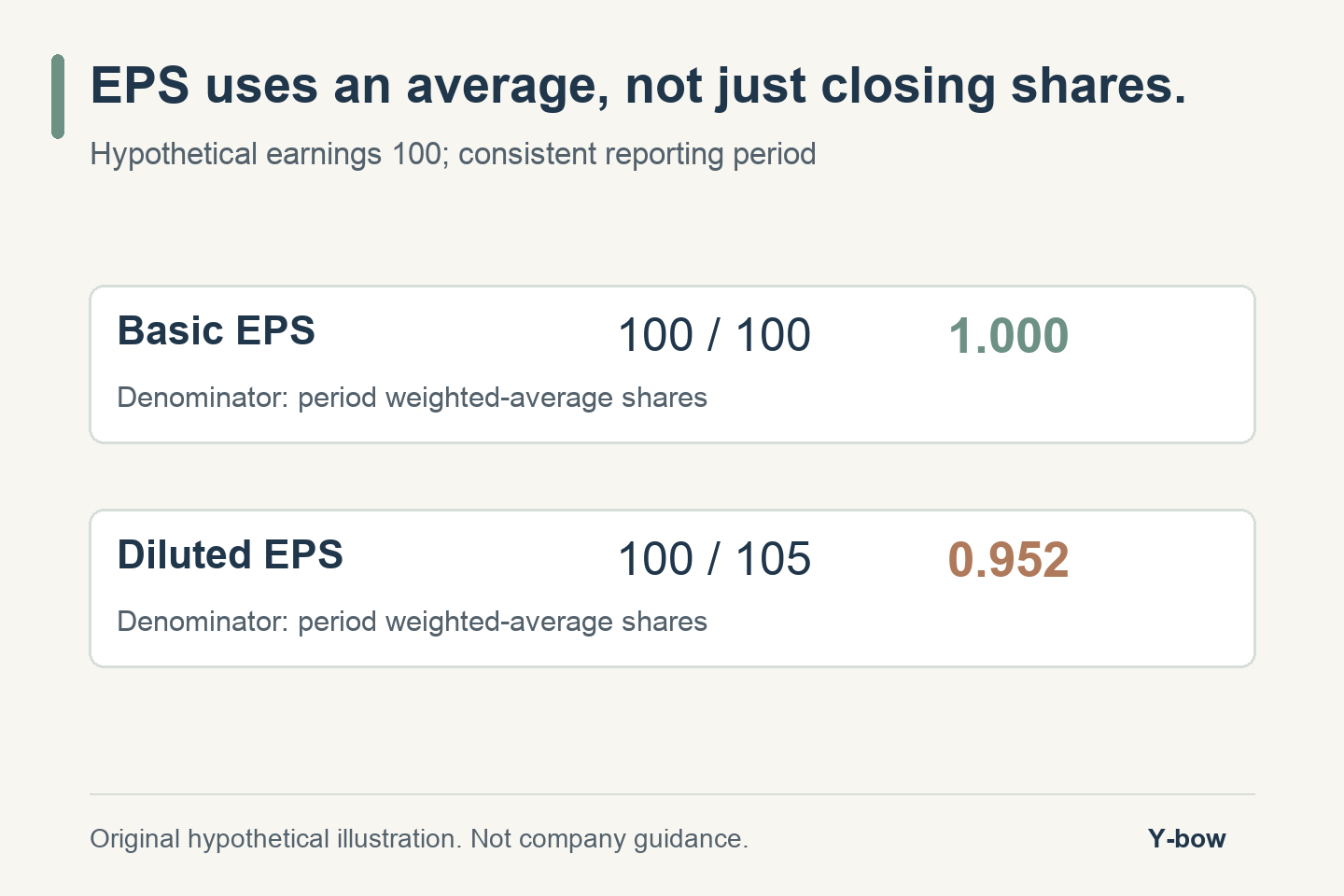
With fictional earnings of 100 and basic weighted-average shares of 100, EPS is 1. If the diluted denominator is 105, diluted EPS is about 0.952. Even if the company ends the year with 98 actual shares, 100 divided by 98 is not automatically its reported EPS. Transaction timing matters.
| Measure | What it answers | What it is not |
|---|---|---|
| Closing shares outstanding | Ownership denominator on that date | The period average or free float |
| Basic weighted-average shares | Basic EPS denominator | The closing balance |
| Diluted weighted-average shares | EPS with applicable potential dilution | Every share that might ever be issued |
| Unvested awards | Possible future delivery and expense | Shares necessarily issued today |
Potential shares can be excluded when their effect would be antidilutive, including in loss-making circumstances. Read the EPS note. Also normalize stock splits and, where relevant, ADR ratios. A change in units is not a change in economic ownership.
NVIDIA’s filing: a current example of why units and periods matter
In its Form 10-Q for July 26, 2026, NVIDIA reports first-half SBC expense of $3.954 billion and repurchases of 203 million shares for $39.8 billion. These are fiscal first-half figures, not calendar-year totals. Its EPS note separately supplies the weighted-average denominators.
You cannot divide the compensation expense by repurchase cash and call the result “the wasted share of the buyback.” The recognized expense does not equal current-period net shares issued. Check the equity reconciliation and the award terms before making that attribution. A dated remaining authorization is also not necessarily the amount still available today.
Non-GAAP does not always exclude SBC
NVIDIA’s FY2026 Q4 CFO commentary says its non-GAAP measures will include SBC beginning in FY2027 Q1. That makes “adjusted earnings always remove stock pay” an unsafe generalization.
When a growth rate changes, check the metric’s definition before assuming the business changed by the same amount. Compare like periods and reconcile all adjustments. The entire gap between GAAP and non-GAAP is not automatically SBC.
広告
Higher EPS does not settle whether a buyback created value
Keep earnings at 100 and reduce the denominator from 100 to 90. EPS rises from 1 to about 1.111. But the company spent cash to achieve the reduction. The price paid affects how many shares it can retire, and the cash has alternatives: invest in operations, repay debt, pay dividends or remain available for difficult conditions.
Equity awards can help attract people and create a more valuable business. They can also absorb a meaningful part of the growth that existing owners hoped to receive. Judge the result through per-share economics and the cash used, rather than a rule that all SBC is bad or all repurchases are good.
How much dilution does one extra issuance create?
If you hold 1 of 100 shares, your ownership is 1%. If total shares rise to 110 while you still hold 1, your fraction becomes approximately 0.909%. That is a relative reduction of about 9.09%, not exactly 10%. The company could still grow enough to increase the value of your holding. Dilution of ownership and a falling stock price are different outcomes.
A seven-step buyback and dilution checklist
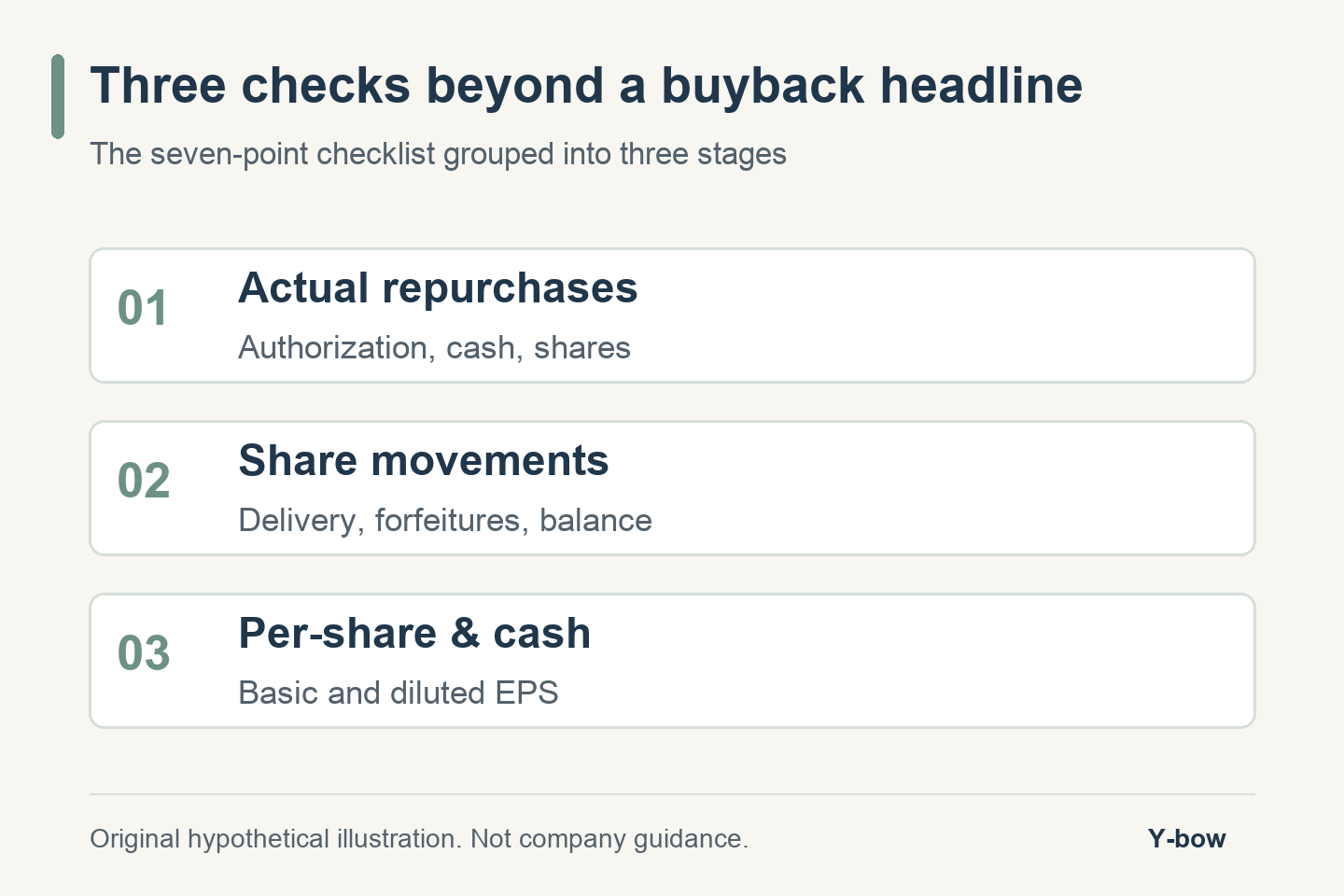
- Authorization: record the limit, remaining amount and expiry conditions.
- Execution: collect cash spent and shares repurchased for the same period.
- Share bridge: reconcile opening and closing outstanding shares.
- Awards: read SBC expense, unrecognized cost, vesting and forfeitures.
- EPS: compare basic and diluted denominators on a consistent basis.
- Cash: separate operating cash, capex, repurchases and financing.
- Valuation: ask what you are paying for the remaining per-share growth.
A multiyear view helps expose timing effects. It does not justify inventing a missing line to make the bridge balance. Mark the uncertainty and return to it in the next filing. The ability to say “not disclosed” is part of analysis.
FAQ: should you subtract SBC from free cash flow?
Can I deduct SBC and also model future dilution?
Only with a clear, consistent treatment. Some valuation approaches treat equity compensation as an ongoing expense; others explicitly model share changes. Combining deductions without checking what each already captures can count the burden twice. Write down where you reflected it.
Does retiring shares guarantee a higher price?
No. Business performance, purchase price, future issuance and market expectations still matter. Free-float treatment for an index is another question; our memory buyback and index-flow guide treats that separately.
Where is a practical follow-up example?
The author’s note on ASICS buyback execution (Japanese) follows announced authorization into actual purchases. It is a different company and compensation system. Check its stated period and free/paid boundaries; no paid analysis is reproduced here.
Sources, original calculations and updates
Checked October 20, 2026. Primary sources: NVIDIA FY2027 Q2 Form 10-Q, Notes 2, 3 and 12, FY2026 Q4 CFO commentary and the SEC statement guide. Diagrams use invented examples, not forecasts. Calculations are 100−10+8=98; EPS 100/100 versus 100/105; and relative ownership change (1/110)/(1/100)−1. Future reviews will check award terms, metric definitions and actual share movements. This is a framework, not a trade instruction.







Comments