

For a busy parent, the obstacle to investing is often not a shortage of market opinions. It is finding a routine that still works when childcare, school forms, work and unexpected bills arrive in the same week.
I write about investing as a father of two, alongside 17 years of investment experience. My own main recurring investments include an unhedged leveraged Nasdaq fund and FANG+. That is a description of my choices, not a starting portfolio for another family. Household cash needs and the ability to absorb losses come first.
The useful goal is not to check a portfolio more often. It is to make the important decisions deliberately, automate the repetitive steps and notice when the family’s circumstances change.
Start with the next twelve months of family spending
List predictable bills before deciding how much to invest. Childcare fees, school costs, medical deductibles, insurance premiums and annual payments can be large even when they do not arrive monthly.
Divide annual or quarterly costs into monthly amounts and set aside money for them separately. A school bill due in three months is not an emergency just because it was absent from last month’s budget. Nor is it long-term investment capital.
An emergency reserve has a different job: income interruption, urgent repairs or another genuinely unexpected expense. The appropriate amount depends on income stability, available support and the household’s obligations. Cash accessibility and applicable deposit protection matter as well as the interest rate. Source: FDIC.
Calculate a contribution the household can keep making
Use money left after essential spending, debt obligations, planned bills and reserve contributions. Do not choose an investment contribution by copying another parent’s amount or by assuming next year’s salary increase will arrive.
Here is a fictional monthly budget in any consistent currency. It is an illustration of the calculation, not a recommended spending level.
| Item | Monthly amount |
|---|---|
| Income after tax | 5,000 |
| Essential household spending | −3,100 |
| Debt payments | −400 |
| Planned annual bills provision | −500 |
| Emergency reserve contribution | −300 |
| Flexible spending | −400 |
| Remaining for long-term investment | 300 |
The 300 is a starting capacity under these assumptions. If childcare rises by 200, the affordable contribution falls unless something else changes. Reducing a contribution to avoid borrowing for daily bills can be a sensible adjustment, not a failure of discipline.
Automate contributions after the cash-flow decision
Automation makes a good instruction repeatable. It also makes a bad instruction repeatable. Schedule a transfer only after checking when income arrives and which bills leave the account first. Keep enough cash to prevent a market contribution from causing an overdraft.
The CFPB describes automatic saving as a way to make saving habitual. The underlying principle applies here: start with an amount that fits, then review it. An investment transfer still carries market risk that a savings transfer does not. Source: CFPB.
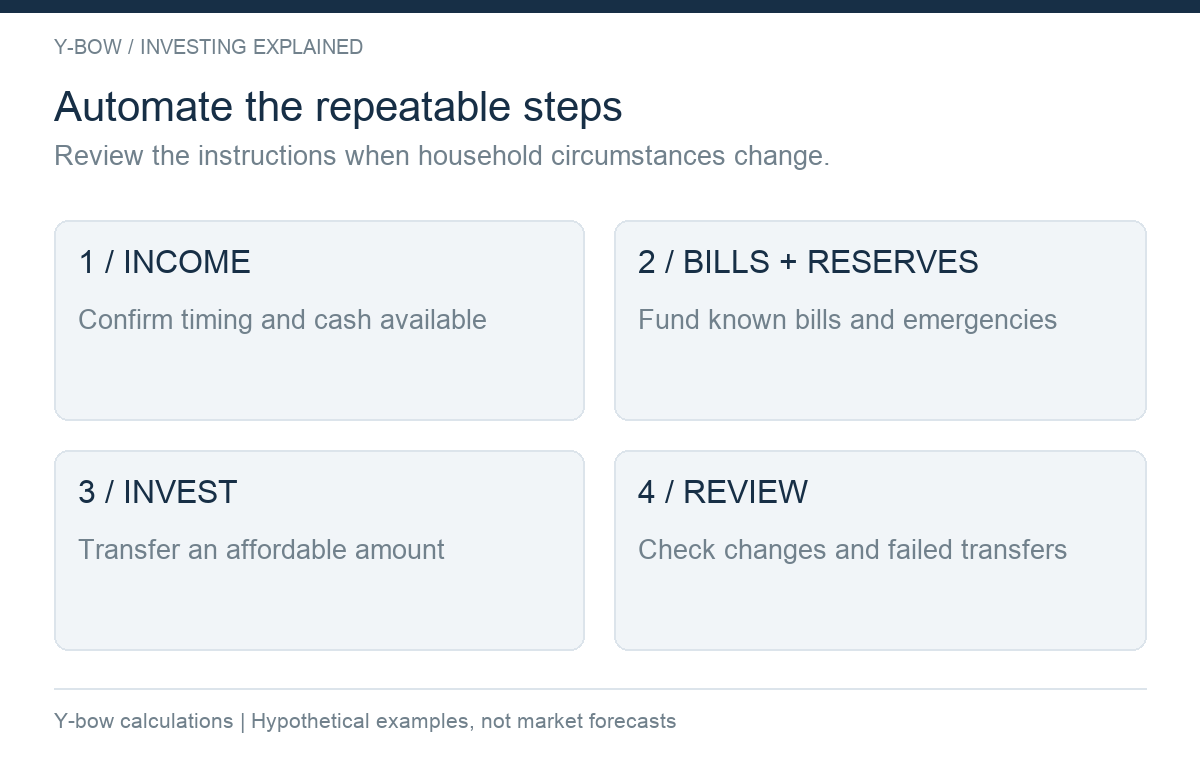
A workable process is: income arrives, bills and reserves are funded, the affordable long-term contribution is invested, and a brief scheduled review checks that the instructions still fit. It does not require making a new market forecast every payday.
Choose a portfolio both adults can explain
If a household shares financial responsibilities, both adults should understand what the money is for and where it is held. “My partner handles all that” can leave a family exposed if the person who knows the accounts becomes unavailable.
A short written plan can record the purpose of each account, the approximate allocation, the contribution amount and what would trigger a review. Store account access and recovery information securely; do not put passwords in a casually shared spreadsheet.
Beneficiary designations, guardianship and account ownership rules depend on the country and account type. These are reasons to use the provider’s official process and appropriate local advice. They are not details a generic online portfolio can settle for every family.
Separate retirement money from education money
The same fund may be available in several accounts, but the deadlines differ. Retirement might be decades away. Tuition payments can start on a known date and continue for several years. A large decline immediately before the first tuition bill can be much harder to accommodate than a decline in a flexible long-term account.
Keep a separate schedule for each goal. A dollar or pound cannot simultaneously be the emergency reserve, next year’s school fee and retirement savings. Separate labels are useful only if the balances are not double-counted.
For a worked approach to payment dates, see building an education fund. For an investment starting point, see the first-month beginner plan.
What to review when family life changes
Review after a job change, parental leave, a new child, a move, a large fee increase or a significant change in debt. These events can matter more to the plan than a week of stock-market headlines.
| Change | Practical question |
|---|---|
| Income becomes less predictable | Does the cash reserve still fit the risk? |
| Childcare or tuition rises | Is the automatic contribution still affordable? |
| A goal moves closer | Is too much of the required payment exposed to stocks? |
| A market rally changes weights | Has concentration grown beyond the written plan? |
| A partner cannot manage the accounts | Can the other adult locate and understand the plan? |
Automation does not remove the need to check fees, fund changes or failed transfers. It removes the need to re-enter a decision that remains appropriate. A brief recurring review can focus on exceptions rather than daily prices.
Avoid using leverage to repair a savings shortfall
A family behind on a goal may be tempted to choose a product with a larger advertised multiplier. That changes the possible loss as well as the possible gain. It does not make a required future payment more certain.
Borrowing to invest can also create interest and repayment obligations that persist after a loss. A cash-purchased leveraged fund has a different structure, but its daily objective can produce substantial losses and unexpected multi-day results. Understand the distinction before using either. See investment leverage, margin and daily reset.
If the plan does not fund a goal under conservative assumptions, consider the contribution, deadline, cost or amount of the goal. A higher assumed return is not a substitute for that conversation.
A family investing routine worth keeping
Keep bills, reserves and long-term goals visible. Automate only an affordable amount. Choose investments the household understands, record the rules and review after material changes.
That routine may look unremarkable next to a spectacular stock chart. Its value is that the family can continue using it when life gets busy—which is exactly when a complicated plan is most likely to be abandoned.
Information checked October 15, 2026. The budget and workflow are illustrative. Account availability, tax treatment and family planning rules depend on residence and personal circumstances.








Comments