

A founder can own shares worth millions on paper while having very little cash available to spend. That is not necessarily a contradiction. A private-company valuation, a company’s bank balance and a founder’s personal proceeds are three different things.
The distinction is useful far beyond startup headlines. It explains why a new funding round can make someone appear wealthier without paying them, why dilution is not automatically a financial loss, and why a stock split cannot create value by itself.
Let us follow a small company through a simple financing and a later sale. All company figures below are invented and exclude fees and taxes.
Equity ownership: start with shares, not a headline valuation
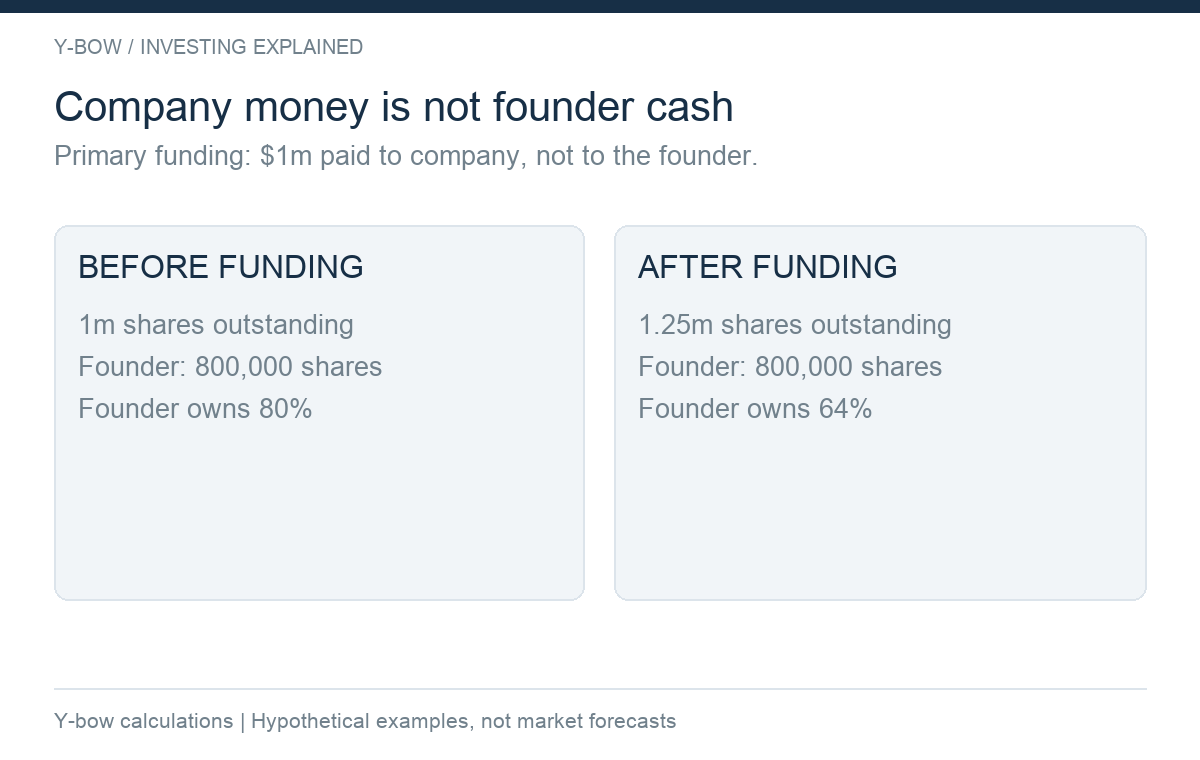
Suppose a company has one million shares. Its founder owns 800,000 and other shareholders own 200,000. The founder therefore owns 80%.
An investor agrees to buy 250,000 newly issued shares at $4 each. The investor pays $1 million to the company. There are now 1.25 million shares outstanding.
| Holder | Shares before | Ownership before | Shares after | Ownership after |
|---|---|---|---|---|
| Founder | 800,000 | 80% | 800,000 | 64% |
| Other existing holders | 200,000 | 20% | 200,000 | 16% |
| New investor | 0 | 0% | 250,000 | 20% |
| Total | 1,000,000 | 100% | 1,250,000 | 100% |
The founder has the same number of shares and a smaller percentage. That is dilution. It is not a transfer of 16% of the founder’s original shares to the investor; the denominator increased because the company issued new shares.
Employee options, warrants and convertible securities can change the calculation. A fully diluted capitalization table includes specified potential shares, while a basic outstanding-share count may not. Always ask which denominator a quoted ownership percentage uses.
Pre-money and post-money valuation
At the negotiated $4 price, the original one million shares imply a $4 million pre-money valuation. Adding the investor’s $1 million produces a $5 million post-money valuation. The investor owns $1 million divided by $5 million, or 20%, in this simplified common-share example.
The founder’s 800,000 shares are marked at $3.2 million: 800,000 × $4. That is 64% of $5 million. The founder did not receive $3.2 million or the $1 million investment. The company received the new money.
Whether the financing benefits existing shareholders depends on what the business can do with the capital and on the terms. A lower percentage of a stronger business can be worth more. A higher valuation accompanied by expensive preferences can be less attractive than the headline suggests.
Primary versus secondary shares: who receives the cash?
A primary financing issues new shares and puts proceeds into the company. A secondary sale transfers existing shares, with proceeds going to the selling holder. A transaction can include both.
If the founder sells 50,000 existing shares to someone else at $4, the buyer pays the founder $200,000 before costs and taxes. That transaction does not itself add cash to the company or increase the total shares outstanding. The founder’s ownership falls because the founder sold shares, not because new shares diluted everyone.
| Transaction | Recipient of cash | New shares created? | Typical question |
|---|---|---|---|
| Primary funding | Company | Yes | Can the new capital produce enough value? |
| Secondary founder sale | Selling founder | No | What restrictions and terms apply? |
| Employee option exercise | Usually company receives exercise price | Often yes | How much dilution was already anticipated? |
The terms determine the actual result. Private securities can have transfer restrictions and limited liquidity. A buyer in one negotiated transaction does not mean every shareholder can sell the same day at the same price. Source: SEC private-placement bulletin.
Preferred shares can change the exit proceeds
Now suppose the new investor receives a simple one-times, nonparticipating liquidation preference. In this example, the investor chooses the larger of its original $1 million investment or its 20% common-equivalent share of sale proceeds. Real contracts can be substantially more complicated.
If the business sells for $3 million available to shareholders, 20% is $600,000. The investor chooses the $1 million preference. The remaining $2 million goes to original holders, of whom the founder owns 80%; the founder receives $1.6 million before costs and taxes.
Multiplying the founder’s headline 64% by the $3 million sale price would give $1.92 million. It would miss the preference. At a sufficiently high exit value, converting to the 20% common-equivalent stake becomes more attractive for the investor.
This is why a financing price paid for preferred securities may not be a clean valuation of every common share. Debt, multiple preference classes, participation rights and option exercises can further change the distribution.
A stock split changes the units, not the economic pie
Imagine a ten-for-one stock split. The founder’s 800,000 shares become eight million, and the total share count increases by the same factor. The founder still owns 64% after the financing.
A consistent per-share price would divide by ten. There are more units, not ten times as much business value. Split-adjusted charts make historical prices comparable; an unadjusted old share price can create a false impression of the return.
The same care applies to a share repurchase, but for a different reason: a repurchase uses company resources and changes the outstanding shares. It is not simply a relabeling of units like a split.
An IPO does not turn all paper wealth into cash immediately
An initial public offering can involve new shares, existing shares or both. Founders may remain subject to lockups, securities rules and practical limits on selling a large holding. The offering price also need not equal later trading prices. Source: SEC IPO bulletin.
A wealth ranking often marks a stake using a recent transaction or public share price. That calculation can be informative, but it is not a statement that the person could sell the entire stake at that price without restrictions, market impact or taxes.
Founder success also comes with concentration. A founder may have salary, career prospects and most personal wealth tied to the same business. The outcome of a successful founder is visible; failed businesses are easier to overlook.
Reading founder wealth claims with a cap table
Ask how many shares the founder owns, which share class they are, what valuation is being used and whether it comes from an actual transaction. Identify new capital separately from secondary proceeds. Then check debt, preferences, dilution and sale restrictions.
For the broader private-market label, see what a unicorn valuation really means. The important skill is the same: follow ownership rights and cash flows before accepting a headline dollar figure.
Information checked October 15, 2026. Original examples simplify financing terms and are educational calculations, not a valuation of a specific company or legal or tax advice.








Comments