

You open your brokerage account and see the loss again. Selling would make it feel final. Holding brings another fear: what if it falls further? Then an apparently neat solution presents itself. Buy more at the lower price, reduce the average cost, and escape when the investment recovers.
Part of that arithmetic is correct. A cheaper purchase can lower your average cost. But a smaller percentage loss on the screen does not mean that fewer dollars have been lost. Adding money can make the display look better while increasing the amount exposed to the next decline.
I have invested for 17 years and currently make regular investments mainly in an unhedged leveraged Nasdaq-100 fund and FANG+. That is context, not a portfolio recommendation. Adding to a declining investment is not automatically a mistake. The important distinction is whether the purchase still fits a considered plan, or whether the need to erase an old loss is setting the size of the next position.
This article focuses on that next order. For the broader household questions, start with the five checks before panic selling. Here we will separate averaging down, the break-even target, and the temptation to take more leverage.
The key points
- Averaging down does not erase an existing dollar loss at the moment of purchase.
- A bigger holding experiences a bigger dollar move for the same subsequent percentage change.
- Your purchase price and the case for owning an investment today answer different questions.
- Write down the funding limit, investment thesis and review conditions before placing another order.
Reviewed October 18, 2026. All numerical examples are hypothetical author calculations, not forecasts or maximum-loss estimates. The cover and editorial illustration are generated images.
When “I want my money back” starts choosing the next investment
The original goal may have been retirement, tuition or financial flexibility. After a loss, another goal can slip into its place: do not let this particular investment end in defeat.
Imagine someone who had planned to invest $300 a month but now wants to add $3,000 to a losing holding. Perhaps the lower valuation justifies the purchase. But ask where the amount came from. Was it chosen from a household budget and a position limit, or calculated backward from the loss that needs to disappear?
A $4,000 loss does not, by itself, make the next opportunity more attractive. Nor does it make the household better able to tolerate another $4,000 decline. The amount you want to recover is not a risk budget.
There is nothing wrong with revising a plan after learning something. The danger is changing the plan simply because the account statement has become uncomfortable. A falling price may offer a better entry point, reflect deteriorating prospects, or do both at once. The price change alone does not settle the investment case.

Averaging down: a lower percentage loss, the same dollar loss
A $10,000 holding falls to $6,000. What does another $6,000 change?
Suppose you bought 100 shares at $100 each. The cost was $10,000. At $60 a share, the position is worth $6,000 and the unrealized loss is $4,000, or 40% of the cost.
Now buy another 100 shares for $6,000. You own 200 shares with a total cost of $16,000. The average cost is $80 per share, while the position is worth $12,000 at the unchanged $60 price.
| Measure | Before | After adding $6,000 |
|---|---|---|
| Shares | 100 | 200 |
| Total cost | $10,000 | $16,000 |
| Average cost | $100 | $80 |
| Market value | $6,000 | $12,000 |
| Unrealized loss | $4,000 | $4,000 |
| Loss as a share of cost | 40% | 25% |
The percentage has improved from 40% to 25%. The $4,000 loss has not changed. You added fresh capital to the denominator. With transaction costs, the immediate dollar loss would be slightly larger.
This does not prove that the purchase is bad. It shows what the purchase actually does. It increases your holding at today’s price; it does not repair the old loss on contact. For a shorter calculation-focused explanation, see average cost and unrealized losses.
Compare the same starting wealth, including the cash you could keep
A fair comparison starts with the same $16,000: $10,000 originally invested and $6,000 held in cash. When the share price reaches $60, either choice leaves $12,000 in combined wealth. Without another purchase, that is $6,000 in shares plus $6,000 cash. After the purchase, it is $12,000 in shares and no remaining cash.
Now assume a further 20% price decline, from $60 to $48. This is a scenario, not a forecast or a worst-case boundary.
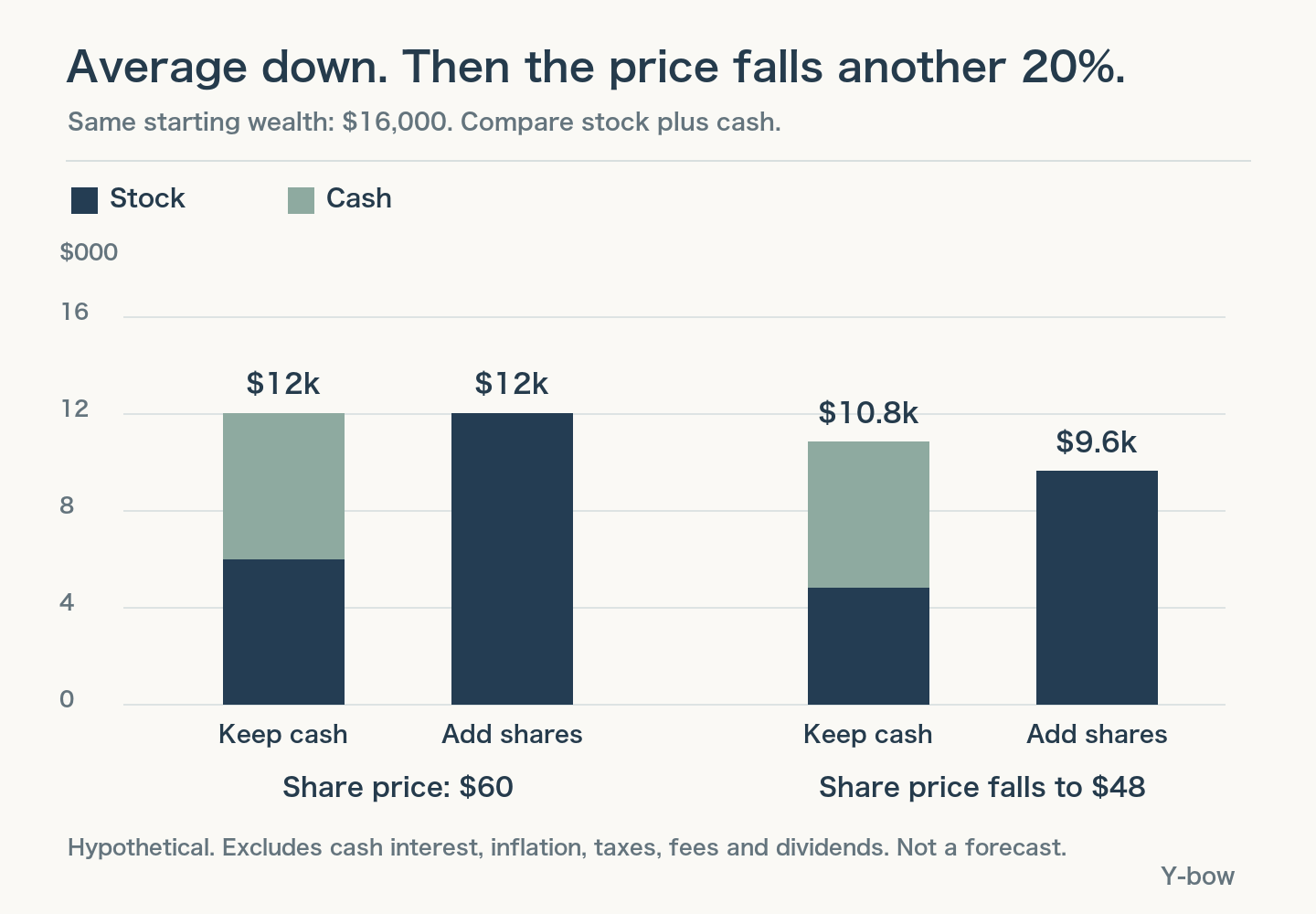
Keeping the cash produces $4,800 in shares plus $6,000 cash, or $10,800. Averaging down produces $9,600 in shares. The next leg lower costs $1,200 in the first case and $2,400 in the second.
If the price rises instead, the larger holding captures a larger dollar gain from that point. That is the trade-off. Averaging down exchanges cash for more exposure to future returns, positive or negative. Whether it is worthwhile depends on the current investment case and the household’s ability to carry that exposure.
The break-even trap: a 40% loss needs a 66.7% gain
A 40% decline and a 40% rebound use different bases. A value of 100 falls to 60; a subsequent 40% gain brings it only to 84. Returning from 60 to 100 requires about 66.7%.
If the decline is d, the gain required to restore the original price is d / (1 − d). A 50% decline needs a 100% gain. A 70% decline needs approximately 233.3%.
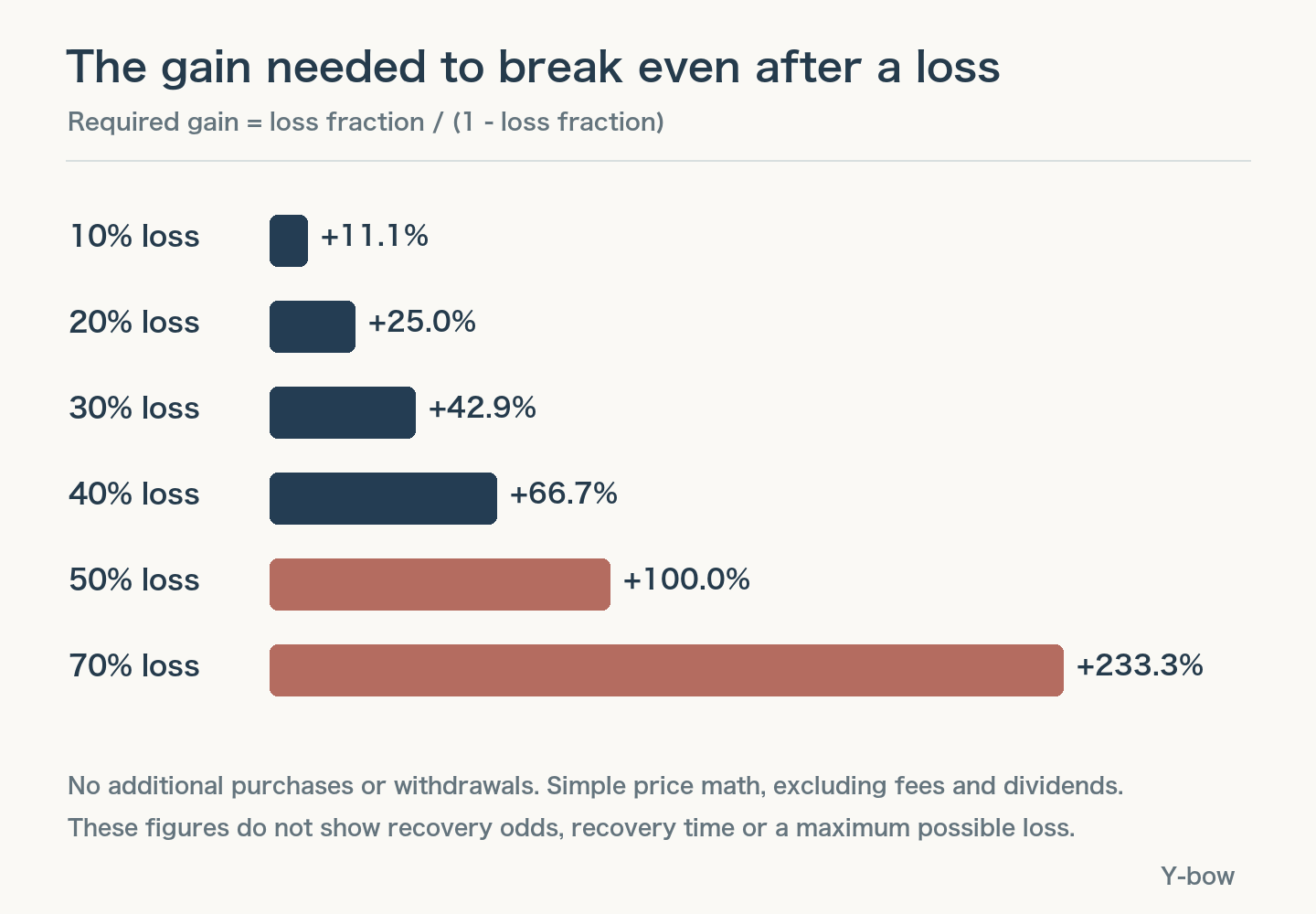
The chart is not an instruction to sell every investment with a large drawdown. It is a way to replace “just a small bounce” with an actual number. The decision still depends on future prospects, the alternatives, costs and the date the money is needed.
Averaging down changes the average-cost target. In the example, moving from $60 to the new $80 average requires a 33.3% gain. That is a different target because extra money was invested. Always keep the additional capital and share count visible when discussing recovery.
Why the purchase price can become an emotional anchor
The tendency to realize gains more readily than losses is called the disposition effect. Terrance Odean’s 1998 study examined 10,000 U.S. discount-brokerage accounts over 1987–1993 and documented this preference. It is evidence from a historical sample, not a diagnosis of every investor or proof that every losing holding should be sold.
There can be sound reasons to keep a position: valuation, the investment thesis, transaction costs and tax consequences all matter. The warning sign is when “I paid $100, so I cannot leave before $100” becomes the entire explanation.
The company does not know your entry price. Its future cash flows do not improve because you need a particular exit price. A useful question is: If I held the current market value in cash today, would I choose this same exposure, in this amount, on today’s information?
This is a thinking tool, not an immediate sell order. Continuing to hold and selling to repurchase are not identical after taxes, trading costs or account restrictions. The question helps reveal whether a purchase price has displaced the forward-looking investment case.
Do not use a leveraged ETF as a deadline for recovering a loss
A leveraged fund may look like a way to reach break-even sooner. But “I need this money back within six months” is not a reason that its risk becomes affordable. Before changing the product, calculate what another decline would do to the dollars left in the household.
Funds targeting daily 2x or 3x returns do not promise 2x or 3x the benchmark’s return over an arbitrary holding period. The SEC’s leveraged and inverse ETF bulletin explains the importance of the daily objective. Read the particular prospectus and distinguish the fund’s leverage from money borrowed personally. See also TQQQ, daily leverage and compounding.
In a margin account, borrowing adds a different set of obligations. The SEC’s margin-account bulletin warns that investors can lose more than their deposited funds and that a broker may liquidate positions. The precise conditions depend on the account agreement and applicable rules. Do not treat a margin deadline as an ordinary decision that can simply wait until tomorrow.
Choosing leverage as part of a defined strategy is different from increasing it because an earlier trade lost money. In the latter case, each loss can become the reason for a bigger position. The original household limit then moves precisely when it is most needed.
Five things to write down before averaging down, holding or reducing
| Question | What to record |
|---|---|
| Cash and deadlines | Expenses, debt payments and dates that cannot depend on a market rebound. Deal with margin or payment deadlines first. |
| A funding ceiling | The total allowed in this holding or sector, not just today’s order. Decide whether another decline would trigger another addition. |
| The current investment case | What supports ownership today: earnings, liquidity, valuation, fund costs and time horizon. Use reasons beyond your entry price. |
| A further-decline scenario | The dollar loss and cash remaining after a hypothetical additional decline. A chosen scenario is not a maximum possible loss. |
| Review conditions | Information that would change the thesis, household events, and the next review date. Price alone is not the whole case. |
If you cannot define the extra amount, not placing a new order today can be a valid choice. That is not permission to ignore a contractual deadline. Separate urgent funding obligations from a discretionary new purchase.
Regular contributions also need limits. A previously agreed allocation and contribution amount is different from an open-ended promise to buy more whenever a position falls. Broad diversification and a longer horizon may help manage some risks; they do not guarantee recovery, and a recurring purchase does not remove concentrated or daily-leverage exposure.
Questions about losses, averaging down and selling
Is averaging down always a mistake?
No. The relevant questions concern today’s investment case, the size after the purchase, available cash and time horizon. A lower average cost alone does not establish that the added exposure is appropriate.
Is an unrealized loss only a loss on paper?
It has not been realized by a sale, but the amount available at today’s price has fallen. Selling changes future exposure and may change tax treatment. Keep realization, current economic value and tax consequences separate.
What percentage decline should trigger a sale?
There is no single threshold suitable for every investment and household. A risk rule needs to fit the product, thesis and funding deadline. Also understand the SEC’s explanation of stop-order limitations; a gap can produce an execution price different from the level you expected.
Does giving up on break-even mean giving up on investing?
No. You can stop requiring one particular holding to repair the account and still invest according to a revised plan. Reducing exposure, diversifying or changing contributions may be options. None guarantees that the replacement will recover the old loss. Account for costs and local tax rules before acting.
Keep the next decision from becoming a verdict on the last one
A losing investment can make the next trade feel like a test of competence. But a market price does not have to vindicate an earlier purchase before you can make a sensible decision now.
If you add, look at total exposure and the cash left over. If you sell, consider what happens to the proceeds and when they are needed. If you hold, explain the thesis in words other than “until I am back to even.”
Start with the risk you can carry from today, rather than the amount you want to recover from yesterday. That will not remove uncertainty. It can keep one uncomfortable position from choosing the size of every decision that follows.
For next steps, read the household checks before panic selling or a practical first-month investing plan.
Sources and calculation notes
- Odean, T. (1998), Are Investors Reluctant to Realize Their Losses?, The Journal of Finance, 53(5), 1775–1798, author-hosted PDF.
- SEC Investor.gov: Updated Investor Bulletin: Leveraged and Inverse ETFs.
- SEC Investor.gov: Understanding Margin Accounts.
Sources checked October 18, 2026. The examples are the author’s arithmetic, using the same initial $16,000 across both alternatives. They exclude fees, taxes, dividends, exchange-rate changes, cash interest and inflation. They do not estimate recovery time, future returns or worst-case losses. The checklist is an editorial decision aid, not personalized investment advice. Tax and account rules differ by country.








Comments