

Leverage means taking investment exposure larger than the capital you put at risk. It can come from a broker loan, derivatives or a fund that targets a multiple of daily returns. These structures share the ability to magnify gains and losses, but they do not create the same obligations.
A useful explanation therefore needs more than “twice the return.” Start with a balance sheet, then compare borrowing with a daily-reset fund and finally look at the whole portfolio.
How a margin loan changes gains and losses
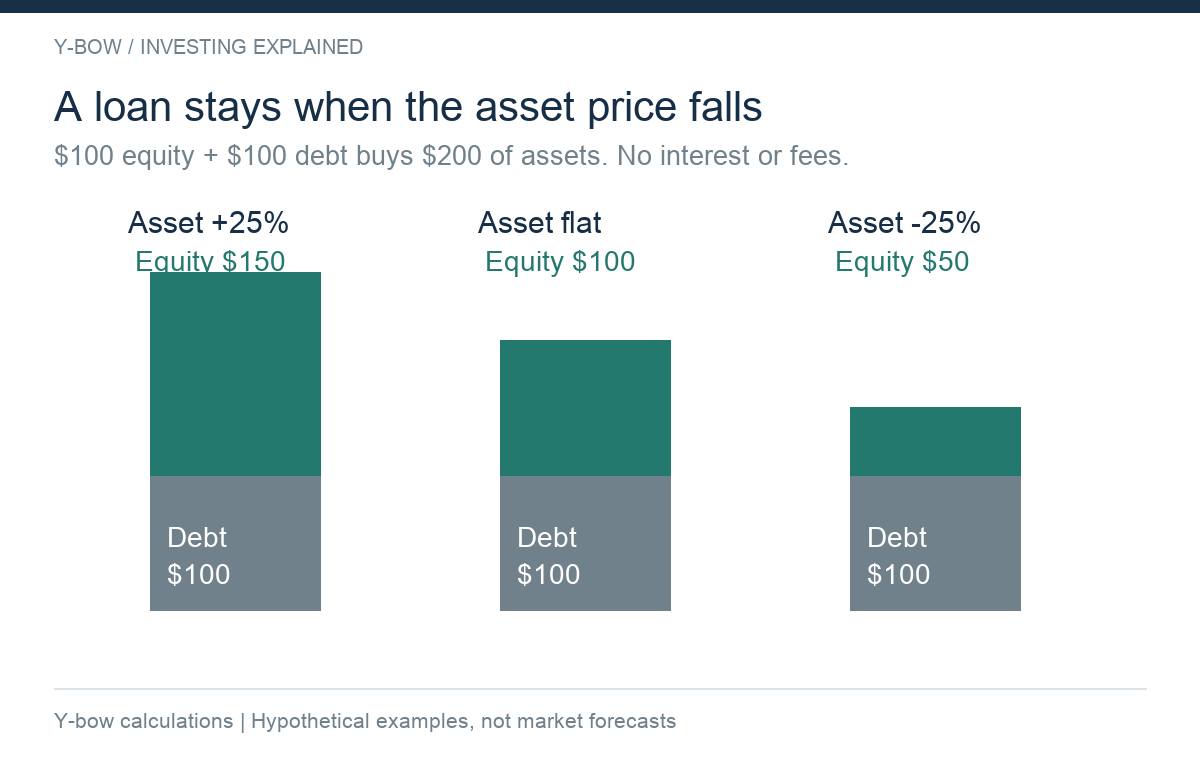
Suppose you invest $100 of your own money and borrow another $100. You buy $200 of an asset. Your equity is assets minus debt: $200 − $100 = $100.
Ignore interest, trading costs and taxes. If the asset rises 25%, it is worth $250. Repaying the unchanged $100 debt leaves $150, a 50% gain on your original $100. If the asset falls 25%, it is worth $150; subtracting debt leaves $50, a 50% loss.
| Asset return | Asset value | Debt | Remaining equity | Return on original equity |
|---|---|---|---|---|
| +25% | $250 | $100 | $150 | +50% |
| 0% | $200 | $100 | $100 | 0% |
| −25% | $150 | $100 | $50 | −50% |
| −50% | $100 | $100 | $0 | −100% |
The loan did not shrink when the asset fell. A larger loss could leave a debt beyond the investor’s original capital, depending on the structure and account rules. The broker may intervene well before the simplified zero-equity row is reached.
Margin calls and forced selling
A broker requires a minimum level of account equity relative to the position. Requirements can depend on the securities and may change. If the account no longer meets them, the investor may need to deposit money or reduce exposure.
Do not assume the broker must wait for a convenient time or allow the investor to choose what to sell. The SEC warns that margin investors can face forced sales and losses greater than the amount initially invested. Read the actual agreement, including the broker’s rights to liquidate. Source: SEC margin bulletin.
This is a cash-flow problem as well as a market problem. An investor may believe the asset will eventually recover and still be unable to meet a margin demand today. A long time horizon does not override a loan contract.
Interest can turn a flat market into an equity loss
Return to the $100 equity plus $100 loan example. If the borrowing cost were 8% for a full year, the simplified interest bill would be $8. A flat asset price would leave equity of $92 after paying the interest, before other costs.
The 8% rate is illustrative, not a quote from a broker. Actual rates, compounding, payment timing and currency differ. The lesson is that borrowing creates a hurdle even when the market goes nowhere.
Interest also changes the recovery calculation. A percentage gain that restores the asset price may not restore the investor’s original equity after financing and trading costs.
Daily leveraged funds: exposure resets instead of a fixed debt example
A fund targeting twice a benchmark’s daily return is not equivalent to buying an asset with a fixed loan and leaving it untouched for years. The target exposure resets with the fund’s value.
Start an index and an ideal daily 2x model at 100. The index rises 10%, then falls by 9.090909% to return to 100. The model rises to 120, then loses 18.181818%, ending near 98.18. The index is flat; the model is down about 1.82% before costs.
| Path | Index ending value | Ideal daily 2x ending value |
|---|---|---|
| +10%, then +10% | 121 | 144 |
| +10%, then −9.090909% | 100 | 98.18 |
| −10%, then −10% | 81 | 64 |
Daily compounding can help in a sustained favorable path and hurt in an oscillating one. These models exclude costs and imperfect tracking. The SEC cautions against assuming that the advertised daily multiple applies to a longer holding period. Source: SEC leveraged ETF alert.
Cash-purchased leveraged funds versus borrowed purchases
If you pay cash for shares in a leveraged fund, the fund’s internal exposure does not by itself give you the same personal loan obligation as borrowing from a broker. You can still lose a very large portion of the money invested. Product terms and unusual market events matter.
Borrowing to buy that fund adds another layer. A daily 3x fund purchased with a loan is not merely “using the fund’s 3x feature.” You now have the fund’s path-dependent exposure plus your own interest, collateral and liquidation obligations.
Do not apply the loss limit of one structure to another. Options, futures, contracts for difference and margin accounts have different payoff and collateral rules. The relevant question is the actual contract and maximum obligation, not whether a product has a familiar ticker.
Portfolio leverage: the position weight matters
Suppose 90% of a portfolio is in an unleveraged index fund and 10% in a daily 3x fund on the same benchmark. Its approximate targeted daily exposure is 0.90 × 1 + 0.10 × 3 = 1.20 times portfolio value, before tracking and other differences.
That is not a promise of 1.20 times the benchmark over a year. Weights change as prices change, and the leveraged fund resets daily. If the funds track different indices, the single exposure number also hides differences in holdings and risk.
For a 50% cash and 50% daily 2x allocation on one benchmark, the initial targeted daily exposure is approximately 1x. It still need not duplicate an ordinary unleveraged fund over time, because the structures, costs, daily resets and rebalancing assumptions differ.
Leverage is not a shortcut around a savings problem
A goal that requires a return higher than a household can reasonably plan for is not solved by choosing a larger multiplier. The multiplier increases the consequences of being wrong and may introduce forced-selling risk.
Check how much can be lost without affecting essential bills, whether additional cash might be required and how a decline interacts with future withdrawals. Money needed on a fixed date has a different job from capital that can remain invested through a long recovery.
See SOXL’s daily 3x mechanics for an industry example and Nasdaq-100 withdrawals in a crash for the spending problem.
Before choosing a leveraged structure
Identify the benchmark, reset period, financing cost, collateral terms, possible loss beyond the initial investment and intended position size. Calculate an adverse path in dollars, including the effect on the rest of the household plan. Read the current documents before relying on an old chart or description.
Leverage is understandable when the cash flows and obligations are made explicit. It becomes dangerous when a daily target is mistaken for a long-term promise, or when a temporary market loss can trigger an immediate demand for money the investor does not have.
Information checked October 15, 2026. Examples are simplified original calculations, not market forecasts, broker quotations or personal investment recommendations.








Comments